
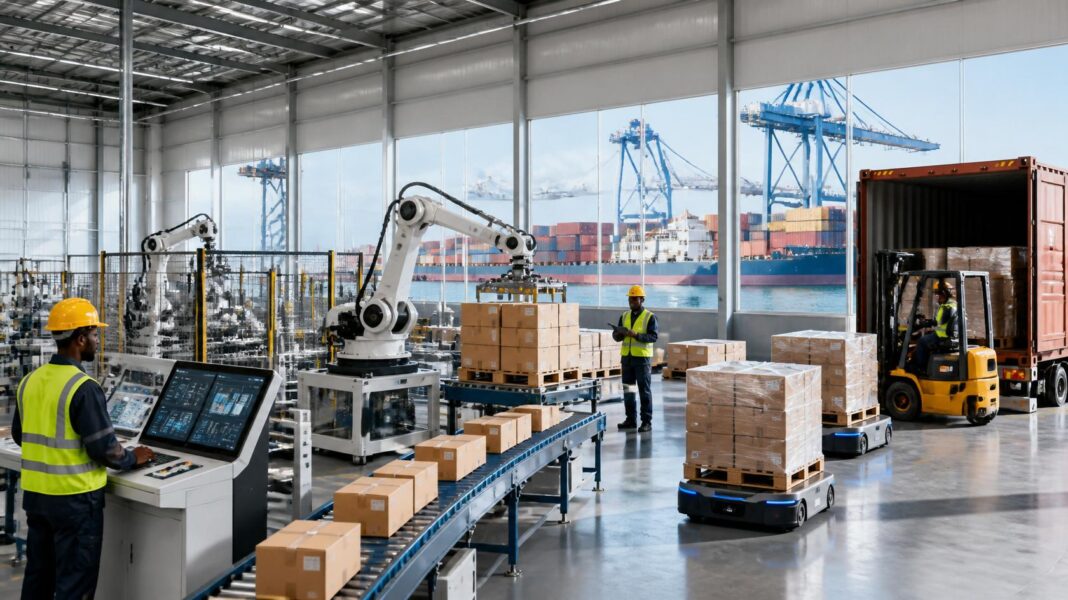
Packaging used to be treated as the last step on the production line — the point where a finished good was boxed, sealed and handed off to logistics.
That view no longer holds. For African manufacturers competing in global markets, packaging has become an integral part of export logistics itself, shaping everything from container utilisation and freight cost to whether a shipment survives the journey to a port in Rotterdam, Dubai or Shanghai intact.
As supply chains tighten and buyers grow less tolerant of inconsistency, packaging automation is emerging not as a luxury for large multinationals but as a strategic necessity for exporters across the continent.
The stakes attached to a single pallet have grown. A damaged carton, an underfilled case, or a mislabelled pallet can trigger rejected shipments, penalty clauses, or the loss of a buyer relationship built over years.
In a trading environment where African exporters are working to prove reliability to international markets, the packaging line has quietly become one of the more consequential parts of the supply chain.
The Growing Pressure on African Exporters
Several forces are converging to make manual packaging processes harder to sustain.
Rising freight costs mean that every centimetre of wasted space inside a container is money left on the table.
Freight rates on major trade lanes have remained volatile in recent years, and exporters who cannot maximise container utilisation are effectively subsidising their competitors’ shipping costs.
Labour shortages are also biting. Manual palletizing — stacking heavy boxes onto pallets, shift after shift — is physically demanding work, and packhouses across the continent report difficulty finding and retaining staff for these roles.
Mike Brewster, Vice President of Sales at Pacteon Group, a company that works with manufacturers on automation, put it plainly: “It’s difficult to find and retain employees to manually stack 60-lb boxes consistently onto a pallet.”
The problem is not unique to any one country — it is a structural feature of manual, repetitive packaging work everywhere labour markets are tightening.
Customer expectations have shifted too. International buyers, particularly in Europe and North America, increasingly expect consistent case counts, tamper-evident sealing, standardised labelling, and full traceability from farm or factory to shelf.
Brewster noted that this pressure is now explicit in commercial conversations: “Customers want a completely automated process.” Whether or not automation is mandated contractually, buyers read consistency as a proxy for reliability.
Product damage during transit remains a persistent drain on margins. Long overland hauls to ports, multiple handling points, and extended sea transit times all raise the risk of crushed cartons, shifted pallets, and contaminated goods — losses that are especially costly for perishable exports like horticulture, coffee and tea.
Finally, stricter international quality standards — phytosanitary rules, retailer specifications, and rules of origin documentation — mean that packaging errors are no longer just an operational inconvenience. They can result in shipments being turned away entirely.
What Packaging Automation Actually Involves
Packaging automation is not a single machine but a category of technologies that can be deployed individually or as an integrated line, depending on a manufacturer’s scale and product type.
Robotic palletizers stack finished cases onto pallets in programmed patterns, replacing manual stacking with a repeatable, consistent process.
Automated filling systems dose liquids, powders or granular products into containers with precision that reduces both underfilling (which risks non-compliance) and overfilling (which wastes product).
Cartoning machines form, fill and seal secondary packaging at a pace and consistency manual labour struggles to match over a full shift.
Stretch wrappers secure palletised loads for transport, reducing load shift during the long road and sea journeys typical of African export routes.
Conveyor systems move product between stages of the packaging line, cutting the manual handling that both slows throughput and increases injury risk.
Machine vision systems inspect packaging for defects, verify fill levels, and check label placement at speeds no human inspector could sustain.
Barcode labeling systems apply and verify the codes that traceability and customs compliance increasingly require.
And warehouse integration software connects the packaging line to inventory and order management systems, so that what leaves the line is accurately reflected in stock and shipment records.
Brewster frames the underlying logic simply: “Manufacturers are looking to automate any process that’s currently manual to keep their lines running and get product out the door.”
For many African producers, the appeal is less about technological ambition and more about keeping production moving when manual capacity is constrained.
How Automation Improves Export Logistics
The efficiency gains from packaging automation extend well beyond the factory floor and into every downstream stage of export logistics.
Production consistency is the most immediate benefit. Automated systems perform the same action the same way, shift after shift, without the natural variation that comes from human fatigue. Brewster made this point directly: “If I were hand-stacking product for an 8- or 10-hour shift, my quality and output would deteriorate. That doesn’t happen with robots.”
Reduced product damage follows from that consistency. Uniform palletizing patterns and properly tensioned stretch wrapping reduce the load shift that damages goods in transit — a meaningful saving for exporters moving high-value or fragile cargo over long distances.
Improved container utilisation is a direct consequence of consistent, well-formed pallets. When cartons are stacked to precise, repeatable patterns, exporters can fit more product into each container, improving the economics of every shipment and reducing the number of containers — and the freight spend — needed to move a given volume of goods.
Faster warehouse operations result from the removal of manual bottlenecks. A packaging line that can run continuously, rather than being paced by the speed of manual labour, shortens the time between production and dispatch — a critical factor when vessel schedules and container cut-off times are unforgiving.
Lower waste comes from more accurate filling and fewer rejected or damaged units, while improved inventory accuracy comes from automated data capture replacing manual stock counts.
The cumulative effect is more reliable shipment schedules — exporters not held hostage to labour availability or manual error rates can commit to delivery windows with more confidence.
This is the calculation Brewster suggests manufacturers increasingly run: “If your goal is to produce 20% more product this year, are you going to hire 100 people — or deploy 10 robots that could be up and running in six months?”
For exporters trying to scale output to meet growing international demand, that trade-off is becoming harder to ignore.
Why Packaging Consistency Matters for Global Markets
Consistency is not a cosmetic concern — it is increasingly a condition of market access. Retailers in Europe and North America work with tightly specified packaging standards, from carton dimensions that must fit standardised retail shelving to labelling that must meet local regulatory requirements.
A shipment that arrives with variable case weights or inconsistent sealing invites additional inspection, delay, and cost.
Markets in Asia and the Middle East bring their own expectations around traceability and documentation, particularly for food and agricultural products.
Exporters who can demonstrate a controlled, automated packaging process are better positioned to meet these requirements consistently, rather than relying on the diligence of individual workers on a given shift.
Automated systems generate the data trail — fill weights, timestamps, inspection results — that increasingly underpins quality assurance conversations with international buyers. In a competitive global market, that documented consistency is itself a selling point.
Supporting AfCFTA and Regional Manufacturing Competitiveness
The African Continental Free Trade Area is intended to expand intra-African trade by lowering tariff and non-tariff barriers between member states. But tariff reduction alone does not guarantee competitiveness.
Manufacturers seeking to serve both regional and international markets under AfCFTA still need to meet the packaging, labelling and quality expectations of buyers wherever they are located.
Packaging automation supports this ambition in two ways. First, it allows manufacturers to scale production to meet expanding regional demand without being constrained by manual labour availability.
Second, it helps standardise output to a level that satisfies both regional buyers and more demanding international ones — meaning a single production line can serve multiple markets rather than running parallel manual and automated processes.
For manufacturers hoping AfCFTA translates into real export growth, that flexibility is a practical advantage.
Industry Applications Across African Exports
The relevance of packaging automation varies by sector, but few major African export categories are untouched by it.
In food processing and agricultural exports, automated filling and cartoning reduce spoilage risk and improve shelf-ready presentation.
Coffee and tea exporters, competing in markets where provenance and quality perception carry a price premium, benefit from consistent bagging, weighing and sealing that protects product integrity across long shipping routes.
Horticulture exporters — moving highly perishable flowers, fruit and vegetables — depend on the speed and gentle handling automated lines provide more reliably than manual packing under time pressure.
Pharmaceuticals face some of the strictest packaging and traceability requirements of any export category, making automated filling, labelling and inspection close to essential for manufacturers targeting regulated markets.
Consumer goods producers rely on packaging consistency for brand presentation as much as protection.
Chemicals exporters need precise, safe filling given the regulatory obligations attached to hazardous materials.
And construction materials — cement, tiles, fittings and similar bulk products — benefit from automated palletizing and wrapping that can handle heavy, repetitive loads without the productivity decline that affects manual labour over long shifts.
Sustainability Benefits
Packaging automation also has an environmental dimension. Precision filling reduces overpackaging and material waste, since automated systems can be calibrated to use the minimum packaging necessary to protect a given product, rather than the generous margins manual processes often default to.
Better-formed, better-secured pallets reduce the product loss that ultimately becomes waste.
And improved container utilisation has a direct emissions benefit: fitting more product into fewer containers lowers the transport emissions associated with a given volume of exports — a gain increasingly relevant to commercial conversations with sustainability-conscious buyers, not just internal efficiency metrics.
Emerging Technologies Reshaping Packaging Lines
The current wave of packaging automation is being extended by a set of newer technologies. Artificial intelligence and machine vision are increasingly combined to not just detect defects but predict where they are likely to occur, allowing adjustments before a fault propagates through a production run.
The Industrial Internet of Things (IIoT) connects packaging equipment into networks that allow real-time monitoring of line performance, feeding data back into broader supply chain and inventory systems.
Collaborative robots, or cobots, are designed to work alongside human operators rather than replacing them entirely — a model that may suit manufacturers seeking a lower-cost entry point.
Autonomous mobile robots (AMRs) and automated guided vehicles (AGVs) move materials around warehouse floors without fixed infrastructure like conveyors, offering flexible automation for facilities that cannot justify a full line rebuild.
Predictive maintenance, enabled by sensors that monitor equipment condition, allows manufacturers to service machinery before it fails rather than after — a meaningful advantage given Brewster’s observation about the underlying reliability of automated equipment: “When you look at the numbers, there’s no contest.
The mean time between failures is around 80,000 to 100,000 hours, and the quality is consistent.”
Together, these technologies point toward the broader concept of smart manufacturing — production environments where packaging, production and logistics data flow together to support faster, better-informed decisions.
Barriers to Adoption
None of this is to suggest automation is a simple or universally accessible upgrade. Several real barriers face African manufacturers considering the investment.
Capital cost remains the most obvious constraint, particularly for small and mid-sized exporters operating on thin margins, and financing for industrial automation is not always readily available on favourable terms in African markets.
Skills shortages cut both ways — automation is often proposed as a response to labour shortages, but operating and maintaining automated equipment requires its own specialised technical skills, which are not always locally available.
Infrastructure limitations, including inconsistent road and port logistics, can undercut some of the efficiency gains automation is meant to deliver, while maintenance capacity — access to spare parts and qualified service technicians — is a genuine concern where equipment suppliers lack a strong local presence.
And electricity reliability remains a fundamental constraint in several African markets. Automated lines are more capital-intensive to leave idle than manual ones, so unreliable power supply is a serious consideration for any manufacturer weighing the investment.
Brewster’s own observation, however, suggests the cost barrier is narrowing faster than perceptions have caught up: “There’s a preconception that automation is extremely expensive. But the industry has come a long way, and the barrier to entry is much lower than it was even a few years ago.”
That does not eliminate the barriers above, but it suggests the calculus is shifting in ways that make automation a more realistic option for a wider range of manufacturers than it once was.
Practical Recommendations for African Manufacturers
For manufacturers weighing packaging automation, a few principles are worth keeping in mind: start with the single bottleneck that most limits output or damages product — palletizing, filling or wrapping — rather than attempting a full-line overhaul at once; assess total cost of ownership, not just purchase price, factoring in maintenance and local technical support; prioritise data capture and traceability alongside physical automation, since documentation often unlocks access to more demanding markets; build in redundancy where power reliability is a genuine risk; and benchmark packaging standards against regional and international peers through pan-African industry bodies and AfCFTA-linked trade platforms.
And so packaging automation is no longer simply an operational efficiency upgrade — it has become a strategic investment with direct consequences for how competitively African exporters can operate in global trade.
It improves reliability, reduces logistics costs, minimises product damage, and helps manufacturers meet the quality and traceability standards that international buyers now expect as a baseline rather than a bonus.
As container shipping costs remain volatile and international quality standards continue to tighten, the manufacturers best positioned to compete will be those who have already begun closing the gap between manual and automated packaging processes.
The broader lesson for African trade is that export competitiveness is no longer determined solely by what is produced.
Increasingly, it depends on how efficiently that product is packaged, handled and moved through supply chains that are themselves becoming more automated at every other stage.
For exporters across food, agriculture, pharmaceuticals, chemicals, consumer goods and construction materials alike, packaging automation is fast becoming less a question of if, and more a question of when.
Also Read
AI Boom Keeps Air Cargo Capacity Tight — What It Means for Africa

- Maersk and Viaservice Target Working Capital Challenge in Kenya’s Container Logistics Sector - August 20, 2026
- South Africa’s Special Economic Zones: 2026 Guide to SEZs, Ports, Logistics and Investment - August 16, 2026
- Africa’s Container Shipping Outlook: Why Freight Capacity Could Stay Tight Through 2026 - August 15, 2026

