
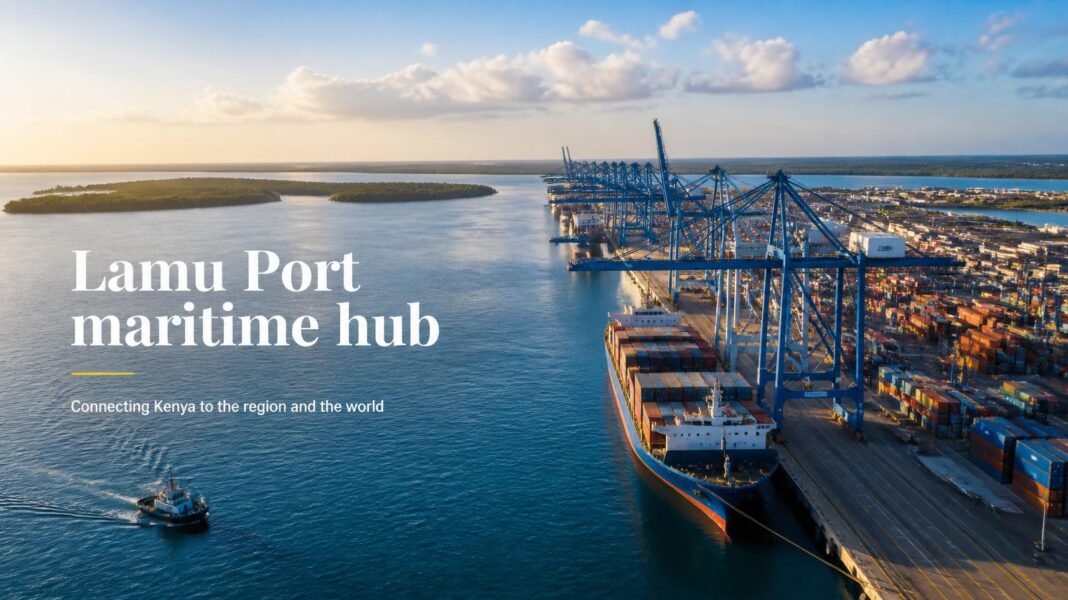
For much of the past decade, Lamu Port was Kenya’s most conspicuous infrastructure gamble — a $480 million deep-water facility on the Indian Ocean that, until recently, ran at roughly five percent of its designed 1.2-million-TEU capacity. That story is changing fast.
Since January 2026, more than 70 vessels have called at the port, with officials expecting traffic to top 100 by year-end, a pace that would have seemed implausible even eighteen months ago.
The shift is drawing renewed attention from shipping lines, port operators, and now one of Africa’s largest industrial investors.
Government officials, private shippers, and multilateral advisors now describe Lamu less as a cautionary tale and more as the anchor of a re-engineered East African trade corridor — one that could finally deliver on the promise behind the $23 billion Lamu Port-South Sudan-Ethiopia Transport (LAPSSET) Corridor first conceived nearly two decades ago.
A NATURAL DEEP-WATER ADVANTAGE
Lamu’s pitch to global shipping lines rests on geology as much as geography. The port’s main channel in Manda Bay has a natural depth of 17 metres, requiring only minimal dredging to reach an operating draft of 17.5 metres — compared with 15 metres at Mombasa.
That extra depth allows Lamu’s first three operational berths, each with 400-metre quay lengths, to receive larger neo-Panamax and Post-Panamax vessels of up to 12,000 TEUs, ships that Mombasa’s older infrastructure cannot easily accommodate.
The advantage has been reinforced by recent milestones. In March 2026, Lamu received the largest cargo vessel ever to call at any Kenyan port, the 369-metre MV Baltimore Express, part of a wave of car-carrier and bulk traffic that has included consignments of roughly 1,200 vehicles originally destined for Middle East markets.
Port officials attribute part of the surge to regional shipping disruptions that have pushed vessels to divert from traditional Gulf routes toward the Western Indian Ocean, though maritime analysts caution against reading a durable structural shift into what is partly crisis-driven demand.
INVESTORS LINING UP AS PPP PIPELINE WIDENS
Kenya’s National Treasury is moving to convert that operational momentum into private capital.
Lamu’s first three berths, along with the 500-hectare Lamu Special Economic Zone, sit at the centre of an expanded Kenya Ports Authority public-private partnership portfolio that now bundles eleven port and inland logistics assets across Lamu and Mombasa, up from an initial four.
Under the plan, a private operator would take on a 25-year landlord concession for Lamu’s container terminal, investing in agri-bulk and liquid-bulk facilities while the state retains ownership of the land and core infrastructure.
The restructuring follows the Government-Owned Enterprises Act, which took effect in December 2023 and is converting KPA into a commercially run public limited company.
Treasury officials project the wider PPP programme could generate an additional KSh 44 billion a year in port revenue, and have signalled a preference for blending international capital with domestic institutional money, including pension funds, to hedge against external financing shocks.
THE DANGOTE EFFECT: A $17 BILLION ANCHOR TENANT
The clearest signal of investor confidence, however, is industrial rather than purely maritime.
Nigerian billionaire Aliko Dangote has confirmed Lamu as the site for a planned 700,000-barrel-per-day oil refinery, a project estimated at between $17 billion and $22 billion — his largest investment outside Nigeria and, once built, the largest refinery in East Africa.
Kenya beat out Tanzania’s port city of Tanga for the project, with Dangote Industries citing Kenya’s infrastructure, logistics networks, and market access as decisive factors.
Growing investor interest in Lamu, including plans by the Dangote Group to establish an oil refinery, further demonstrates the region’s immense economic potential.
— Lee Kinyanjui, Cabinet Secretary for Trade and Investment
Dangote Industries says site selection, soil testing, and engineering work are already under way, with financing expected to come from internal cash flow, bond issuances, and a planned initial public offering rather than sovereign or multilateral debt.
President William Ruto has said a ground-breaking date has been set and has projected the refinery could create up to 60,000 jobs while supplying refined fuel to Kenya, Uganda, Tanzania, and South Sudan — markets that currently import nearly all their petroleum products.
The project is not without friction. Environmental groups, including Greenpeace Africa and the Save Lamu coalition — which previously blocked a proposed coal plant on the same stretch of coast — have raised concerns about oil-spill risk to Lamu’s mangrove forests, coral reefs, and fishing grounds, and have questioned whether the refinery’s economics will hold up as global markets shift toward electric transport.
Financing also remains provisional: Nigeria’s securities regulator has yet to receive an IPO application tied to the project.
COMPETITIVE STAKES: MOMBASA, DAR ES SALAAM AND DJIBOUTI
Lamu’s rise is unfolding against a more contested regional shipping map. Mombasa, East Africa’s largest port, handled a record 45.46 million tonnes of cargo in 2025 and is itself attracting fresh investment, including a reported $820 million upgrade commitment from CMA CGM to expand capacity and strengthen regional trade corridors.
But Mombasa is also losing ground to Tanzania’s Dar es Salaam, where a 30-year concession awarded to DP World has pulled cargo away from Kenya’s traditional gateway, particularly from Uganda, Rwanda and Burundi shippers seeking shorter, cheaper routes to the sea.
Kenyan officials increasingly frame Lamu and Mombasa as complementary rather than competing assets — a dual-port system in which Lamu’s depth captures large-vessel traffic while Mombasa continues to serve as the region’s high-volume workhorse.
Beyond shipping, Lamu’s planners are also positioning the port as a livestock and agricultural export gateway, with roughly 30,000 acres earmarked near Bargoni for a holding zone linked to the port’s livestock processing terminal.
OUTLOOK
None of Lamu’s momentum guarantees a smooth path. Hinterland connectivity along the LAPSSET corridor toward South Sudan and Ethiopia remains incomplete, environmental opposition to the refinery is unresolved, and the PPP concessions are not expected to reach financial close for at least three years.
Shippers’ groups have also pressed Nairobi to protect port jobs and ensure transparent tendering as KPA transitions to a commercial structure.
Even so, the combination of a natural deep-water advantage, a widening investor pipeline, and a mega-scale industrial anchor in the Dangote refinery gives Lamu a stronger claim to regional relevance than at any point since construction began in 2014.
For freight forwarders, shipping lines, and investors tracking East Africa’s next logistics frontier, Lamu is no longer a project to watch — it is one already reshaping cargo flows across the Western Indian Ocean.
Also Read

- Air freight costs climb as capacity constraints reshape global trade routes - October 22, 2026
- Beyond the Truck: How UD Trucks Is Redefining Fleet Performance in Southern Africa - October 12, 2026
- Maersk and Viaservice Target Working Capital Challenge in Kenya’s Container Logistics Sector - August 20, 2026

