
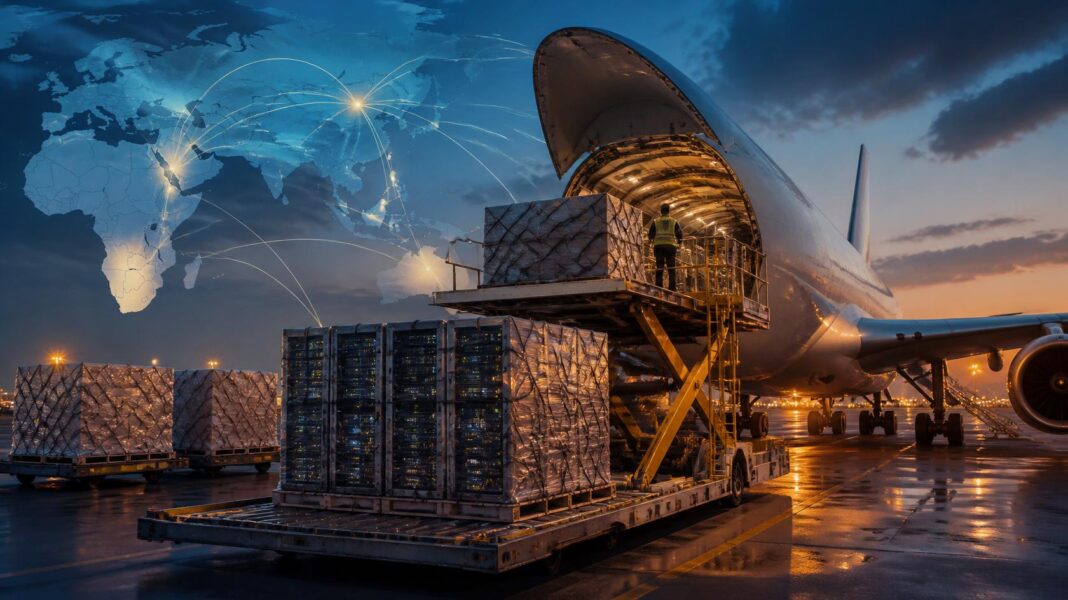
Artificial intelligence has quietly become the most powerful force in global air freight.
What began as a niche flow of servers and networking gear out of Taiwan has, over the past year, hardened into the industry’s dominant growth driver — outpacing e-commerce, absorbing scarce freighter space, and pushing rates higher on the world’s busiest cargo corridors.
For Africa, a continent whose airlines are posting the fastest cargo growth of any region, the story is no longer just about chips flowing from Asia to America.
It’s starting to show up on the tarmac in Lagos, Addis Ababa and Dar es Salaam too.
A structural, not seasonal, shift
Global air cargo demand rose 7% year-on-year in June, driven largely by semiconductor and AI-hardware shipments, according to analytics firm Xeneta — growth that came in well ahead of the roughly 3% expansion in available capacity.
Xeneta’s head of airfreight, Niall van de Wouw, has pointed out that AI-linked cargo makes up less than a tenth of everything that flies, yet it is now the clearest driver of the market’s growth, noting that global semiconductor sales more than doubled year-on-year in April — the strongest reading since industry records began in 1986.
The effects are concentrated but severe. Taiwan-to-US air rates hit $7.02 per kilogram in May, up 24% from a year earlier, as Taipei’s transit hub filled with AI server and chip cargo, according to Dimerco’s July regional freight report.
Booking lead times have stretched, general cargo is increasingly bumped onto indirect routings to make room for premium tech shipments, and — because a new freighter takes 18 to 24 months to move from order to delivery — meaningful new capacity won’t arrive until 2027 or 2028.
In the meantime, ageing Boeing 747 freighters remain the backbone of heavy-lift cargo, and with Boeing having delivered its final 747 in 2023, industry executives at May’s transport logistic China summit warned there is no successor aircraft in development with the same oversized-cargo capability.
Layered on top of the AI surge has been a bout of geopolitical disruption. Middle East airspace closures and jet fuel supply shocks earlier in the year knocked out a meaningful share of Gulf hub capacity, pushing global spot rates up as much as 41% year-on-year in May before easing somewhat as the region stabilised.
Even with that partial recovery, industry forecasters expect the market to stay structurally tight through the rest of 2026, since fuel volatility and AI-driven base demand are now feeding off each other rather than offsetting one another.
The African angle
Against that backdrop, Africa is not a bystander — it’s one of the fastest-moving parts of the story.
African carriers posted the strongest air cargo growth of any region for five consecutive months into early 2026, with cargo tonne-kilometres up 21% year-on-year in February alone, roughly double the global average, according to IATA data.
The Africa–Asia trade lane has been the standout: it expanded 61.9% year-on-year in February, accelerating from around 10% growth as recently as mid-2025, a trajectory analysts have compared to the early growth curve of the now-dominant Asia–North America route.
Three things are driving that acceleration. New trade agreements — including a preferential deal between Kenya and China signed in January — are opening up direct commercial links.
Middle East disruption pushed time-sensitive cargo through Addis Ababa as shippers rerouted around closed Gulf hubs, giving Ethiopian Airlines a bookings surge it has since worked to retain.
And cargo demand on the continent is diversifying: at May’s transport logistic China panel, project-cargo executive Ravi Wickrema pointed specifically to growing activity in Nigeria, Ethiopia and Tanzania, where markets once centred on flowers, fruit and fish are now also moving industrial equipment, technology infrastructure and the server racks that power AI data centres.
That diversification matters because Africa’s traditional air cargo model — dominated by perishable exports, which still account for roughly 40% of outbound volumes — is fundamentally different from the high-value tech cargo now driving global capacity crunches. But the two are starting to intersect.
Ethiopian Airlines, Africa’s largest cargo carrier, has been adding freighters and expanding its China network, including new routes to secondary Chinese cities, positioning Addis Ababa to capture more of the AI-adjacent hardware moving between the two continents.
Kenya Airways has built out pharmaceutical and cold-chain handling at Nairobi to capture higher-value cargo generally.
Nigeria, despite a comparatively underdeveloped air cargo base historically, is being cited by industry executives as a market where technology infrastructure shipments are now a visible category rather than an afterthought.
Capacity, not demand, is the constraint
The risk for African shippers is the same one squeezing importers everywhere: capacity, not demand, is the binding constraint.
African airlines expanded capacity by 17.3% year-on-year even as demand grew faster, and continental load factors, at just under 44%, remain below the global average — suggesting some room to absorb more volume before African routes see the kind of acute rate spikes hitting Taiwan-US lanes.
But that headroom could close quickly if global freighter scarcity persists into 2027 and 2028, since Africa competes for the same limited pool of widebody and freighter aircraft — and the same jet fuel supply — as every other region.
The continent’s heavy reliance on fuel transiting the Middle East (an estimated 70% of African jet fuel supply passes through the Strait of Hormuz) also means it is more exposed than most to the kind of Gulf-linked shocks that have already driven cost spikes for smaller regional carriers this year.
For African logistics operators, freight forwarders and manufacturers dependent on imported components, the practical takeaway echoes what high-tech shippers in Asia are already living with: book earlier, expect volatility in short-term spot rates, and watch whether liberalisation efforts — such as the push to unlock fifth- and seventh-freedom cargo rights under the Single African Air Transport Market — can help the continent’s carriers add capacity faster than the next freighter delivery cycle allows.
In a market where AI hardware is increasingly competing with cut flowers for space on the same aircraft, the airlines and hubs that move fastest on capacity and route access stand to capture a growing share of a market still expanding at nearly twice the global rate.
Also Read
Why CMA CGM’s $1.4 Billion FedEx Supply Chain Deal Could Reshape Global Logistics
Air vs. sea: Choosing the right cargo transport method

- Inside Isuzu’s Plan to Make South Africa the Truck Manufacturing Hub for Africa - October 12, 2026
- UPF Group Expands African Logistics Network with New Rwanda Office - September 18, 2026
- DP World’s Africa Network Is Growing While Jebel Ali Takes a Heavy Hit - August 15, 2026

