
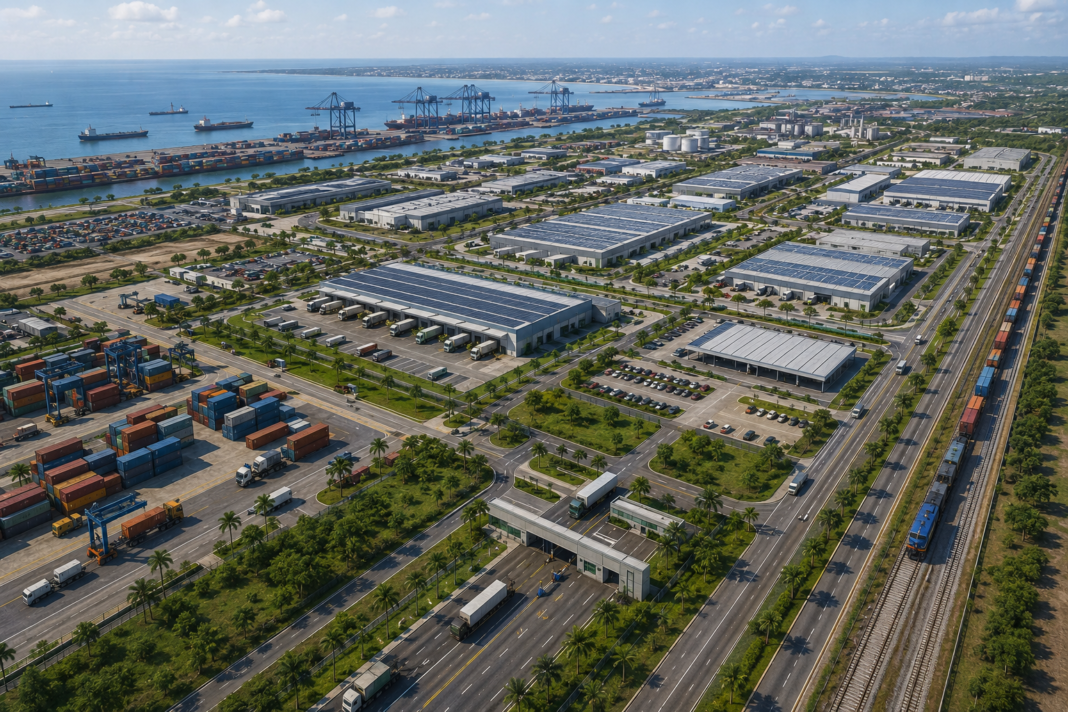
On 30 June 2026, President John Dramani Mahama cut the sod for the Tema Integrated Industrial Park (TIIP), formally launching construction on land within the Tema Heavy Industrial Area, near the Volta Aluminium Company (VALCO) smelter.
Mahama framed the project as a return to first principles, invoking Kwame Nkrumah’s original vision for Tema as the engine room of Ghana’s post-independence industrial economy.
But the language used at the ceremony went further than nostalgia: officials described TIIP as central to integrating Ghanaian producers into regional and continental value chains, not just national ones.
That framing matters for anyone moving freight through West Africa. Ghana already anchors the Africa Continental Free Trade Area (AfCFTA) Secretariat, headquartered in Accra.
A serious industrial park attached to the country’s busiest port is a statement of intent: Ghana wants to be a production base for the free trade area, not simply a transit point for goods made elsewhere.
Inside the Tema Integrated Industrial Park
The project is structured as a public-private partnership between three parties: TDC Ghana Limited, the state agency responsible for planning and developing Tema since 1952; the Ghana Integrated Aluminium Development Corporation (GIADEC), created to build out Ghana’s downstream aluminium value chain; and ARISE Integrated Industrial Platforms (ARISE IIP), a pan-African industrial zone developer already operating in fifteen countries.
The three partners incorporated a special-purpose vehicle, Tema Integrated Industrial Parks Company Limited (TIIPCo), in April 2026 to manage development and long-term operation of the site.
TIIP will occupy between 100 and 120 hectares within the existing Tema Heavy Industrial Area, giving it direct proximity to Ghana’s largest container port and to the VALCO smelter that GIADEC oversees.
The government projects more than 4,000 direct jobs from the initial phase, with a much larger multiplier effect expected across construction, logistics, and downstream processing.
Alongside the groundbreaking, Ghana’s Cabinet approved four sector-specific manufacturing policies designed to give investors regulatory certainty and a reason to commit capital to the park rather than to a competing jurisdiction: the Ghana Textiles and Garments Manufacturing Policy, the Ghana Pharmaceutical Manufacturing Policy, the Automotive Components Manufacturing Policy, and the National Agribusiness Policy covering 2026 to 2036.
Each targets a sector where Ghana currently imports heavily and where local production capacity is judged capable of scaling.
Officials have described the package as giving investors sector roadmaps and fiscal frameworks for long-term commitments, rather than a single generic incentive scheme.
Why the Timing Matters: AfCFTA and Value Addition
TIIP is not being built in isolation. It arrives as African governments face a consistent structural problem: the continent exports raw and semi-processed commodities and imports the finished goods made from them.
Aluminium is the clearest example in Tema’s own backyard — Ghana has bauxite reserves and a smelter at VALCO, but has historically exported unprocessed or semi-processed material rather than finished aluminium products.
GIADEC’s participation in TIIP signals an attempt to close that loop domestically, with textiles, pharmaceuticals, and automotive components following a similar logic in other sectors.
AfCFTA changes the addressable market for that strategy. A garment, drug, or vehicle component made in Tema no longer has to sell into Ghana’s roughly 34-million-person domestic market alone; it can, in principle, move under preferential tariff terms into a market of 1.3 billion people across the continent, assuming rules-of-origin compliance and the supporting logistics infrastructure exist.
That is the wager behind TIIP: that a production base sited directly on a major port, backed by sector-specific policy and an experienced pan-African zone operator, can capture manufacturing investment that might otherwise go to Morocco, Egypt, or Southeast Asia.
Where Tema Fits in Africa’s Industrial Corridor Race
TIIP joins a growing list of African megaprojects competing for the same pool of manufacturing and logistics investment.
Each pairs port access with an industrial zone and a rail plan, but they are built around different trade corridors and different competitive advantages.
| Hub | Country | Port Access | Rail | Industrial Zone | AfCFTA Advantage |
| Tema Integrated Industrial Park | Ghana | ✓ | Planned/Expanding | ✓ | High |
| Lamu Port | Kenya | ✓ | ✓ | ✓ | East Africa |
| Tanger Med | Morocco | ✓ | ✓ | ✓ | Europe Gateway |
| Suez Canal Economic Zone | Egypt | ✓ | ✓ | ✓ | Middle East & Europe |
| Lekki Free Zone | Nigeria | ✓ | ✓ | ✓ | West Africa |
Several things stand out from that comparison. Tanger Med and the Suez Canal Economic Zone are the most mature of the five, with decades of operating history, dense rail connectivity, and proximity to European and Middle Eastern demand that Tema cannot replicate — Ghana’s advantage is continental market access under AfCFTA rather than proximity to a wealthy northern market.
Lamu Port anchors Kenya’s LAPSSET corridor and gives East Africa a comparable model: port, rail, and industrial zone bundled together, though Lamu has faced its own well-documented delays in attracting anchor tenants.
Lekki Free Zone in Nigeria is TIIP’s most direct regional competitor. Both sit on the West African coast, both target AfCFTA-driven manufacturing, and both are trying to attract many of the same categories of investor — textiles, agro-processing, light manufacturing.
Lekki has a head start in scale and in rail linkage to its deep-water port, but Tema’s position next to Ghana’s most established container terminal, combined with Accra’s role as AfCFTA’s institutional home, gives Ghana a policy-proximity argument that Lagos cannot easily match.
The one column where Tema is explicitly behind its peers is rail. TIIP’s rail connectivity is described by Ghanaian authorities as planned or expanding rather than operational, while Lamu, Tanger Med, Suez, and Lekki all already have functioning rail links into their industrial zones.
For a project positioning itself as a continental manufacturing and export base, that gap is the clearest execution risk on the table — port access moves containers to a ship, but rail is what moves bulk industrial inputs and finished goods efficiently inland and to neighbouring landlocked markets such as Burkina Faso and Mali, both of which already rely on Tema Port for a share of their sea trade.
The Execution Gap: What Tema Still Needs to Prove
Announcements of this kind are common across Africa; delivery is the harder test.
TIIP has cleared an important credibility hurdle by moving from a special-purpose vehicle incorporated in April 2026 to an actual sod-cutting within roughly ten weeks — a faster timeline than many comparable African industrial zone projects have managed between incorporation and construction start.
ARISE IIP’s involvement is also a meaningful signal: the company already operates industrial ecosystems in multiple African countries and has a track record of moving zones from construction to occupancy, which is precisely the phase where many state-led industrial park projects on the continent have stalled.
Still, three variables will determine whether TIIP becomes a genuine trade hub or another underused industrial estate.
First, anchor tenants: sector policies create favourable conditions, but they do not guarantee that pharmaceutical, textile, or automotive component manufacturers will actually commit capital to Tema over competing sites.
Second, rail delivery: without the planned rail expansion materialising on a credible timeline, TIIP’s inland reach — and its usefulness to landlocked neighbours — will be constrained.
Third, port capacity: Tema Port is already Ghana’s busiest, and the industrial park’s export ambitions will depend on continued investment in port throughput and turnaround times rather than treating the port as a fixed asset.
What It Means for Freight Forwarders, Shippers and Investors
For logistics operators, freight forwarders, and trade finance providers active in West Africa, TIIP is worth tracking now rather than after tenants are confirmed.
A functioning industrial park adjacent to Tema Port would generate new categories of demand: inbound flows of raw materials and industrial inputs for textiles, pharmaceuticals, and automotive components; outbound flows of finished and semi-finished goods destined for AfCFTA markets; and, if the rail expansion proceeds, a stronger case for routing landlocked Sahel trade through Tema rather than competing corridors.
For manufacturers weighing where to locate AfCFTA-facing production, TIIP adds a fourth serious West African option alongside Lagos, Lomé, and Abidjan — one backed by sector-specific policy, an experienced zone operator, and direct adjacency to Ghana’s primary port.
The comparison with Lekki, Tanger Med, Suez, and Lamu is a useful discipline for evaluating that pitch: Tema’s case rests on AfCFTA positioning and speed of policy execution, not yet on the rail and scale advantages its more established peers already have.
The next twelve to eighteen months — anchor tenant announcements, rail funding decisions, and Tema Port throughput data — will show whether the sod-cutting on 30 June 2026 marks the start of a genuine West African manufacturing hub or another ambitious plan awaiting delivery.
Also Read
- Lamu Port Set to Become East Africa’s Next Maritime Hub as Global Investors Show Interest
- South Africa’s Private Rail Operators Go Live: What the First Open-Access Corridors Mean for African Freight

- Maersk and Viaservice Target Working Capital Challenge in Kenya’s Container Logistics Sector - August 20, 2026
- South Africa’s Special Economic Zones: 2026 Guide to SEZs, Ports, Logistics and Investment - August 16, 2026
- Africa’s Container Shipping Outlook: Why Freight Capacity Could Stay Tight Through 2026 - August 15, 2026

