
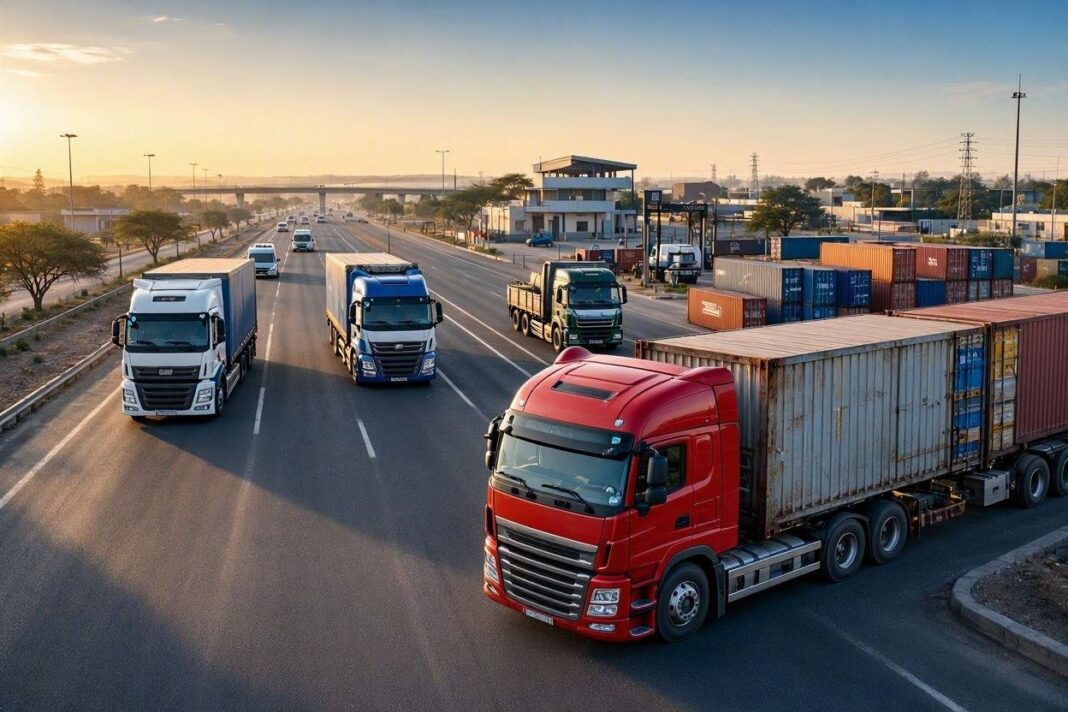
Africa’s trucking industry is becoming more competitive and increasingly focused on total cost of ownership.
From Scania, Volvo and Isuzu to FAW, HOWO and SHACMAN, fleet operators are weighing fuel consumption, uptime, financing, service support and technology as they decide what trucks to buy.
The continent is not moving toward one dominant truck brand, nor is there a single purchasing strategy that applies from Cape Town to Cairo.
Instead, the market is becoming increasingly segmented as transport operators respond to different freight corridors, cargo types, financing conditions, fuel costs and infrastructure realities.
For fleet operators, the question is increasingly moving beyond “How much does the truck cost?” The more important question is: “How much will it cost to move freight with this truck over its working life?”
That shift is changing the competitive landscape. Established European, Japanese and other international manufacturers continue to compete on reliability, fuel efficiency, technology, safety and after-sales support, while Chinese manufacturers are expanding aggressively with competitive acquisition prices, broader product ranges and growing dealer networks.
At the same time, electrification is beginning to enter the commercial-vehicle market, although the transition is likely to be much more gradual and fragmented than in passenger vehicles.
Africa Is Not One Truck Market
One of the biggest mistakes in assessing Africa’s commercial-vehicle opportunity is treating the continent as a single market. Truck demand is closely connected to what individual economies produce, consume and export.
A mining economy requires a different truck from a city-based distribution operation. A vehicle hauling containers from Mombasa to Kampala faces different operating conditions from one transporting manufactured goods between Johannesburg and Durban.
This makes freight corridors, rather than national borders alone, increasingly important to truck manufacturers.
The Northern Corridor connecting the Port of Mombasa to Uganda, Rwanda, South Sudan and the wider Great Lakes region creates one type of opportunity. The Central Corridor through Tanzania creates another.
The Copperbelt and emerging Lobito Corridor create heavy-duty demand associated with minerals.
Southern Africa’s road network supports mining, manufacturing, agriculture and regional distribution, while West Africa presents another combination of construction, consumer distribution, agriculture and cross-border freight.
The result is a market in which the right truck depends increasingly on the job it is being asked to perform.
Africa’s Truck Import Market Is Already Substantial
The underlying numbers show why international truck manufacturers are paying attention. Recent market research indicates that Africa imported approximately 288,000 trucks in 2024, with an estimated import value of about $6.4 billion. Several countries stand out as particularly important import markets.
| Market | Approx. Truck Imports (2024) |
|---|---|
| Nigeria | 57,000 |
| Algeria | 19,000 |
| Zambia | 15,000 |
| Morocco | 15,000 |
| South Africa | 14,000 |
| Zimbabwe | 14,000 |
| Tanzania | 13,000 |
The ranking tells an important story. Nigeria’s enormous domestic market creates demand for commercial vehicles across logistics, construction, agriculture and distribution.
Zambia’s truck demand is closely connected to mining, agriculture and its position within regional freight networks.
Tanzania benefits from the Port of Dar es Salaam and the Central Corridor, while South Africa combines domestic freight demand with an established automotive manufacturing and distribution industry.
Morocco and Algeria have strong connections to North African and European industrial supply chains.
These differences matter because a truck exporter seeking growth in Africa cannot simply ask which country imports the most vehicles. It must ask why those vehicles are being imported and what kind of freight they will carry.
Related Intelligence

The Biggest Opportunity May Not Be Heavy Trucks
Africa’s truck market is often described as a heavy-truck opportunity because of mining, infrastructure development and long-distance freight.
But the import data points to a much broader market. Research indicates that around 206,000 trucks imported into Africa in 2024 were diesel vehicles below five tonnes, accounting for approximately 69% of total truck imports.
| Market Segment | 2024 Indication |
|---|---|
| Total truck imports | ~288,000 |
| Diesel trucks below 5 tonnes | ~206,000 |
| Share below 5 tonnes | ~69% |
| Heavy trucks above 20 tonnes | ~13,000 |
| Total import value | ~$6.4 billion |
This changes the way the African opportunity should be viewed. The continent’s truck market is not being driven only by major haulage companies — it is also being driven by thousands of smaller businesses moving agricultural produce, construction materials, consumer goods and manufactured products.
Urbanisation is particularly important. As African cities expand, distribution networks become more complex: food, building materials, retail products, agricultural inputs and manufactured goods all have to move between ports, warehouses, markets and consumers.
That creates demand for light and medium trucks even in countries where heavy trucking receives more attention.
China Is Becoming a Major Force in African Trucking
The strongest structural change in the global truck market is arguably the expansion of Chinese manufacturers into overseas markets. Chinese light-truck exports illustrate the scale of this shift.
Research from China’s KERUI automotive industry analysis indicates that Chinese light-truck exports reached approximately 156,000 units in 2025, with exports projected to reach around 200,000 units in 2026.
The geographic distribution is particularly significant. During the first six months of 2026, Central and South America accounted for 28.4% of Chinese light-truck exports, while Africa represented an even larger destination share according to the same analysis.
The message for African truck buyers and international exporters is clear: China is no longer simply a low-cost alternative supplier.
Chinese manufacturers are increasingly building overseas dealer networks, developing financing relationships, expanding product portfolios and establishing after-sales capabilities — giving them the ability to compete across multiple truck segments rather than only at the entry level.
Why Chinese Trucks Are Gaining Ground
Price remains an important advantage, particularly in markets where commercial-vehicle financing is expensive.
But price alone does not explain the expansion. African fleet operators operate in an environment where capital is often constrained, and a lower acquisition price can make it easier for a small or medium-sized operator to add vehicles to its fleet.
Yet once the truck enters service, the economics change. Fleet managers begin looking at fuel consumption, maintenance costs, parts availability, downtime, dealer coverage, financing costs, payload, driver safety, resale value, telematics and warranty support.
This means the next stage of competition is unlikely to be based simply on purchase price — it will increasingly be based on cost per kilometre and cost per tonne moved.
South Africa Shows How Competitive the Market Has Become
South Africa provides one of the clearest examples of the changing competitive landscape because it has one of Africa’s most developed commercial-vehicle industries. According to naamsa’s July 2026 figures, South Africa recorded strong year-on-year growth across several commercial-vehicle categories.
| Vehicle Category | July 2025 | July 2026 | Change |
|---|---|---|---|
| Light commercial vehicles | 12,401 | 13,710 | +10.6% |
| Medium commercial vehicles | 706 | 843 | +19.4% |
| Heavy trucks and buses | 2,097 | 2,243 | +7.0% |
The medium commercial-vehicle segment recorded particularly strong growth, while heavy trucks and buses also increased. But South Africa’s import data reveals an even more interesting development.
For road tractors under HS 870120, South Africa imported 2,770 units in 2023, valued at approximately $161.6 million. China supplied 1,732 units — roughly 62.5% of the imported units in this specific category.
| Supplier | Road Tractors Imported | Approx. Share |
|---|---|---|
| China | 1,732 | 62.5% |
| Spain | 250 | 9.0% |
| Netherlands | 228 | 8.2% |
| Brazil | 150 | 5.4% |
| UK | 140 | 5.1% |
| Other suppliers | 270 | 9.8% |
| Total | 2,770 | 100% |
This should not be interpreted as meaning China controls South Africa’s entire truck market — the figures concern a specific HS category and imported vehicles only; they do not include every truck category or domestically produced vehicles.
Nevertheless, the implication is important: Chinese manufacturers are competing for heavy-duty road-tractor business in one of Africa’s most sophisticated trucking markets.
That is a considerably more important development than simply seeing Chinese trucks in lower-cost markets.
Kenya Shows Why Freight Corridors Matter
Kenya provides another useful example. The country is not simply a domestic trucking market — its importance is amplified by the Port of Mombasa and the Northern Corridor.
Cargo arriving through Mombasa can travel deep into East and Central Africa, meaning a truck purchased by a Kenyan operator may spend much of its working life transporting freight associated with Uganda, Rwanda, South Sudan or the wider Great Lakes region.
Recent industry data indicated that Kenya recorded approximately 5,496 truck sales in 2025. But the more important question is where those trucks operate.
A tractor working between Mombasa and Kampala has different requirements from a light truck operating within Nairobi.
Long-distance corridor operators may prioritise fuel economy, engine durability, payload, driver comfort and service coverage, while urban operators may place greater emphasis on manoeuvrability, acquisition cost, maintenance simplicity and fuel consumption.
The Kenyan example therefore reinforces a broader conclusion: truck demand follows freight corridors as much as it follows national economies.
Mining Is Creating a Different Heavy-Truck Opportunity
If light trucks are benefiting from urbanisation and distribution, heavy trucks are benefiting from Africa’s mineral economy.
Zambia and the Democratic Republic of Congo are particularly important — copper and cobalt production generates large volumes of freight that must move between mines, processing facilities, border crossings and ports.
The development of the Lobito Corridor adds another strategic dimension by improving connections between mineral-producing regions and Angola’s Atlantic coast.
For truck manufacturers, mining-related freight presents a potentially attractive market because vehicle utilisation can be extremely high.
But it also raises the technical requirements — placing considerable demands on engines and drivetrains, braking systems, suspension, cooling systems, tyres, chassis durability, payload capacity and service intervals.
In this environment, a cheaper truck is not necessarily the better truck: if downtime stops a high-value freight operation, the financial cost can quickly exceed the difference in purchase price between two vehicles.
Total Cost of Ownership Is Becoming the Real Battlefield
This is where the African truck market is becoming more sophisticated. Fleet operators are increasingly looking beyond the showroom price. A useful way of thinking about truck economics is:
Total Cost of Ownership = Purchase + Financing + Fuel + Maintenance + Tyres + Insurance + Downtime − Residual Value
Fuel is particularly important. A truck that travels hundreds of thousands of kilometres over its working life can accumulate enormous fuel costs, so even a modest difference in fuel consumption can produce substantial savings over time.
But fuel is only one part of the equation — a truck that is fuel-efficient but regularly waits for parts can still be expensive to operate, and a truck with an attractive purchase price can become less competitive if its resale value is weak.
This explains why established manufacturers continue to emphasise dealer networks, parts availability, warranties and service support. The truck itself is increasingly only one component of the proposition.
The Dealer Network Is Becoming Part of the Product
For an African fleet operator, after-sales support can be as important as horsepower. A truck operating thousands of kilometres from the capital cannot afford extended periods of downtime while waiting for a specialist component — particularly in countries where road infrastructure is still developing and distances between major commercial centres can be considerable.
Manufacturers therefore increasingly compete through a combination of truck, financing, parts, dealer network, telematics and technical support, rather than simply on price.
FAW Trucks Southern Africa, for example, says it has a network of 39 dealership and service centres across South Africa and provides 24/7 roadside assistance.
The strategic point is broader than one manufacturer. As Chinese brands expand across Africa, their ability to build comparable support ecosystems will become an important test of whether their initial market-share gains can be sustained.
Used Trucks Remain One of the Biggest Competitors
There is another competitor that new-truck manufacturers cannot ignore: the used truck. In many African markets, operators can acquire an established Japanese or European truck that has already depreciated significantly, creating a difficult comparison for a new entrant — a new Chinese truck is not necessarily competing against a new European truck, but may be competing against a used Japanese truck with an established reputation and a familiar parts ecosystem.
This is why residual value and brand confidence matter. If an operator believes a used Japanese truck will remain easy to maintain and sell, the apparently higher price of a new vehicle can become harder to justify.
For new entrants, winning the first sale is therefore only the beginning — they must build confidence that the truck will remain economically attractive several years later.
What Are African Fleets Actually Buying?
The answer increasingly depends on the application.
| Fleet Requirement | What Operators Are Looking For |
|---|---|
| Urban distribution | Affordable, manoeuvrable, fuel-efficient trucks |
| Agriculture | Durable trucks with useful payload capacity |
| Construction | Robust chassis and high uptime |
| Regional haulage | Fuel efficiency and service support |
| Mining logistics | Heavy-duty durability and high payload |
| Cross-border freight | Reliability and extensive support networks |
| Long-distance trucking | Fuel economy, driver comfort and uptime |
| SME transport | Low acquisition and maintenance costs |
“buying Chinese trucks” or “buying European trucks.”
They are buying different vehicles for different economic tasks.
China’s advantage is that its manufacturers increasingly have products covering many of those tasks.
European manufacturers retain strengths in premium heavy-duty applications and advanced technology.
Japanese manufacturers retain powerful brand recognition and long-established African relationships.
Indian manufacturers remain highly relevant where affordability and robust, relatively simple commercial vehicles are important, and South African manufacturers and assemblers have geographic and industrial advantages in Southern Africa.
Electrification Will Enter the Market — But Differently
Electrification is also beginning to change commercial-vehicle procurement. South Africa’s new-energy vehicle market provides an early indication of the direction of travel: naamsa reported 3,045 new-energy vehicles sold in June 2026, more than double the 1,491 units recorded in the corresponding month of 2025.
But hybrids accounted for the largest share of these sales, with traditional hybrids representing 48.9% of NEV sales.
This is significant because it demonstrates that Africa’s transition is unlikely to follow a single path.
Commercial vehicles face additional challenges compared with passenger cars — a truck may travel long distances, carry heavy payloads and operate on routes where charging infrastructure is limited. For many African freight operators, diesel therefore remains highly relevant.
The transition to electric trucks is likely to begin where the economics and infrastructure make the technology viable — potentially urban delivery, fixed routes, municipal fleets, logistics hubs and other predictable operations. The result is likely to be a multi-technology African truck market for many years.
What International Truck Exporters Need to Understand
For international manufacturers looking at Africa, the opportunity is substantial. But simply identifying countries with high truck imports is not enough. A successful market-entry strategy needs to answer five questions:
- What freight is moving? Mining, agriculture, construction, retail and container logistics generate different requirements.
- Which truck segment is required? A five-tonne distribution truck and a 40-tonne road tractor serve completely different markets.
- What is the operator’s total cost of ownership? Purchase price is only the beginning.
- What support infrastructure exists? Parts, technicians, dealers and roadside assistance can determine whether a truck succeeds.
- How will the vehicle be financed? In many African markets, financing availability can be just as important as the vehicle’s specifications.
This is where manufacturers that understand Africa as a collection of freight economies, rather than a single market, can gain an advantage.
The New African Trucking Battle Is About Economics
The evidence points toward a fundamental change in how commercial vehicles are being bought. Africa still needs more trucks, but fleet operators are becoming more selective about which trucks they buy.
The market is moving from a simple question of purchase price toward a much broader assessment of economic productivity — favouring manufacturers capable of combining competitive acquisition prices with low fuel consumption, high uptime, strong parts availability, financing and reliable after-sales support.
China has gained significant momentum because it can increasingly offer that combination. But European, Japanese, Indian and South African manufacturers retain important advantages of their own, so the competition is unlikely to produce one universal winner.
Instead, Africa’s trucking market is likely to become increasingly segmented — a manufacturer may dominate light trucks in one country, heavy tractors in another and mining applications somewhere else.
The winners will be those that understand the economics of each market and adapt their products and support networks accordingly.
Africa’s Truck Market Is Becoming a More Sophisticated Buyer
The most important development is therefore not simply that Africa is importing more trucks.
It is that African fleet operators are becoming more sophisticated buyers — increasingly asking how much fuel a vehicle consumes, how long it stays on the road, how quickly it can be repaired, how much freight it can move, what financing costs look like and what the vehicle will be worth at the end of its working life.
That is changing the competitive equation. The cheapest truck is not necessarily the cheapest truck to operate.
The most expensive truck is not necessarily the most productive. And the truck with the most technology is not necessarily the right solution for every African route.
The winning proposition is increasingly the one that delivers the lowest sustainable cost of moving freight while maintaining uptime and productivity. For truck manufacturers watching Africa, that may be the most important market signal of all.
Africa is not simply becoming a bigger truck market. It is becoming a smarter truck market.
Also Read
- The AI skills gap could become logistics’ biggest supply chain challenge
- Senegal Unveils New Maritime and Logistics Development Priorities in Bid to Become West Africa’s Leading Trade Hub
- Five Logistics Challenges Still Limiting Kenyan Exports Under AfCFTA

- Maersk and Viaservice Target Working Capital Challenge in Kenya’s Container Logistics Sector - August 20, 2026
- South Africa’s Special Economic Zones: 2026 Guide to SEZs, Ports, Logistics and Investment - August 16, 2026
- Africa’s Container Shipping Outlook: Why Freight Capacity Could Stay Tight Through 2026 - August 15, 2026

