
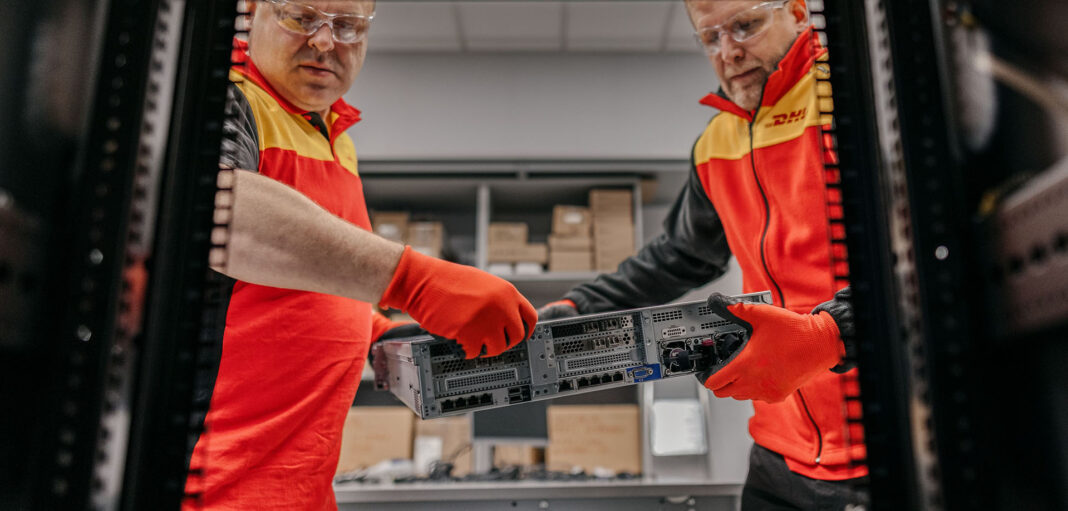
As artificial intelligence, cloud computing and digital transformation fuel an unprecedented wave of data centre construction worldwide, logistics providers are discovering one of the industry’s fastest-growing and most lucrative opportunities.
DHL Group‘s latest financial results reveal that logistics infrastructure for data centre operators is already emerging as a significant source of new business—a trend that could reshape supply chains in Africa over the coming decade.
For decades, logistics companies built their fortunes moving consumer goods, automotive components, industrial machinery and retail products across global supply chains. Today, a new customer is driving demand for highly specialised logistics services: the data centre industry.
The rapid expansion of artificial intelligence (AI), cloud computing, hyperscale facilities and edge computing has created a global race to build digital infrastructure.
“AI is triggering one of the largest infrastructure build‑outs in history, and the logistics industry is key to its growth,” says Ti Insight in its Global Data Centre Logistics 2026 research.
Every new data centre requires thousands of tonnes of highly sensitive equipment—from servers and networking hardware to cooling systems, backup generators and power distribution units.
Unlike conventional freight, these shipments require precision handling, secure transportation, climate-controlled storage and carefully coordinated deliveries.
As a result, logistics companies are increasingly positioning themselves as strategic partners in the digital economy rather than simply freight movers.
The latest results from DHL Group show this transformation is already underway.
DHL Is Seeing Data Centre Logistics Become a Growth Driver
In its 2026 Half-Year Report, DHL disclosed that its Supply Chain division secured €3.99 billion in new business during the first six months of the year, with significant contributions from the Retail, Technology and Life Sciences & Healthcare sectors.
The company specifically highlighted that relevant new business arose in part from logistics infrastructure for data centre operators, underscoring the growing commercial importance of the sector.
The numbers illustrate the momentum behind the business.
DHL Supply Chain generated €9.22 billion in first-half revenue, an increase of 7.7% year-on-year.
During the second quarter alone, revenue climbed 12.9% to €4.72 billion, with growth recorded across every region in which the company operates.
For logistics providers, this signals that digital infrastructure projects are no longer niche assignments—they are becoming mainstream revenue generators.
Why Data Centres Need Sophisticated Logistics
Building a modern hyperscale data centre is comparable to constructing a highly specialised industrial facility.
Every project involves coordinating deliveries from hundreds of manufacturers across multiple continents.
Critical cargo typically includes:
-
High-performance servers
-
AI computing hardware
-
Network switches and fibre infrastructure
-
Cooling equipment
-
Transformers and electrical systems
-
Diesel or gas backup generators
-
Battery energy storage systems
-
Precision security equipment
Many of these assets are high-value, oversized or extremely sensitive to vibration, humidity and temperature.
Delivery schedules are equally demanding. A delayed shipment of cooling equipment or electrical infrastructure can postpone the commissioning of an entire facility, costing operators millions of euros in lost revenue.
“AI is like the Industrial Revolution for information,” says Jeffrey Shih, CEO of Dimerco. “Just as factories once required steel, machinery, and railroads, AI requires massive data centers.
Every server, switch, cooling unit, and power system must be manufactured, transported across the globe, cleared through customs, stored, and delivered to data centers safely, securely and on time.”dimerco
As AI accelerates global demand for computing power, logistics providers capable of managing these complex projects are finding themselves at the centre of a rapidly expanding market.
AI Is Accelerating Global Investment
Artificial intelligence has fundamentally changed the economics of data centres.
Training and running advanced AI models requires exponentially greater computing capacity than traditional cloud services.
Technology companies are therefore investing billions of dollars in new hyperscale campuses equipped with specialised AI servers and advanced cooling systems.
DHL itself notes that the scale of AI-related investment is helping support economic growth in the United States despite broader global economic weakness. The company expects U.S. GDP growth to remain relatively resilient because of continued investment in AI infrastructure.
For logistics companies, this translates directly into increased demand for specialised transport, warehousing, customs management and installation support.
More Than Transportation
Modern logistics providers are increasingly offering end-to-end project logistics rather than simply moving cargo.
These services include:
-
International freight forwarding
-
Customs brokerage
-
Secure warehousing
-
White-glove equipment handling
-
Final-mile delivery
-
Installation coordination
-
Reverse logistics for obsolete equipment
-
Spare parts management
-
Asset tracking and inventory control
This integrated approach allows data centre developers to concentrate on construction while logistics specialists manage the complex global supply chain behind every project.
“In the AI economy, supply chain strategy is infrastructure strategy. The ability to anticipate disruption, secure critical components, and maintain end‑to‑end visibility will determine how quickly organizations can deploy compute capacity and scale for future demand,” says Ya‑Han Brownlee‑Chen, Vice President – Data Center Strategy (Americas) at DP World, in the company’s Data Center Supply Chains and AI Infrastructure Report of July 2026.
Africa’s Opportunity
Although North America, Europe and Asia currently dominate data centre investment, Africa is emerging as one of the industry’s newest growth markets.
Rapid internet adoption, expanding cloud services, mobile banking, e-commerce and AI applications are driving demand for local data processing capacity across the continent.
International cloud providers, telecommunications companies and infrastructure investors are expanding facilities in countries including South Africa, Kenya, Nigeria, Egypt and Morocco.
Each new project creates demand for specialised logistics services capable of transporting highly valuable equipment safely from manufacturers to construction sites.
For African logistics companies, this represents an opportunity to diversify beyond traditional freight forwarding into higher-value supply chain services.
Companies with expertise in oversized cargo, project logistics, customs compliance and secure transport could become key partners in Africa’s digital transformation.
Healthcare and Battery Logistics Follow Similar Trends
Data centre logistics is not the only specialist sector attracting investment.
DHL says it continues expanding capabilities in Life Sciences & Healthcare, battery logistics and other high-growth industries as part of its long-term strategy.
These sectors share similar characteristics.
They involve valuable products, strict regulatory requirements, complex international supply chains and customers willing to pay premium rates for reliability.
As a result, specialist logistics services often generate stronger margins than conventional freight transport.
Investing for Long-Term Growth
DHL is backing its strategy with significant investment.
During the first half of 2026, the company invested €1.336 billion, primarily in maintaining and expanding network infrastructure.
These investments include warehouses, digital systems, automation technologies and transport networks designed to support future growth sectors such as healthcare, advanced manufacturing, battery supply chains and digital infrastructure.
For the logistics industry, the message is clear: future competitiveness will depend less on moving standard cargo and more on managing increasingly complex supply chains.
Challenges Remain
Despite strong demand, data centre logistics presents unique operational challenges.
Equipment often originates from multiple countries, requiring careful customs planning and regulatory compliance.
Many components are oversized or extremely fragile, demanding specialist lifting equipment and experienced project managers.
Supply chains also remain vulnerable to geopolitical tensions, changing trade regulations and shipping disruptions.
DHL acknowledges that ongoing geopolitical conflicts, fuel price volatility and evolving customs rules continue to pose risks to international logistics operations.
Successfully navigating these risks will be essential for companies seeking to expand into digital infrastructure logistics.
A New Growth Engine for Global Logistics
For decades, logistics growth was driven primarily by retail, manufacturing and global trade.
Today, digital infrastructure is rapidly becoming another pillar of the industry.
Every AI model trained, every cloud application launched and every streaming platform expanded ultimately depends on physical infrastructure—and that infrastructure depends on logistics.
DHL’s latest results suggest the shift has already begun.
By identifying data centre operators as an important source of new Supply Chain business, the company is signalling where future investment is likely to flow.
For African logistics providers, ports, freight forwarders and project cargo specialists, the rise of data centre logistics presents an opportunity to participate in one of the fastest-growing segments of the global supply chain industry.
As governments and private investors accelerate digital infrastructure projects across the continent, the companies capable of delivering specialised logistics solutions may find themselves serving not only today’s economy, but the digital economy of tomorrow.
Also Read
- The AI skills gap could become logistics’ biggest supply chain challenge
- Top 10 pharmaceutical companies in the world
- Top 50 Logistics Companies in South Africa (2026 Guide)

- Air freight costs climb as capacity constraints reshape global trade routes - October 22, 2026
- Beyond the Truck: How UD Trucks Is Redefining Fleet Performance in Southern Africa - October 12, 2026
- Maersk and Viaservice Target Working Capital Challenge in Kenya’s Container Logistics Sector - August 20, 2026

