
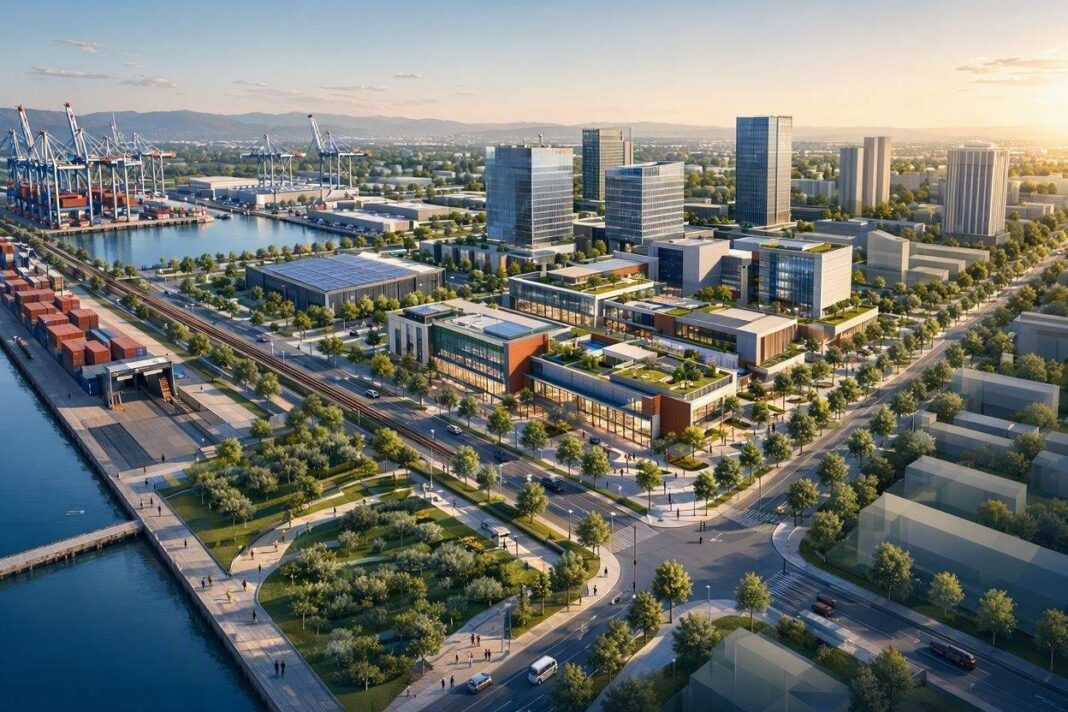
DP World has signed an agreement to develop a 222-hectare Special Economic Zone near the Port of Mombasa, which Mohammed Akoojee, CEO and Managing Director of DP World Africa, describes as an “integrated logistics ecosystem that connects ports, manufacturing and distribution.”
That description is important because it signals that DP World is not approaching the Mombasa Industrial Park simply as an industrial real-estate project.
The company is positioning the SEZ as part of a wider supply-chain architecture in which manufacturing, warehousing and distribution sit close to one of East Africa’s most important maritime gateways.
The first phase will cover 40 hectares, with subsequent expansion planned, giving the project the potential to develop incrementally as industrial demand emerges.
For Kenya, the significance extends beyond the amount of land involved. The development could strengthen Mombasa’s role in a part of the supply chain that has traditionally received less attention than the port itself: the activity that takes place around cargo after it arrives and before it moves into the regional market.
DP World is targeting the space between the port and the market
The most important feature of the Mombasa Industrial Park may not be its size but its location within the wider logistics chain.
A port is fundamentally a gateway. It allows cargo to enter and leave a market, but the economic value associated with that cargo can be generated at many points beyond the terminal. Imported machinery can become part of a manufacturing operation.
Raw materials can be processed into finished products. Components can be assembled, packaged and redistributed.
Consumer goods can be stored before being sent to wholesalers and retailers across a region.
The closer these activities can be integrated with the maritime gateway, the more opportunities exist to reduce unnecessary movement and create additional economic activity around the cargo.
This is the logic behind Akoojee’s description of the project as an integrated ecosystem connecting ports, manufacturing and distribution.
It suggests that DP World sees the SEZ as a platform through which businesses can connect several stages of their supply chains rather than as a standalone industrial estate.
That distinction is important because it places the project within the broader evolution of global logistics, where major operators are increasingly seeking to participate in activities surrounding cargo rather than limiting their role to transportation.
The 20-kilometre advantage
The Mombasa Industrial Park is planned less than 20 kilometres from the Port of Mombasa.
For an industrial development, that proximity is commercially meaningful because the port remains the principal maritime gateway through which international cargo enters Kenya and much of the wider East African hinterland.
The value of locating an industrial operation near the port depends heavily on its business model. A company producing goods entirely from locally sourced materials may have little reason to prioritise port proximity.
A manufacturer importing machinery, components or raw materials, however, can potentially benefit from having its production facilities close to the point at which those inputs enter the country.
The same principle applies to export-oriented businesses.
A manufacturer can bring in components through Mombasa, process or assemble them within the SEZ and then distribute finished products into Kenya or other African markets. In that model, the port is no longer simply an entry point for imported goods. It becomes part of an integrated production and distribution system.
That is the economic proposition DP World is putting behind the project.
Why the manufacturing component matters
The strongest potential economic impact will come if the SEZ attracts manufacturers rather than functioning predominantly as a warehousing and logistics estate.
Warehouses are essential to modern supply chains, but manufacturing creates a broader economic footprint.
A factory needs transport, packaging, equipment maintenance, spare parts, technical services, security, financial services and other inputs.
As several manufacturers establish operations in the same area, suppliers have an incentive to locate nearby, creating the possibility of an industrial cluster.
This is where the concept of an SEZ becomes more significant than simply providing serviced industrial land.
The objective is to create an environment in which companies benefit from being close to one another and close to transport infrastructure.
For Kenya, that could support a long-standing industrial policy objective: capturing more value locally from goods that currently enter the country as finished products.
If imported components are instead processed or assembled in Kenya before the resulting products are distributed across East Africa, the country captures additional economic activity through manufacturing, labour, logistics, services and regional distribution.
The scale of that opportunity will ultimately depend on the companies that occupy the park.
The first 40 hectares will tell the story
The initial 40-hectare phase is likely to be the most revealing part of the development.
The headline figure of 222 hectares describes the eventual scale, but the first phase will demonstrate whether the commercial proposition can attract the kind of businesses capable of turning the site into an industrial cluster.
The first tenants will matter because they can determine the direction of the wider development.
If manufacturers with regional or export ambitions become anchor tenants, they could attract suppliers and logistics companies around them. If distribution companies dominate the first phase, the development may develop primarily as a regional logistics hub.
Neither outcome would make the project unsuccessful, but they would have very different implications for Kenya’s industrialisation strategy.
The distinction is particularly important because Africa’s logistics infrastructure is increasingly moving towards specialised ecosystems.
A logistics park handles cargo. An industrial ecosystem creates and transforms cargo while also providing the infrastructure needed to distribute it.
DP World has a reason to think beyond the terminal
DP World’s involvement makes the project particularly interesting because the company operates across several layers of the global supply chain.
The company has increasingly built its business around ports, logistics, freight services, market access and economic zones.
Its economic-zone strategy is based on connecting businesses to transport infrastructure and international markets while providing industrial and logistics facilities around major trade gateways.
Mombasa fits that model naturally.
The company does not need to control every part of the port infrastructure to participate in the commercial flows generated by the port.
An industrial park gives it an opportunity to engage directly with manufacturers, distributors and logistics companies whose businesses depend on maritime trade.
That potentially creates a different revenue and market opportunity from terminal operations alone.
A terminal primarily earns from the handling and movement of cargo.
An industrial and logistics ecosystem can participate in the storage, processing, distribution and production activities that create the demand for cargo in the first place.
That is a broader proposition.
The earlier Mombasa terminal proposal provides useful context
DP World’s interest in Mombasa also predates the current SEZ announcement.
In 2023, the company was associated with a proposed arrangement involving four berths at Mombasa and a terminal with projected capacity of approximately one million TEUs.
The proposal became the subject of legal and political controversy and did not result in DP World becoming the operator of those berths.
That history should not be overstated, but it provides useful context for understanding the company’s latest move.
DP World is now establishing a significant industrial and logistics position close to the same maritime gateway without requiring control of the terminal itself.
This means the company’s relationship with Mombasa can develop through another route: by positioning itself around the businesses and supply chains that use the port.
The distinction is subtle but strategically important.
Mombasa’s value extends far beyond Kenya
The commercial case for the SEZ also rests on Mombasa’s regional hinterland.
The Port of Mombasa serves Kenya, but its importance extends into landlocked and inland markets across East and Central Africa.
Goods entering through the port can ultimately be destined for businesses and consumers far beyond the coastal region.
That creates an opportunity for an industrial park near Mombasa to function as a production and distribution base rather than simply a facility serving the local market.
A manufacturer could potentially import inputs through Mombasa, undertake production or assembly within the SEZ and then use regional transport corridors to reach markets across East Africa.
This changes the way the location should be evaluated.
The relevant market is not simply the population within driving distance of Mombasa.
It is the much larger regional market that can be reached through the port and the corridors extending inland from it.
This could strengthen the Northern Corridor
The Mombasa Industrial Park could also reinforce the commercial importance of the Northern Corridor, which connects the Kenyan coast with the country’s interior and neighbouring economies.
The relationship between industrial development and transport infrastructure can become mutually reinforcing.
More manufacturers near Mombasa can generate more inbound raw-material flows and outbound finished-product movements. More cargo can support demand for transport and logistics services. More logistics activity can make the region more attractive to additional manufacturers.
That creates the possibility of a feedback loop in which industrial development increases cargo volumes while the availability of a major maritime gateway makes industrial development more attractive.
This is precisely why integrated logistics ecosystems can have a greater economic impact than individual warehouses or factories operating in isolation.
Dongo Kundu is a separate story
The DP World-GulfCap project should not be confused with the Dongo Kundu Special Economic Zone, which is a separate, much larger government-led development near Mombasa.
Dongo Kundu covers roughly 3,000 acres and has been positioned as a major industrial, logistics and trade development.
The existence of both projects makes the future industrial geography of Mombasa particularly interesting.
Kenya is effectively creating multiple opportunities for industrial investment around its principal maritime gateway. The challenge will be ensuring that these developments complement rather than simply duplicate one another.
If they attract different industries and generate supplier relationships between companies located across the various zones, the combined effect could be much larger than the individual projects.
If, however, they compete for the same limited pool of tenants without sufficient infrastructure or market demand, the result could be an oversupply of industrial land.
The outcome will depend on execution.
GulfCap gives the project a local development dimension
The partnership with GulfCap Africa also matters because the project combines DP World’s international logistics expertise with a Kenyan investment and development partner.
For an industrial development, local knowledge can be important in navigating land, regulatory, infrastructure and investment considerations, while an international logistics company can bring relationships with manufacturers, traders and supply-chain operators.
The combination potentially gives the Mombasa Industrial Park a different proposition from a conventional industrial estate seeking tenants on the basis of land availability alone.
Businesses considering an SEZ location are looking for an ecosystem.
They want infrastructure, market access, regulatory efficiency and reliable logistics to work together.
That is exactly the proposition DP World is describing.
The biggest risk is execution
The strategic logic is strong, but the project still has to prove that logic commercially.
An industrial park does not become a manufacturing hub simply because it has been designated an SEZ.
International companies will assess electricity reliability, water availability, telecommunications, roads, customs processes, labour availability, security, land arrangements and the overall predictability of the business environment.
The transport connection to the port will also matter.
If cargo can move quickly between the SEZ and Mombasa but faces significant delays elsewhere along the regional corridor, part of the location advantage disappears.
The first phase will therefore be an important test not only of demand but of Kenya’s ability to deliver the infrastructure and operating environment required by internationally competitive manufacturers.
What would success look like?
The most useful way to measure the project will not be by hectares developed.
It will be by the economic activity generated per hectare.
If the SEZ attracts manufacturers that produce for regional and international markets, the development could create a much wider economic footprint than its physical size suggests.
If manufacturers bring suppliers, logistics companies establish distribution operations and exporters begin using the zone as a production base, Mombasa could gradually develop a deeper industrial ecosystem around its maritime gateway.
That would create a very different economic relationship between the port and the surrounding economy.
Instead of cargo simply passing through Mombasa before moving inland, more of the cargo could be transformed into higher-value products within the coastal region before entering the regional market.
The strategic shift is from cargo movement to cargo value
This is ultimately why DP World’s Mombasa announcement deserves attention.
Africa’s logistics market is entering a period in which the competitive advantage of a gateway will increasingly depend on what surrounds the gateway.
Ports need efficient terminals, but manufacturers also need industrial land. Logistics companies need warehouses, but exporters need reliable access to international markets. Distributors need storage, but regional businesses need predictable transport connections.
The strongest trade hubs bring these requirements together.
Akoojee’s description of the Mombasa Industrial Park as an “integrated logistics ecosystem that connects ports, manufacturing and distribution” captures that shift.
For DP World, the opportunity is to position itself within the wider economic system generated by Mombasa’s trade flows.
For Kenya, the opportunity is potentially even larger: to capture more value from the cargo entering through its principal maritime gateway by encouraging more processing, manufacturing and distribution to take place locally.
The 222-hectare development is therefore not simply about adding industrial land near Mombasa.
It is an attempt to change the relationship between the port and the economy around it.
If the first 40 hectares attract the right companies and the supporting infrastructure performs as intended, Mombasa could begin moving towards a model in which the port feeds the industrial ecosystem, while the industrial ecosystem generates more cargo for the port.
That would make Mombasa more than a gateway for East African trade.
It could increasingly become a place where that trade is processed, manufactured, stored and redistributed—capturing a larger share of the economic value that moves through the region.
Also Read
- Top 10 Material Handling Equipment Every Modern Warehouse Needs
- Global Air Cargo Demand Rises 8.5% in June as North America Leads Growth, Africa Faces Capacity Constraints
- Why Packaging Automation Matters More Than Ever for African Exporters

- Maersk and Viaservice Target Working Capital Challenge in Kenya’s Container Logistics Sector - August 20, 2026
- South Africa’s Special Economic Zones: 2026 Guide to SEZs, Ports, Logistics and Investment - August 16, 2026
- Africa’s Container Shipping Outlook: Why Freight Capacity Could Stay Tight Through 2026 - August 15, 2026

