
Africa is becoming a more important battleground for global container shipping — and the latest capacity data shows just how quickly the market is changing.
According to Alphaliner liner-shipping capacity data, the Asia–West Africa trade added approximately 347,500 TEU of container capacity between May 2025 and May 2026, representing a 34.4% year-on-year increase.
The increase was largely associated with MSC’s Africa Express service, which deploys around 14 ultra-large container vessels with capacity of about 24,000 TEU each.
Across Africa-related services, Alphaliner recorded 576,100 TEU of additional capacity, equivalent to growth of 25.3%.
That is more than a capacity story.
It suggests global carriers are making a larger bet on West African trade at a time when containerised imports are also accelerating.
MB Shipbrokers’ trade analysis shows West African containerised imports increased 15% year-on-year in Q1 2026.
The same analysis says March volumes were 8% higher than a year earlier, while West African containerised imports had already grown substantially in the previous year.
The result is a potentially important shift in Africa’s shipping map.
The question for importers, freight forwarders and logistics investors is no longer simply whether more vessels are coming to West Africa.
It is which gateways will capture the additional cargo — and whether port and inland infrastructure can convert additional shipping capacity into lower-cost, more reliable supply chains.
34.4%
Year-on-year growth in Asia–West Africa container capacity, according to Alphaliner data.
347,500 TEU
Additional capacity added to the Asia–West Africa trade.
25.3%
Growth in total Africa-related container capacity, representing 576,100 additional TEU.
15%
Year-on-year growth in West African containerised imports in Q1 2026, according to MB Shipbrokers.
2.1M+ TEU
Nigerian container traffic in 2025, according to Nigerian Ports Authority operational data.
Why are carriers adding so much capacity?
The first explanation is demand.
West Africa’s import market is becoming increasingly connected to Asian manufacturing supply chains, particularly China. Machinery, vehicles, electronics, construction materials, consumer products and industrial inputs are moving through the region in growing volumes.
But demand is only part of the story.
The structure of the shipping network is changing as carriers deploy larger vessels and redesign services around major African gateways.
Maersk, for example, announced in February 2026 that it would introduce an additional Asia–West Africa service from Q2 2026, describing the change as a way to provide greater stability, increased capacity and more focused West African coverage.
The carrier’s announcement is important because it confirms what the Alphaliner capacity data is showing: the increase is not merely the result of statistical changes in fleet deployment. Major carriers are actively redesigning services around the corridor.
There is also evidence of a broader increase in vessel deployment.
An Alphaliner-based analysis published earlier in 2026 showed that the number of vessels operating on the Asia–West Africa trade had increased from 122 in January 2025 to 164 one year later, while average vessel size increased by 4.5%.
The strategic message is clear.
West Africa is becoming important enough for carriers to dedicate more ships, larger ships and more specialised services to the trade.
Related Market Intelligence
- Lamu Port Set to Become East Africa’s Next Maritime Hub as Global Investors Show Interest
- Senegal Unveils New Maritime and Logistics Development Priorities in Bid to Become West Africa’s Leading Trade Hub
- How Port Community Systems Are Transforming African Ports
- 10 Most Efficient Ports in Sub-Saharan Africa
Nigeria: the volume heavyweight
Nigeria is arguably the market that makes the capacity expansion commercially compelling.
According to the Nigerian Ports Authority’s 2025 Operational Performance Report, total container traffic increased 25.7% to more than 2.1 million TEU in 2025.
But the composition of that growth is even more interesting.
Import-laden containers increased 32.8%, while transshipment containers surged 205.8%. Export containers increased by 3.1%.
The transshipment figure deserves particular attention.
A rise of more than 200% suggests that Nigeria’s ports are not simply handling cargo destined for the domestic market. They are increasingly participating in regional cargo flows.
That changes the competitive equation.
Nigeria has the scale to attract direct services because of its enormous domestic market. But if transshipment volumes continue increasing, Nigerian ports could also compete for cargo destined for neighbouring markets.
For freight forwarders, the question becomes more sophisticated:
Which Nigerian gateway offers the best combination of vessel frequency, terminal performance, customs efficiency and inland connectivity?
The cheapest ocean freight rate may not produce the cheapest delivered cargo.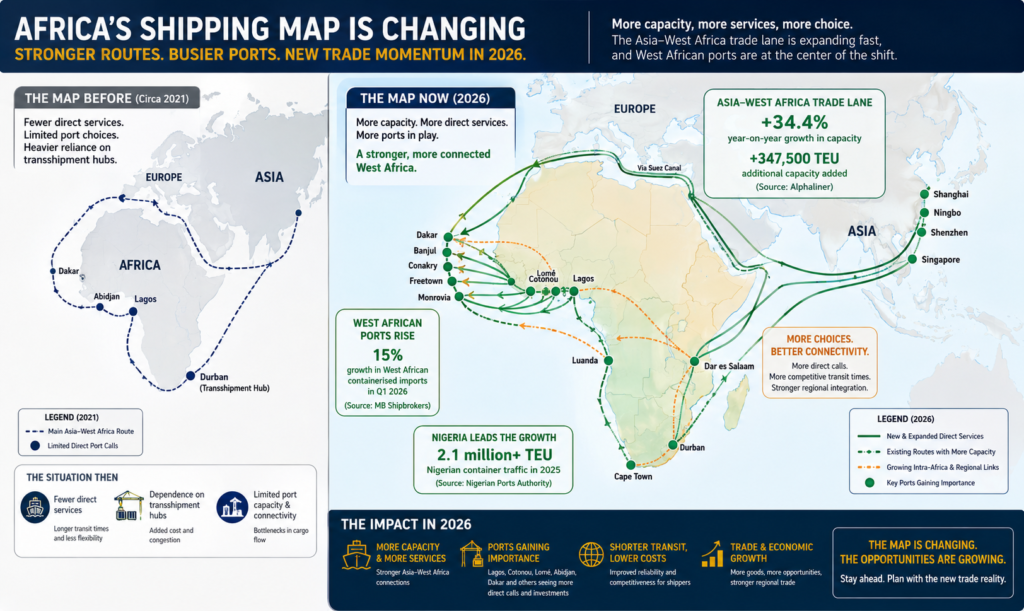
Ghana: can Tema turn connectivity into regional cargo?
Ghana’s opportunity is different.
The strategic value of Tema is not limited to Ghana’s domestic import market. Its position gives it the potential to act as a gateway into a wider West African hinterland.
That makes increased Asia–West Africa capacity particularly significant.
If carriers can provide more frequent direct connections to Tema, importers gain greater scheduling options. But the port’s real competitive advantage will ultimately be determined by what happens after the vessel docks.
For a cargo owner, the relevant calculation is not:
Asia → Tema
It is:
Asia → Tema → customs → truck → warehouse → final customer.
This is the central issue facing West Africa as shipping capacity expands.
A port can win additional vessel calls and still lose cargo if congestion, customs delays or inland transport costs erase the advantage of the ocean connection.
The next stage of competition will therefore be about end-to-end corridor performance, not simply container-handling capacity.
Côte d’Ivoire: Abidjan faces the absorption test
Côte d’Ivoire is another major contender for regional cargo.
Abidjan has established itself as an important West African gateway and has benefited from substantial investment in container infrastructure.
But the increase in shipping capacity creates a different challenge: can the port absorb additional vessel and cargo volumes without creating new bottlenecks?
Kuehne+Nagel’s carrier and port operational updates during 2026 have recorded periods of significant vessel waiting and operational pressure at Abidjan.
That illustrates an important market-intelligence point: capacity deployed by shipping lines and capacity effectively available to cargo owners are not always the same thing.
If vessels spend more time waiting for berths, or containers remain longer in terminals, the apparent benefit of additional services can be diluted.
This is why port performance needs to be analysed alongside shipping capacity.
More ships do not automatically mean faster logistics.
Senegal: Dakar and the western gateway competition
Dakar adds another dimension to the competition.
Its geographical position gives Senegal a natural role in serving the western end of the continent, while its maritime connections allow it to participate in broader regional shipping networks.
The strategic question is whether West Africa will evolve into a system of several specialised gateways or whether a smaller group of ports will emerge as dominant regional hubs.
The answer will depend on several variables:
- vessel size and frequency
- terminal productivity
- port congestion
- customs clearance
- inland road and rail connections
- transshipment capability
- reliability of shipping schedules
- total logistics cost
This is why the current capacity expansion should not be viewed as a simple Nigeria-versus-Ghana or Abidjan-versus-Dakar contest.
It is a network competition.
Will more capacity actually reduce freight costs?
This is where the market becomes more complicated.
In theory, a 34.4% increase in capacity should put downward pressure on freight rates if demand does not rise at the same pace.
And there are signs that global container shipping is moving into a period of greater capacity pressure.
In February, Reuters reported that Maersk expected declining freight rates in 2026, partly because of global vessel oversupply and the potential return of ships to the Suez Canal.
But West African importers should not assume that additional vessel slots will automatically translate into cheaper landed goods.
Carriers continue to adjust surcharges and operating costs.
For example, Maersk announced revisions to its Operational Cost Imports surcharge for shipments to West Africa, covering markets including Ghana, Côte d’Ivoire, Nigeria and Senegal, effective April 2026.
That means freight buyers need to look beyond the headline ocean rate.
The real cost includes:
Ocean freight + surcharges + terminal charges + customs + storage + demurrage + inland transport.
A reduction in the base freight rate can be wiped out by congestion or higher inland costs.
For freight forwarders, this creates an opportunity to move from simply booking cargo to providing route intelligence.
The Suez Canal could change the equation again
The capacity story is unfolding while the global shipping network itself is being reorganised.
For more than two years, security concerns in the Red Sea pushed many container vessels away from the Suez Canal and around the Cape of Good Hope.
That increased sailing distances and absorbed additional vessel capacity.
Now the picture is changing.
On 10 August 2026, Reuters reported that Maersk and Hapag-Lloyd were resuming another container service through the Red Sea and Suez Canal, continuing a gradual return to the route.
Maersk had already announced the return of its WAF6 service through the Red Sea in July, linking the Middle East, Mediterranean and West Africa.
This creates an important variable for Africa’s shipping market.
If more services return to Suez, vessels previously tied up in longer Cape of Good Hope routings can potentially be redeployed more efficiently. That could add further capacity to the global container market and increase pressure on freight rates.
But the security situation means the transition remains gradual rather than a complete return to pre-Red Sea patterns.
For West Africa, the implication is that carrier capacity decisions in the region are increasingly being influenced by global network economics, not just African demand.
What importers and freight forwarders should watch
The biggest opportunity from the capacity increase may be greater choice.
Importers should increasingly compare competing gateways rather than automatically using the traditional port for a particular country or corridor.
For example:
Asia → Lagos
could be compared against:
Asia → Tema → inland destination
or:
Asia → Abidjan → inland destination.
The correct decision will depend on the complete cost and transit-time equation.
Freight forwarders should therefore monitor five indicators particularly closely:
1. Carrier capacity: Are new services permanent or seasonal?
2. Port congestion: Is additional cargo creating longer vessel and container dwell times?
3. Freight rates: Are lower base rates being offset by surcharges?
4. Inland connectivity: Can trucks, rail and border systems absorb additional cargo?
5. Reliability: Are scheduled services actually delivering predictable transit times?
The winners will be logistics providers that can combine this information rather than looking at freight rates in isolation.
The bigger market signal
The 34.4% increase in Asia–West Africa capacity is one of the clearest indicators yet that global shipping lines see long-term commercial potential in the region.
But the data also shows why capacity alone should not be confused with logistics competitiveness.
- Alphaliner’s capacity data shows the scale of the carrier investment.
- MB Shipbrokers’ trade data shows that cargo demand is rising.
- Nigeria Ports Authority data demonstrates the rapid expansion of one of the region’s largest maritime markets.
- Carrier announcements from Maersk confirm that shipping lines are actively redesigning services around West Africa.
The next question is therefore not whether Africa will receive more shipping capacity.
It is which African gateways can convert that capacity into faster, cheaper and more reliable trade corridors.
Nigeria has scale. Ghana has regional gateway potential. Côte d’Ivoire has a strong hub position. Senegal has strategic geography.
But the decisive competitive advantage may ultimately belong to the port that can do something much more difficult:
Move a container from the ship to its final destination with the least cost, least delay and greatest predictability.
Editorial note: Capacity figures in this article refer to liner shipping capacity, while container trade figures refer to actual containerised cargo volumes. They measure different things and should not be interpreted as equivalent indicators.
Also Read
- DRC’s Kalemie Industrial Port Takes Shape as Lithium Reshapes the Lake Tanganyika Corridor
- Africa’s Trucking Industry Is Changing. Here’s What Fleets Are Buying and why
- DP World’s Mombasa SEZ: Why the Port’s Next Opportunity May Be Beyond the Terminal

- Beyond the Truck: How UD Trucks Is Redefining Fleet Performance in Southern Africa - October 12, 2026
- Maersk and Viaservice Target Working Capital Challenge in Kenya’s Container Logistics Sector - August 20, 2026
- South Africa’s Special Economic Zones: 2026 Guide to SEZs, Ports, Logistics and Investment - August 16, 2026

