
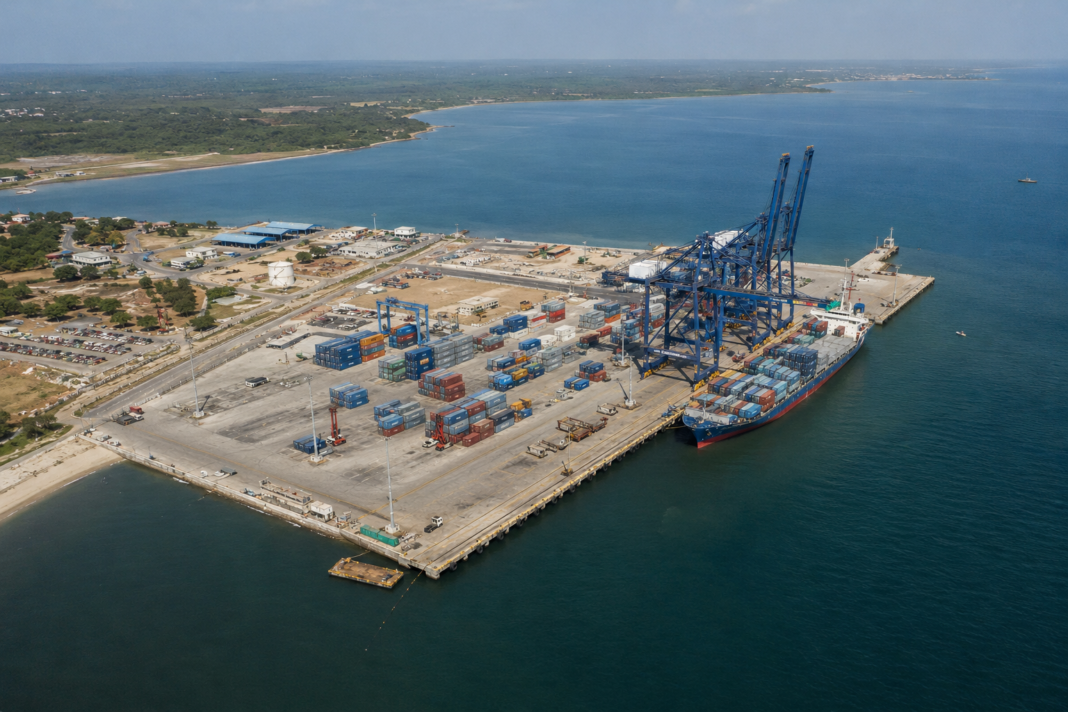
Stretching from Kenya’s Indian Ocean coast into Ethiopia and South Sudan, the Lamu Port-South Sudan-Ethiopia Transport (LAPSSET) Corridor is one of Africa’s largest integrated infrastructure programmes.
Combining a new deep-water port, highways, railways, an oil pipeline, airports and special economic zones, the project is designed to transform regional connectivity and strengthen East Africa’s position in global trade.
With the Port of Lamu now handling live cargo, the corridor has moved from blueprint to operating infrastructure, and its early performance is beginning to reshape how goods move through the Horn of Africa.
What Is the LAPSSET Corridor?
LAPSSET was conceived under Kenya’s Vision 2030 development blueprint as the country’s first fully integrated, homegrown mega-infrastructure programme, planned and initiated without external technical assistance.
Its core vision is to open up Kenya’s underdeveloped north, give landlocked Ethiopia and South Sudan a second reliable route to the sea, and position Kenya as a logistics and transport hub for the wider Great Lakes region.
Three countries anchor the programme — Kenya, Ethiopia and South Sudan — with knock-on relevance for Uganda, Rwanda, Burundi, the Democratic Republic of Congo and the Horn of Africa more broadly.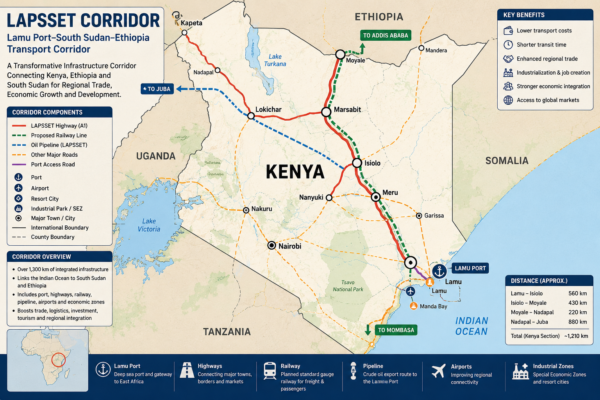
Estimated at roughly $25 billion in total investment across its full scope, LAPSSET is managed by the LAPSSET Corridor Development Authority (LCDA), which reports directly to the Kenyan presidency.
Strategically, the corridor gives Kenya a second deep-sea gateway alongside Mombasa and gives Ethiopia — the world’s most populous landlocked country — an alternative to its near-total reliance on Djibouti for maritime trade.
Major Components
Lamu Port
The anchor project of the entire programme is the Port of Lamu at Manda Bay, planned for 32 deep-water berths and designed to rank among the largest ports in Africa.
Its berths carry drafts of up to 17.5 metres, deep enough to accommodate post-Suezmax vessels that cannot call at Mombasa.
The port is being built to handle three cargo streams: containerised freight, bulk cargo such as grain and minerals, and — in later phases — crude oil exports linked to the pipeline component.
Kenyan transport officials confirmed in February 2026 that Lamu’s first-phase berths were fully operational, with cargo ships already offloading simultaneously and volumes projected to reach 1.2 million TEUs by 2027.
Highways
A network of trunk roads is intended to physically stitch the corridor together, linking Lamu through Garissa and Isiolo to Moyale on the Ethiopian border, and through Isiolo, Merille, Marsabit and Turkana toward Nadapal on the South Sudan border, then on to Juba.
These roads open up historically marginalised northern Kenya while giving Ethiopian and South Sudanese exporters a direct route to the coast.
Construction has continued in phases, with Chinese contractor China Communication Construction Company Limited (CCCC) executing works along the Lamu front under close coordination with the Kenya National Highways Authority (KeNHA).
Railway
A standard-gauge railway line linking Lamu to South Sudan and Ethiopia remains part of the long-term masterplan, intended to eventually connect with Kenya’s existing SGR network and give the corridor the high-volume, low-cost freight capacity that road transport alone cannot match.
Railway development trails the port and road components and is expected to be phased in as traffic volumes justify the investment.
Pipeline
An oil pipeline, originally conceived to move South Sudanese and prospective Kenyan crude from the Lokichar basin to Lamu for export, forms part of the programme’s long-term energy logistics ambitions, offering an alternative to routing crude through Port Sudan.
Airports
New airport infrastructure at Lamu, Isiolo and along the corridor is intended to support both cargo logistics and the tourism and resort-city components, improving regional connectivity for a corridor that otherwise depends heavily on long overland hauls.
Resort Cities
Three planned resort cities — at Manda Bay in Lamu, Isiolo, and on the shores of Lake Turkana — form the tourism diversification arm of LAPSSET, intended to draw investment and population into the corridor and support the large special economic zone earmarked for Lamu.
Why It Matters
LAPSSET’s significance lies less in any single component than in what an integrated corridor does to the economics of regional trade:
- Reduced transport costs — a second deep-water port and direct northern routes shorten the distance goods travel to reach Ethiopia and South Sudan.
- Faster cargo movement — dedicated berths and roads reduce the congestion that has long slowed traffic through Mombasa.
- Regional integration — shared infrastructure across three countries builds the physical backbone for closer East African cooperation.
- Export competitiveness — easier access to a deep-sea port improves the economics of exporting agricultural produce, minerals and, eventually, crude oil.
- AfCFTA alignment — LAPSSET is explicitly linked to the African Union’s Programme for Infrastructure Development in Africa (PIDA) and supports the free movement of goods that the African Continental Free Trade Area depends on.
- Industrial development — the Lamu Special Economic Zone is designed to anchor manufacturing and value-addition activity around the port.
- Cross-border logistics — a functioning Lamu-Isiolo-Moyale-Juba network gives freight forwarders and shippers a genuine alternative routing option for the first time.
Economic Impact
For Kenya, LAPSSET offers a second maritime gateway that eases pressure on Mombasa while opening up the historically underdeveloped north to investment, jobs and public services — including new technical training institutes already under construction in Lamu County.
For Ethiopia, the corridor represents a strategic hedge against near-total dependence on the port of Djibouti, part of a wider push toward port diversification that also includes Berbera in Somaliland.
For South Sudan, a functioning Lamu route offers an alternative to routing trade through Sudan, relevant given the instability along that corridor.
Balancing regional economic transformation with environmental protection and the rights of local communities remains essential to achieving sustainable infrastructure development.
Uganda and the wider Great Lakes region stand to benefit indirectly as the network matures and offers shippers routing choices beyond the traditional Mombasa-Kampala axis.
Northern Kenya — Garissa, Isiolo, Marsabit and Turkana counties — is positioned as the corridor’s biggest structural beneficiary, moving from one of the country’s least-connected regions to a transit and logistics zone in its own right.
Challenges
LAPSSET’s progress has not been without friction, and balanced reporting requires acknowledging the obstacles alongside the ambition:
- Funding — a programme of this scale depends on a mix of Kenyan public financing, bilateral and multilateral support, and private investment, and components such as the railway and pipeline have moved more slowly than the port for funding reasons.
- Security — sections of the corridor pass through the Boni enclave in Lamu County, an area affected by militant activity; the Kenya Defence Forces’ Operation Amani Boni has been formally tied to protecting construction sites and restoring contractor confidence, and in March 2026 Kenya and Ethiopia agreed to joint military operations to secure the Moyale-Marsabit-Turkana corridor.
- Environmental concerns — the Lamu Port project has faced scrutiny over its impact on mangrove ecosystems and local fishing grounds, prompting mitigation commitments including tree-planting programmes.
- Community engagement — Lamu County communities have pressed for local jobs and benefit-sharing; the LCDA has responded with scholarship programmes and pledges to train and employ local youth.
- Construction timelines — as with most multi-decade infrastructure programmes, individual components have advanced at uneven speeds, with the port outpacing the road, rail and pipeline elements.
Financing remains a critical, recurring challenge for the project. Former LAPSSET CEO Silvester Kasuku previously warned that reliance on Kenya Ports Authority funding, rather than direct government allocation, resulted in significant construction delays.
But perhaps the biggest challenge facing the project lies in balancing regional economic transformation with environmental protection and local rights, notes Professor Justin Willis, History and Head of Department at the University of Durham.
LAPSSET vs Northern Corridor
Kenya’s established Northern Corridor, anchored at Mombasa, remains the region’s dominant trade route.
LAPSSET is not designed to replace it but to complement it, giving shippers, freight forwarders and the wider region a second option:
| Feature | LAPSSET | Northern Corridor |
| Main Port | Lamu | Mombasa |
| Countries Served | Kenya, Ethiopia, South Sudan | Kenya, Uganda, Rwanda, Burundi, DRC |
| Purpose | New development corridor | Established trade corridor |
| Growth Potential | Very High | Mature |
Table: Comparing LAPSSET and the Northern Corridor across key logistics dimensions.
Future Outlook
LAPSSET’s trajectory over the coming years will be shaped by how well its components come online together.
The African Continental Free Trade Area gives the corridor a continental policy tailwind, since AfCFTA depends on exactly the kind of cross-border road, rail and port infrastructure LAPSSET is building.
Regional industrialisation plans built around the Lamu Special Economic Zone could turn the port from a pure transit point into a manufacturing and value-addition hub.
Port diversification — for Kenya alongside Mombasa, and for Ethiopia alongside Djibouti and Berbera — reduces single-point-of-failure risk across East African trade.
And as Indian Ocean shipping routes face their own pressures, from congestion to security concerns along alternative corridors, Lamu’s deep drafts and greenfield capacity position it as a credible new gateway for East and Central Africa.
The port’s operationalisation in 2026 marks the point where LAPSSET stops being a Vision 2030 aspiration and starts being tested as working trade infrastructure — and the coming years, as road, rail and pipeline components catch up, will determine how far that promise extends.
Also Read
- How Ghana’s Tema Integrated Industrial Park Could Reshape West African Trade
- Lamu Port Set to Become East Africa’s Next Maritime Hub as Global Investors Show Interest

- How Ghana’s Tema Integrated Industrial Park Could Reshape West African Trade - July 20, 2026
- Why Packaging Automation Matters More Than Ever for African Exporters - July 19, 2026
- LAPSSET Corridor: How East Africa’s Mega Infrastructure Project Is Reshaping Regional Trade and Logistics - July 19, 2026

