
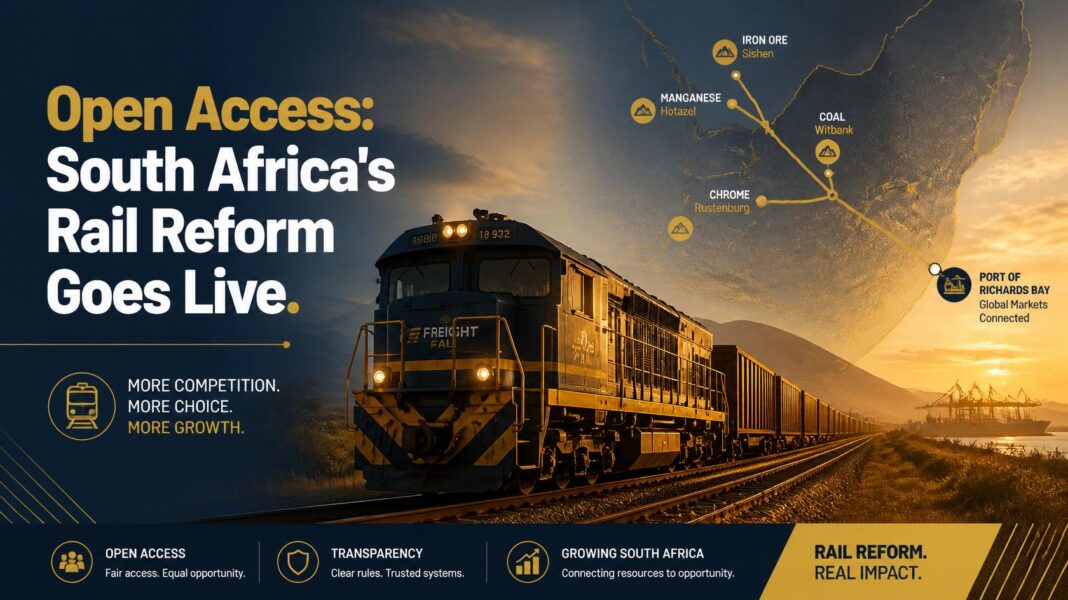
After more than three decades of running freight rail as a state monopoly, South Africa is about to watch private trains move on its national network for the first time.
Eleven train operating companies (TOCs), selected from a field of 25 applicants, are finalising contracts to run services across six freight corridors, with the first private trains expected to begin operating in the second half of 2026.
For a continent watching Transnet’s slow-motion decline with growing anxiety, this is the moment reform stops being a policy document and starts being a scheduled departure.
From monopoly to marketplace
Transnet has controlled South Africa’s freight rail network since 1990. That monopoly has not aged well.
Rail freight volumes have fallen from a peak of 226 million tonnes in 2017/2018 to around 152 million tonnes in 2023/2024, driven by cable theft, locomotive shortages, chronic underinvestment and a debt pile that has ballooned past R130 billion.
Coal exporters and iron ore miners, unable to rely on rail, have shifted cargo onto trucks, clogging the N3 highway between Johannesburg and Durban and pushing South Africa’s logistics costs to an estimated 14% of GDP — more than double the global average.
The open-access model now being rolled out is the government’s answer.
Under the National Rail Policy approved by Cabinet in March 2022, Transnet’s infrastructure stays in state hands, but third-party operators can lease slots on the network and run their own trains, rolling stock and commercial arrangements.
The mechanism echoes open-access regimes already used in parts of Europe and North America, and Transport Minister Barbara Creecy has called it the most significant liberalisation of South African rail since nationalisation.
The process moved from paper to practice through 2025 and into 2026.
Transnet split its rail division into two separate entities: Transnet Freight Rail, which continues to operate trains, and the Transnet Rail Infrastructure Manager (TRIM), which now acts purely as the network’s referee — publishing access terms, allocating slots and setting tariffs through a foundational document called the Network Statement.
The first Network Statement was published in December 2024, and the application window that followed drew 25 bids for slot access.
Eleven of those applicants cleared Transnet’s technical, financial and safety screening.
What the operators actually get
The awards cover 41 routes spread across six corridors, concentrated on the commodities that have suffered most under Transnet’s decline: coal, iron ore, chrome, manganese, sugar, fuel and containers.
The North Corridor, which carries coal and chrome, attracted the heaviest interest, with six new entrants awarded 15 routes between them.
The Iron Ore Corridor drew one new entrant, the Container Corridor drew four operators competing for five routes carrying containers, coal and sugar, and further allocations covered the Cape Corridor and other freight lines linking inland mines and industrial hubs to the ports of Durban, Richards Bay and Saldanha Bay.
South African logistics group Grindrod has confirmed it is among the successful applicants; Transnet has not yet published the full list of winning TOCs, their shareholders or their specific routes, pending completion of commercial negotiations.
Those negotiations are not trivial. Slot durations range from one to ten years, and before any operator can move a single wagon, it needs a safety permit from the Railway Safety Regulator, confirmed rolling stock availability and — critically — guaranteed offloading capacity at the ports its trains are aiming for.
Transnet CEO Michelle Phillips has said at least one operator expects to be running by the second half of 2026, with others targeting a 2027 start once contracts and certification are finalised.
Government’s numbers on what this is worth are ambitious. Officials estimate the new entrants could add 20 million tonnes of annual freight capacity in the near term, with the potential to scale toward 52 million tonnes over five years, as part of a push to lift total rail freight volumes from around 180 million tonnes toward a 250-million-tonne target by 2029/2030.
Some estimates put the associated private investment in wagons, locomotives and sidings at up to R100 billion over the next decade — capital South Africa’s freight network badly needs after years of Transnet running on deferred maintenance.
TRIM CEO Moshe Motlohi has framed the shift in structural terms rather than purely operational ones.
Describing the slot allocation as “a significant moment in the transformation of South Africa’s rail sector,” he has said Transnet is “evolving from a vertically integrated operator to an infrastructure custodian” — a description that captures how far the model has moved from the old single-operator system.
Motlohi has also said the arrival of multiple operators on the same network is expected to introduce competitive dynamics South African rail has never had, with benefits for customers including reduced lead times and improved service options.
The gap between allocation and operation
None of this means the reform is complete, or even secure. The most closely watched data point in the sector right now is not the headline tonnage target — it is the Business Leadership South Africa (BLSA) Reform Tracker, which showed South Africa’s freight logistics reform index actually falling 4% in the first quarter of 2026, the sharpest single-category decline of any sector it monitors.
The specific culprit is Network Statement Volume 4, the next iteration of the access framework covering the 2026/27 slot allocation cycle, which industry operators and financiers have described as largely unbankable in its current form and which remains unpublished well past its original February 2026 deadline.
That delay matters because financing depends on it. Operators cannot commit to multi-year rolling stock leases, and financiers cannot underwrite them, without clarity on tariffs, access terms and contract security for the years beyond the initial slot allocations.
BLSA CEO Busisiwe Mavuso has pointed to a structural tension at the heart of the reform: Transnet remains both referee and player at exactly the moment the industry is being opened up to competitors, since TRIM sits inside the same group structure as Transnet Freight Rail, the incumbent operator the new entrants are meant to be competing against.
Port capacity is the other constraint analysts keep flagging. Rand Merchant Bank has warned that if rail liberalisation is not synchronised with port expansion, new private trains risk arriving at congested terminals with nowhere to unload — turning a rail success story into a port bottleneck.
We are evolving from a vertically integrated operator to an infrastructure custodian.
Moshe Motlohi
 CEO, Transnet Rail Infrastructure Manager
That risk is easing gradually: Durban’s Pier 2 is now operating under a 25-year public-private partnership with International Container Terminal Services Inc, which manages 49% of operations there, and concession activity is increasing at Richards Bay and Ngqura.
But ports and rail are being liberalised on separate, only loosely coordinated timelines, and the industry’s confidence in 2026 depends on those tracks converging rather than diverging.
Why this matters beyond South Africa
South Africa’s rail opening is not happening in isolation. It lands in the same year as continued Lobito Corridor development linking Angola, Zambia and the Democratic Republic of Congo to Atlantic ports, ongoing work on the Kenya-Uganda Standard Gauge Railway, and the broader push under AfCFTA to make cross-border freight movement faster and cheaper across the continent.
For shippers and logistics planners working multiple African markets, South Africa’s experiment in open-access rail is effectively a live test case: can a legacy state monopoly be opened to competition without collapsing service in the transition, and can regulatory design keep pace with commercial ambition once operators are actually running trains rather than negotiating for the right to?
The early signs are genuinely mixed, which is itself useful information for regional planners. Port traffic data for 2025 showed real recovery, with 8,630 vessels calling at South African ports — the highest number in 15 years.
Ratings agencies have taken note: S&P affirmed South Africa’s BB/BB+ sovereign rating in June 2026 citing reform progress in logistics, and Fitch upgraded the country’s rating to BB days later.
Yet the same reform tracker that shows overall momentum also shows freight logistics specifically losing ground quarter-on-quarter, a reminder that headline announcements and operational delivery are not the same thing.
The corridor to watch
For African freight operators and cargo owners, the practical question through the rest of 2026 is simple: does at least one of the eleven TOCs actually get a train moving on schedule.
If a private operator is hauling coal or containers on the North or Container Corridors by the fourth quarter of the year, it will be the first tangible proof that South Africa’s rail reform can move from allocation letters to freight tonnage.
If Network Statement Volume 4 remains stuck and the promised operators slip into 2027 as a group rather than individually, it will confirm what the BLSA tracker is already signalling — that this reform, like much of South Africa’s broader infrastructure turnaround, is real, but still fragile.
Either outcome will shape how the rest of the continent approaches rail liberalisation. South Africa built the deepest, most industrialised rail network in Africa and then spent a decade running it into the ground.
Whether private operators can help rebuild it — and how fast — is now one of the most consequential logistics stories on the continent to watch through the back half of 2026.
Also Read
Why CMA CGM’s $1.4 Billion FedEx Supply Chain Deal Could Reshape Global Logistics
Mozambique’s First Port Community System: A Turning Point for African Trade

- Inside Isuzu’s Plan to Make South Africa the Truck Manufacturing Hub for Africa - October 12, 2026
- UPF Group Expands African Logistics Network with New Rwanda Office - September 18, 2026
- DP World’s Africa Network Is Growing While Jebel Ali Takes a Heavy Hit - August 15, 2026

