
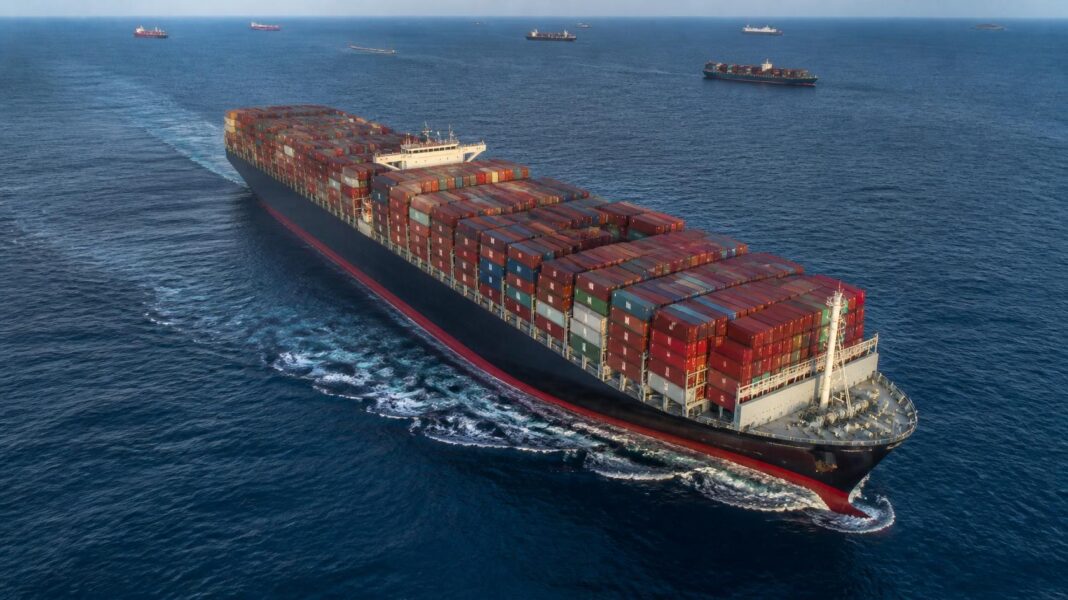
Container ships have become some of the largest and most sophisticated commercial vessels ever built.
At almost 400 metres long and more than 60 metres wide, today’s ultra-large container vessels can carry more than 24,000 twenty-foot equivalent units (TEUs) on a single voyage.
Their enormous scale reflects the economics of modern global trade, particularly on the high-volume Asia-Europe routes where shipping lines can spread operating costs across tens of thousands of containers.
But the race to build larger ships has also changed the requirements for ports, terminals and inland logistics networks.
MEGA CONTAINER SHIPS — 2026
24,000+ TEU — capacity of the newest generation of ultra-large container ships.
~400 metres — approximate length of the world’s largest vessels.
60+ metres — beam of today’s biggest container ships.
Asia–Europe — the core trade corridor for many ultra-large vessels.
27,500 TEU — approximate capacity targeted by some next-generation ship designs.
The world’s biggest vessels need deep water, large ship-to-shore cranes, expansive container yards and highly efficient cargo-handling systems.
The latest generation also illustrates another major shift in container shipping. Size is no longer the only objective.
Shipbuilders and carriers are increasingly combining capacity with fuel efficiency, air lubrication, improved hull design, alternative fuels, digital navigation and other technologies intended to reduce the environmental impact of moving each container.
Here are the world’s largest container ships, ranked by maximum nominal TEU capacity.
The 10 Largest Container Ships in the World
| Rank | Container Ship | Capacity | Length | Beam | Delivered |
|---|---|---|---|---|---|
| 1 | MSC Irina | 24,346 TEU | 399.9 m | 61.3 m | 2023 |
| 2 | OOCL Spain | 24,188 TEU | 399.9 m | 61.3 m | 2023 |
| 3 | ONE Innovation | 24,136 TEU | 399.9 m | 61.4 m | 2023 |
| 4 | MSC Tessa | 24,116 TEU | 399.9 m | 61.5 m | 2023 |
| 5 | CMA CGM Notre Dame | 24,212 TEU | 400 m | 62 m | 2026 |
| 6 | Ever Alot | 24,004 TEU | 399.9 m | 61.5 m | 2022 |
| 7 | Ever Ace | 23,992 TEU | 399.9 m | 61.5 m | 2021 |
| 8 | HMM Algeciras | 23,964 TEU | 399.9 m | 61 m | 2020 |
| 9 | CMA CGM Seine | 23,876 TEU | 399.9 m | 61.3 m | 2025 |
| 10 | MSC Gülsün | 23,756 TEU | 399.9 m | 61.5 m | 2019 |
Note: Rankings can vary depending on whether individual vessels or ship classes are counted and whether ships with identical specifications are grouped together.
1. MSC Irina
Operator: Mediterranean Shipping Company (MSC)
Capacity: 24,346 TEU
Length: 399.9 metres
Beam: 61.3 metres
Year delivered: 2023
The MSC Irina sits at the top of the current ultra-large container ship rankings by nominal TEU capacity.
Delivered in 2023, the vessel pushed container-ship capacity beyond the 24,300-TEU mark. At nearly 400 metres long and 61.3 metres wide, it belongs to a new generation of vessels designed to move enormous volumes of cargo between the world’s busiest trade centres.
The MSC Irina is one of a group of similarly sized vessels built for MSC as the carrier expanded its fleet of ultra-large container ships.
Related Articles
DP World’s Mombasa SEZ: Why the Port’s Next Opportunity May Be Beyond the Terminal
Africa’s Shipping Map Is Changing: Asia–West Africa Capacity Jumps 34% in 2026
DRC’s Kalemie Industrial Port Takes Shape as Lithium Reshapes the Lake Tanganyika Corridor
The AI Skills Gap Could Become Logistics’ Biggest Supply Chain Challenge
The scale of the vessel is particularly significant because its capacity represents the culmination of several decades of container-ship growth.
From ships carrying only a few thousand TEUs several decades ago, the industry has moved into vessels capable of carrying more than 24,000 TEUs.
The MSC Irina has also demonstrated that vessels of this size are not simply engineering exercises. In 2025, it made a notable call at India’s Vizhinjam International Seaport, demonstrating the port’s ability to accommodate one of the world’s largest container vessels.
2. OOCL Spain
Operator: Orient Overseas Container Line (OOCL)
Capacity: 24,188 TEU
Length: 399.9 metres
Beam: 61.3 metres
Year delivered: 2023
The OOCL Spain is another member of the new generation of 24,000-TEU-class container ships.
With a nominal capacity of 24,188 TEU, it is only slightly behind the MSC Irina in terms of maximum container capacity.
The vessel forms part of OOCL’s G-class fleet and was built to provide greater economies of scale on major international trade routes.
At approximately 400 metres long, the OOCL Spain illustrates how little room remains for container ships to grow in length. Instead, future increases in capacity are likely to depend increasingly on vessel width, container-stacking arrangements, propulsion technology and operational efficiency.
The arrival of ships such as OOCL Spain has also increased pressure on ports to upgrade their infrastructure, particularly cranes capable of reaching across increasingly wide vessels.
HOW MUCH CARGO CAN 24,000 TEU HOLD?
TEU stands for twenty-foot equivalent unit and is the standard measurement used to describe container-ship capacity.
One TEU represents the capacity of a standard 20-foot container. A 40-foot container generally counts as two TEUs.
A ship rated at more than 24,000 TEU can therefore carry an enormous volume of containerised cargo on a single voyage, although the actual number and mix of containers carried depends on weight, cargo type, loading configuration and operational conditions.
3. ONE Innovation
Operator: Ocean Network Express (ONE)
Capacity: 24,136 TEU
Length: 399.9 metres
Beam: approximately 61.4 metres
Year delivered: 2023
The ONE Innovation was the first 24,000-TEU-class Megamax vessel delivered to Ocean Network Express.
The Japanese-built vessel has a maximum capacity of 24,136 TEU and was designed around the principle that larger cargo volumes can be moved with lower energy consumption per container.
Its design incorporates a number of energy-efficiency features, including an optimised hull, a bow windshield, an energy-saving device and an exhaust-gas cleaning system.
ONE deployed the vessel on its Asia-Europe network, one of the world’s most important container shipping corridors.
The ONE Innovation is important not simply because of its size, but because it represents the direction in which the industry has been moving: combining enormous cargo capacity with technology designed to reduce fuel consumption and emissions per container transported.
4. MSC Tessa
Operator: Mediterranean Shipping Company (MSC)
Capacity: 24,116 TEU
Length: 399.9 metres
Beam: 61.5 metres
Year delivered: 2023
The MSC Tessa is another vessel from the generation of container ships that pushed nominal capacity above 24,000 TEU.
Like many of its peers, it measures almost exactly 400 metres in length while having a beam of more than 61 metres.
The MSC Tessa belongs to a wider trend in which shipping companies have concentrated significant capacity into relatively small numbers of extremely large vessels.
For carriers, the attraction is straightforward. A larger vessel can move more containers on a single voyage, potentially lowering the fuel and operating cost allocated to each container when the ship is efficiently loaded.
However, the economics only work when these vessels can maintain high utilisation. That is why the largest ships are concentrated on major trade corridors with sufficient cargo demand.
400 METRES OF CONTAINER SHIP
≈ 400 metres
The world’s largest container ships stretch for roughly 400 metres from bow to stern — longer than the height of the Eiffel Tower, which stands at approximately 330 metres to its tip.
The comparison illustrates the extraordinary scale of today’s ultra-large container vessels. Their size is comparable to a major piece of urban infrastructure laid horizontally on the water.
5. CMA CGM Notre Dame
Operator: CMA CGM
Capacity: 24,212 TEU
Length: 400 metres
Beam: 62 metres
Year delivered: 2026
The CMA CGM Notre Dame is one of the most important new additions to the world’s mega-ship fleet.
Delivered in 2026, it is designed to carry up to 24,212 TEU, putting it firmly in the world’s largest container-ship category.
What distinguishes the CMA CGM Notre Dame is not simply its capacity. It is powered by LNG and is the first of a series of ten 24,212-TEU LNG-powered vessels for CMA CGM.
The vessel also incorporates technologies covering digital navigation, artificial intelligence and energy efficiency.
CMA CGM has deployed the ship on its French Asia Line connecting Asia and Northern Europe. The service includes major ports such as Ningbo, Shanghai, Yantian, Singapore, Le Havre, Rotterdam, Hamburg and Tanger Med.
The CMA CGM Notre Dame therefore illustrates the next stage of mega-ship development: combining very high cargo capacity with alternative-fuel technology and increasingly sophisticated digital systems.
6. Ever Alot
Operator: Evergreen Marine
Capacity: 24,004 TEU
Length: 399.9 metres
Beam: 61.5 metres
Year delivered: 2022
The Ever Alot was one of the vessels that pushed container-ship capacity beyond 24,000 TEU.
It belongs to Evergreen’s A-class of mega container ships, a series that includes several vessels with capacities around the 24,000-TEU mark.
The Ever Alot is approximately 400 metres long and more than 61 metres wide, making it comparable in physical size to most of the world’s other largest container ships.
The A-class ships were designed primarily for major long-haul routes where their massive cargo capacity can be used efficiently.
Their arrival marked an important transition in the container shipping industry. The previous generation of record-breaking ships, including the Ever Ace, had capacities just below 24,000 TEU. The Ever Alot and its sister vessels pushed the industry across that threshold.
FROM 1,000 TEU TO 24,000+ TEU
7. Ever Ace
Operator: Evergreen Marine
Capacity: 23,992 TEU
Length: 399.9 metres
Beam: 61.5 metres
Year delivered: 2021
The Ever Ace was one of the most important container ships of its generation.
When it entered service, its 23,992-TEU capacity placed it at the very top of global container shipping. It was among the first ships to demonstrate that a vessel could approach the 24,000-TEU threshold while remaining within the approximately 400-metre length and 61-metre-plus beam dimensions that have become common among the largest vessels.
Built by Samsung Heavy Industries in South Korea, the Ever Ace formed part of Evergreen’s A-class fleet.
Its significance today is partly historical. Although newer ships have overtaken it in capacity, the Ever Ace helped establish the template for today’s ultra-large container ships.
8. HMM Algeciras
Operator: HMM
Capacity: 23,964 TEU
Length: 399.9 metres
Beam: 61 metres
Year delivered: 2020
The HMM Algeciras was the world’s largest container ship when it was delivered in 2020.
Its 23,964-TEU capacity represented a major increase over the previous generation of mega vessels and demonstrated how rapidly container ships were growing.
The vessel was built by Daewoo Shipbuilding & Marine Engineering and became the lead ship in HMM’s Algeciras-class fleet.
Like many of the largest vessels, it was designed principally around the Asia-Europe trade.
Although newer ships have surpassed its nominal capacity, the HMM Algeciras remains an important milestone in the development of ultra-large container vessels.
9. CMA CGM Seine
Operator: CMA CGM
Capacity: 23,876 TEU
Length: 399.9 metres
Beam: 61.3 metres
Year delivered: 2025
The CMA CGM Seine belongs to the Jacques Saadé family of large container vessels and represents the continuing expansion of CMA CGM’s high-capacity fleet.
With a nominal capacity of 23,876 TEU, the vessel sits comfortably within the ultra-large container ship category.
The ship is particularly interesting because CMA CGM’s fleet strategy increasingly combines very large vessels with alternative-fuel technology.
The broader Jacques Saadé class helped establish LNG-powered container shipping at the ultra-large scale, demonstrating that alternative-fuel vessels could operate on major long-distance trade routes rather than only short regional services.
10. MSC Gülsün
Operator: Mediterranean Shipping Company
Capacity: 23,756 TEU
Length: 399.9 metres
Beam: 61.5 metres
Year delivered: 2019
The MSC Gülsün was a record-setting vessel when it entered service in 2019.
With capacity of 23,756 TEU, it was the first container ship to move beyond the 23,000-TEU threshold and represented a major step forward in ship size.
Built by Samsung Heavy Industries, the vessel incorporated design features intended to improve cargo capacity, safety and fuel efficiency.
The MSC Gülsün demonstrated the commercial logic behind the industry’s move towards ever-larger ships: when operating on sufficiently dense trade lanes, carriers can move more cargo without increasing the number of voyages proportionally.
It also helped establish the approximate 400-metre length and more than 60-metre beam as the dimensions of the new generation of ultra-large container vessels.
AFRICA’S MEGA-SHIP CHALLENGE
As container ships grow larger, African ports are competing to attract major shipping lines and become regional gateways or transshipment hubs.
| Port | Country | Strategic Role |
|---|---|---|
| Tanger Med | Morocco | Europe–Africa gateway and major transshipment hub |
| Port Said | Egypt | Strategic Suez Canal container hub |
| Durban | South Africa | Major Southern African gateway |
| Mombasa | Kenya | Key East African gateway |
| Lekki | Nigeria | Modern deep-water West African gateway |
| Lomé | Togo | Important West African transshipment hub |
The bigger question: Can African ports not only receive mega-ships, but also move the resulting cargo efficiently through customs, roads, railways and inland logistics networks?
Why Are Container Ships Getting So Large?
The growth of container-ship size is fundamentally an economics story.
Shipping companies operate in a capital-intensive industry where fuel, crew, maintenance, port charges and other operating costs can be substantial. Increasing vessel capacity allows carriers to distribute many of these costs across a larger number of containers.
This creates economies of scale.
A ship carrying 24,000 TEU does not require 24 times the crew of a vessel carrying 1,000 TEU. Nor does it require 24 times as much fuel.
As a result, moving more containers on a single voyage can reduce the average cost per container when the ship is well utilised.
The largest vessels are therefore particularly attractive on high-volume routes connecting major manufacturing and consumption centres.
The Asia-Europe Route Is Driving the Mega-Ship Race
The world’s biggest container ships are heavily associated with the Asia-Europe trade.
Asia is home to many of the world’s major manufacturing centres, while Europe represents one of the largest consumer and industrial markets.
The result is an enormous flow of containerised cargo between the two regions.
This trade density gives shipping companies an environment in which ultra-large vessels can operate efficiently.
A 24,000-TEU ship is less useful on a route where cargo demand is relatively low. It needs sufficient volumes and compatible ports at both ends of its journey.
That explains why many of the world’s largest vessels operate on major east-west services rather than on smaller regional routes.
What Does a 24,000-TEU Ship Mean for Ports?
The arrival of mega-ships has transformed port infrastructure.
A container terminal handling a 24,000-TEU vessel must be able to deal with enormous cargo volumes during a single port call.
This places pressure on almost every part of the terminal.
Deep-water channels
The largest ships require sufficient water depth to enter and leave ports safely.
Larger quay cranes
Their width means that ports need cranes capable of reaching across many container rows.
Bigger container yards
A single large vessel can discharge thousands of containers within a relatively short period. Terminals therefore need sufficient yard capacity to store and move those boxes.
Faster truck and rail connections
A highly productive ship-to-shore operation can create congestion if containers cannot leave the terminal quickly enough.
This means that mega-ships have effectively extended the infrastructure requirements of ocean shipping into the hinterland.
A port cannot fully benefit from handling a 24,000-TEU vessel if trucks, railways, customs systems and inland depots cannot handle the resulting cargo volumes.
The biggest ship in the world is only as efficient as the supply chain that receives it.
What Does the Mega-Ship Race Mean for Africa?
For Africa, the growth of container ships has important implications.
The continent is seeking to increase its role in global trade while major ports invest in deeper channels, larger berths, modern cranes and automated terminals.
Ports such as Tanger Med in Morocco, Port Said in Egypt, Durban in South Africa and emerging facilities such as Lekki in Nigeria are part of a broader competition to capture international container traffic.
The question for African ports is no longer simply whether a terminal can accommodate a large ship.
It is whether the entire logistics ecosystem can process the cargo efficiently.
A 24,000-TEU vessel can bring enormous volumes into a port. But if containers spend days waiting for customs clearance, trucks queue outside the terminal or rail connections are inadequate, the advantages of the mega-ship are reduced.
This is why port automation, digital documentation, artificial intelligence, cargo visibility and efficient inland logistics are becoming increasingly important.
The biggest ships are therefore influencing not only maritime infrastructure but the wider supply chain.
Mega-Ships Are Also Changing Transshipment
The rise of ultra-large container vessels is contributing to the importance of major transshipment hubs.
A mega-ship may call at a relatively small number of major ports, while smaller vessels distribute containers to regional markets.
This hub-and-spoke model allows shipping lines to deploy their largest ships on the busiest routes while using feeder vessels to serve smaller ports.
For Africa, this can create both opportunities and challenges.
Ports capable of becoming regional transshipment hubs can attract additional traffic and develop logistics ecosystems around their terminals.
However, smaller ports may become increasingly dependent on feeder connections rather than receiving direct calls from the largest vessels.
Are Bigger Ships Always More Efficient?
Not necessarily.
The economic advantage of a mega-ship depends heavily on utilisation, route density and port productivity.
A 24,000-TEU vessel operating with a high cargo load on a major trade corridor can deliver significant economies of scale.
But a massive vessel calling at a congested port can create bottlenecks.
There is also a concentration risk.
When huge quantities of cargo are concentrated on a single vessel, disruptions can have significant consequences for schedules and supply chains.
Events such as canal closures, port congestion, severe weather and geopolitical disruptions can therefore have effects that extend across global logistics networks.
The lesson is that bigger ships are only one part of a much larger supply-chain equation.
The Next Generation Could Be Even Bigger
The container shipping industry may not have reached the end of the size race.
One of the most interesting developments is the emergence of proposed designs for ships capable of carrying substantially more than today’s 24,000-TEU vessels.
One project highlighted by the maritime industry is the proposed Green Sealion 27500, a next-generation design targeting approximately 27,500 TEU. The project is intended to combine much greater capacity with technologies such as dual-fuel LNG propulsion, shore-power compatibility and smart operational systems.
If such ships eventually enter commercial service, they would represent another significant jump in capacity.
But the physical size of ships is only one consideration.
Port infrastructure, crane outreach, berth dimensions, channel depth, terminal automation, canal restrictions and the ability of inland logistics systems to absorb cargo all impose practical limits.
That means the future of container shipping may not simply be about building bigger ships.
It may be about building smarter ships and smarter ports.
The Future of Container Shipping
The next phase of container shipping is likely to be defined by several trends working together.
Alternative fuels
Shipping companies are experimenting with LNG, methanol and other lower-emission fuels as the industry seeks to reduce greenhouse-gas emissions.
Energy efficiency
Air lubrication, improved hull forms, energy-saving devices and more efficient engines can reduce the amount of energy required to move each container.
Digitalisation
AI, predictive analytics, digital twins and automated decision-making are increasingly being integrated into vessel and port operations.
Automation
Automated cranes, remotely controlled equipment and autonomous yard systems can improve terminal productivity.
Shore power
Ports are increasingly looking at shore-side electricity systems that allow vessels to reduce emissions while berthed.
Larger but more specialised ships
Rather than every shipping route using the largest vessels, mega-ships are likely to remain concentrated on the world’s highest-volume corridors.
A MEGA-SHIP IS ONLY THE FIRST STEP
Vessel arrives
Cranes unload
Containers enter yard
Customs clearance
Truck / rail
Inland distribution
The real logistics challenge begins after the ship docks. A port can handle one of the world’s largest vessels, but its wider supply chain must also have the capacity to process thousands of containers quickly.
The Bottom Line
The world’s largest container ships are more than spectacular engineering achievements.
They are physical manifestations of the economics of globalisation.
The progression from 20,000-TEU vessels to ships capable of carrying more than 24,000 TEU demonstrates how aggressively shipping lines have pursued economies of scale.
But the future of maritime logistics will not be determined by vessel size alone.
The real competitive advantage will increasingly come from the ability to connect these enormous ships with efficient ports, automated terminals, reliable rail and road networks, digital customs systems and well-organised inland logistics.
For Africa, that distinction is particularly important.
The continent does not simply need ports capable of receiving the world’s largest ships. It needs logistics systems capable of turning every additional container handled at those ports into faster, cheaper and more reliable trade.
As the world’s container fleet continues to evolve, the race is therefore moving beyond how big a ship can become.The next race is about how efficiently the global supply chain can handle it.
Also Read
- Africa’s Shipping Map Is Changing: Asia–West Africa Capacity Jumps 34% in 2026
- DRC’s Kalemie Industrial Port Takes Shape as Lithium Reshapes the Lake Tanganyika Corridor
- Africa’s Trucking Industry Is Changing. Here’s What Fleets Are Buying and why

- Inside Isuzu’s Plan to Make South Africa the Truck Manufacturing Hub for Africa - October 12, 2026
- UPF Group Expands African Logistics Network with New Rwanda Office - September 18, 2026
- DP World’s Africa Network Is Growing While Jebel Ali Takes a Heavy Hit - August 15, 2026

