
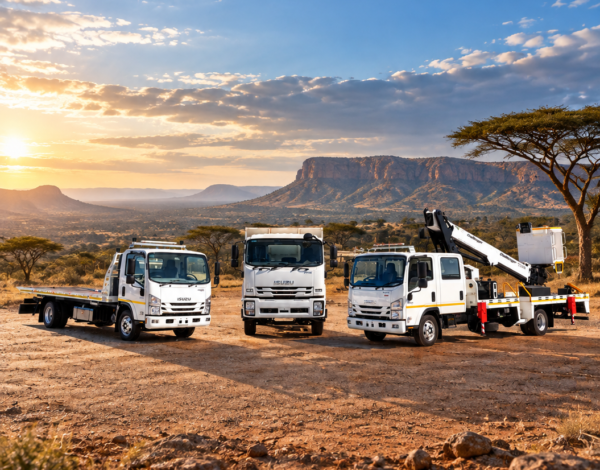
Africa’s commercial vehicle market is entering a new phase.
Fleet operators are facing rising fuel and operating costs, ageing vehicles, tougher demands for reliability and growing pressure to improve safety and efficiency.
At the same time, the continent’s infrastructure varies enormously, requiring trucks to combine increasingly sophisticated technology with the durability needed to operate in demanding environments.
For manufacturers, the challenge is no longer simply to build a truck capable of carrying a heavy load.
The next generation of African commercial vehicles must be engineered around specific applications, supported by reliable parts and service networks, and increasingly equipped with connectivity, advanced safety systems and more efficient powertrains.
For Isuzu Motors South Africa, that transformation is closely linked to its ambition to position South Africa as a manufacturing and export hub for the wider continent.
“We are positioning ourselves as the manufacturing hub for commercial trucks in the African market,” says Mpho Nkhumeleni, Department Executive: CV, Isuzu Motors South Africa.
“This strategy aims to increase volumes and maximize locally sourced components through our localization initiatives.”
Building a Continental Truck Business
Isuzu already has an established African footprint. The company exports its D-MAX to more than 30 African countries, including Zimbabwe, Zambia, Mozambique, Botswana and Namibia, while it is looking to expand further into West Africa.
Nkhumeleni identifies Ivory Coast as an important potential gateway for future volume growth as Isuzu develops its Rest of Africa (ROFA) strategy.
“We are currently expanding our footprint in West Africa, targeting the Ivory Coast as a critical gateway for volume growth,” he says.
“We are building on this momentum through our Rest of Africa (ROFA) agenda, which focuses on deepening our presence and fostering a thriving automotive sector across the continent.”
The regional strategy is supported by Isuzu’s manufacturing operation in Gqeberha, which the company regards as a cornerstone of its African commercial vehicle ambitions.
The plant has the capacity to produce approximately 4,000 medium, heavy and extra-heavy trucks annually.
Local manufacturing also gives the company greater control over production while creating opportunities to strengthen regional supply chains and respond more quickly to market requirements.
“By manufacturing trucks locally, we ensure stringent, world-class quality control while fostering economic growth through job creation,” Nkhumeleni says.
The strategy extends beyond vehicle assembly. Isuzu is seeking to increase the proportion of locally sourced components, with localisation becoming an important part of its longer-term African manufacturing strategy.
Engineering for African Roads
The diversity of African operating environments presents a fundamental engineering challenge.
A truck may spend one part of its working life on paved highways and another on corrugated gravel, unpaved roads or construction sites.
Isuzu says its African vehicle development programme therefore incorporates extensive research and development, durability testing and application engineering.
Its vehicles can be configured with reinforced chassis frames, heavy-duty leaf springs and high-tensile steel cross-members designed to withstand demanding road conditions.
“This specialized configuration is designed to absorb the high stress caused by corrugated gravel, unpaved terrain, and deep potholes,” says Nkhumeleni.
The company’s approach also recognises that vehicle specifications cannot simply be transferred from one market to another without considering local conditions.
Isuzu’s validation process includes application engineering, infrastructure assessments and vehicle durability testing.
Components are tested for potential failure, allowing the company to identify weaknesses and strengthen designs before vehicles enter demanding operating environments.
Customer feedback is another part of the process. Through initiatives such as its “Legends of the Long Run” campaign, Isuzu engages with truck owners and operators to gain insight into real-world vehicle performance.
The result is an approach that places durability alongside fuel efficiency and total cost of ownership when developing trucks for African markets.
From Workhorses to Application-Specific Trucks
The requirements of African fleets are changing.
According to Nkhumeleni, customers are increasingly moving away from basic workhorse vehicles towards trucks that are configured around specific applications.
“We have observed a major shift in requirements away from basic ‘workhorses’ toward highly optimized, technologically advanced vehicles,” he says.
That shift is particularly important in a market where the demands placed on a truck can differ dramatically depending on the sector.
A logistics operator may prioritise fuel economy, payload and uptime. A construction company may need greater durability and off-road capability, while mining operations can place even greater demands on chassis strength and powertrain performance.
Agricultural operators may require four-wheel-drive capability for remote or difficult terrain.
Isuzu’s product range reflects these different requirements. The N-Series is positioned for logistics and general distribution, while the FX and FY ranges address heavier construction and mining applications.
The NPS 300 4×4 is aimed at operations such as agriculture where access to rugged terrain is an important consideration.
Across these segments, the purchasing decision is increasingly influenced by the complete operating cost of the vehicle rather than its purchase price alone.
Technology Moves Into the Cab
Technology is becoming increasingly integrated into the commercial vehicle.
Telematics, once commonly treated as an optional fleet-management addition, is becoming an important source of operational information.
Data on harsh braking, acceleration and idling can help fleet managers understand driver behaviour, improve training and identify opportunities to reduce fuel consumption.
“Telematics, connectivity, and digital infrastructure have transitioned from optional add-ons to integral, factory-installed components deeply woven into vehicle design,” Nkhumeleni says.
The growing role of technology also extends to driver safety and comfort.
Driver retention remains an important issue for transport operators, particularly in long-distance operations.
Automated Manual Transmissions can reduce the physical demands placed on drivers while also helping to limit drivetrain stress associated with inappropriate gear changes.
For fleet owners, the value of these technologies is therefore not simply about having a more advanced truck.
The objective is to improve vehicle utilisation, driver performance, fuel efficiency and overall operating costs.
The Complicated Road to Lower Emissions
The transition towards lower-emission commercial transport is also gathering momentum, but Africa presents infrastructure challenges that manufacturers must take into account.
Isuzu has been evaluating technologies including Euro 5, compressed natural gas (CNG), diesel dual-fuel systems and other alternative powertrains.
However, the suitability of each technology depends heavily on conditions within individual markets.
Fuel quality remains one of the challenges.
Euro 5 technology requires low-sulphur diesel to protect advanced exhaust after-treatment systems, yet some African markets continue to operate with higher sulphur levels.
This creates a difficult balance between introducing cleaner technology and ensuring long-term reliability in markets where fuel infrastructure has not developed at the same pace.
CNG offers another pathway, but widespread adoption requires sufficient fuelling infrastructure.
Electric trucks face a different challenge.
Heavy commercial vehicles require substantial charging capacity, and in some markets electricity grids may not be able to provide the required power reliably without additional infrastructure investment.
“Charging fleets of medium and heavy electric trucks demands high-kilowatt fast chargers that local power grids cannot stably supply without operators investing heavily in localized solar arrays or microgrids,” Nkhumeleni says.
Alternative-fuel applications are rapidly gaining traction in the commercial transport sector, with Isuzu leading the charge by deploying compressed natural gas (CNG) trucks to major fleet operators.
Among its key clients, Tiger Brands’ Albany Bakery now operates 14 CNG vehicles for bread delivery, backed by a dedicated on-site refueling facility.
Isuzu has also supplied 16 CNG trucks to Premier FMCG’s Blue Ribbon division, along with additional delivery to logistics provider Kintru Truck Hire.
The experience illustrates an important point for Africa’s transition: lower-emission technologies may need to develop alongside the infrastructure required to support them.
The Next Generation
Against this backdrop, Isuzu’s next-generation truck range is being developed around the changing requirements of African businesses.
The company says the new models address evolving B2B requirements through improved fuel efficiency, advanced safety technologies, telematics compatibility and a focus on lower total cost of ownership.
The range also incorporates Euro 5 technology without AdBlue, while the new trucks feature an ECE-R29 cabin rating as part of their safety specification.
“The trucks offer improved fuel efficiency, advanced safety technologies, telematics compatibility, and a lower total cost of ownership,” Nkhumeleni says.
For fleet operators, however, technology ultimately has to translate into productivity.
A more sophisticated truck still has to withstand African operating conditions, remain economical to operate and receive the parts and technical support required to keep it working.
Uptime Is Still the Business Case
Despite the increasing sophistication of commercial vehicles, one of the most important considerations for transport operators remains remarkably simple: uptime.
“In the transport sector, downtime is the ultimate enemy of profitability,” Nkhumeleni says. “Even the most durable vehicle becomes a liability if a lack of local support keeps it off the road.”
For a fleet operator, an immobilised truck can mean lost revenue, delayed deliveries and additional costs. As a result, parts availability and technical support are becoming increasingly important components of the vehicle ownership proposition.
Isuzu says its support strategy includes regional parts distribution centres, dealer networks and specialised diagnostic tools designed to help technicians identify faults and reduce unnecessary downtime.
This makes the after-sales network an important part of the commercial vehicle itself. A truck’s real-world value depends not only on how it performs when new, but on how effectively it can be maintained throughout its working life.
Localisation and Fleet Renewal
Africa’s ageing commercial vehicle fleets represent a significant long-term replacement opportunity, and Isuzu sees localisation as central to its response.
The company is targeting 45% production localisation, with an ambition to shift more commercial truck manufacturing from Japan to South Africa while strengthening the local supply chain.
The strategy also gives Isuzu an opportunity to leverage the African Continental Free Trade Area, supporting the company’s ambition to use South Africa as a manufacturing and export base for markets across the continent.
For African fleet operators, the next generation of trucks will therefore be judged not simply by engine performance or the amount of technology in the cab. Durability, fuel efficiency, safety, connectivity, parts availability and technical support will all contribute to the real cost and productivity of operating a commercial vehicle.
The transition is also creating a new role for South Africa’s manufacturing sector. If localisation can increase, supply chains can deepen and production can become more responsive to regional requirements, the country’s automotive industry could play a larger role in meeting Africa’s growing demand for modern commercial vehicles.
For Isuzu, that ambition ultimately comes back to the Gqeberha plant and its role in supporting fleet renewal across the continent.
“Our ambition is to ensure that the Gqeberha plant remains a strategic manufacturing hub for Africa supporting fleet renewal while delivering long-term value to our customers, employees, suppliers and the broader economy,” says Nkhumeleni.
Also Read
- Beyond the Truck: How UD Trucks Is Redefining Fleet Performance in Southern Africa
- UPF Group Expands African Logistics Network with New Rwanda Office
- Africa’s Container Shipping Outlook: Why Freight Capacity Could Stay Tight Through 2026

- Inside Isuzu’s Plan to Make South Africa the Truck Manufacturing Hub for Africa - October 12, 2026
- UPF Group Expands African Logistics Network with New Rwanda Office - September 18, 2026
- DP World’s Africa Network Is Growing While Jebel Ali Takes a Heavy Hit - August 15, 2026

