
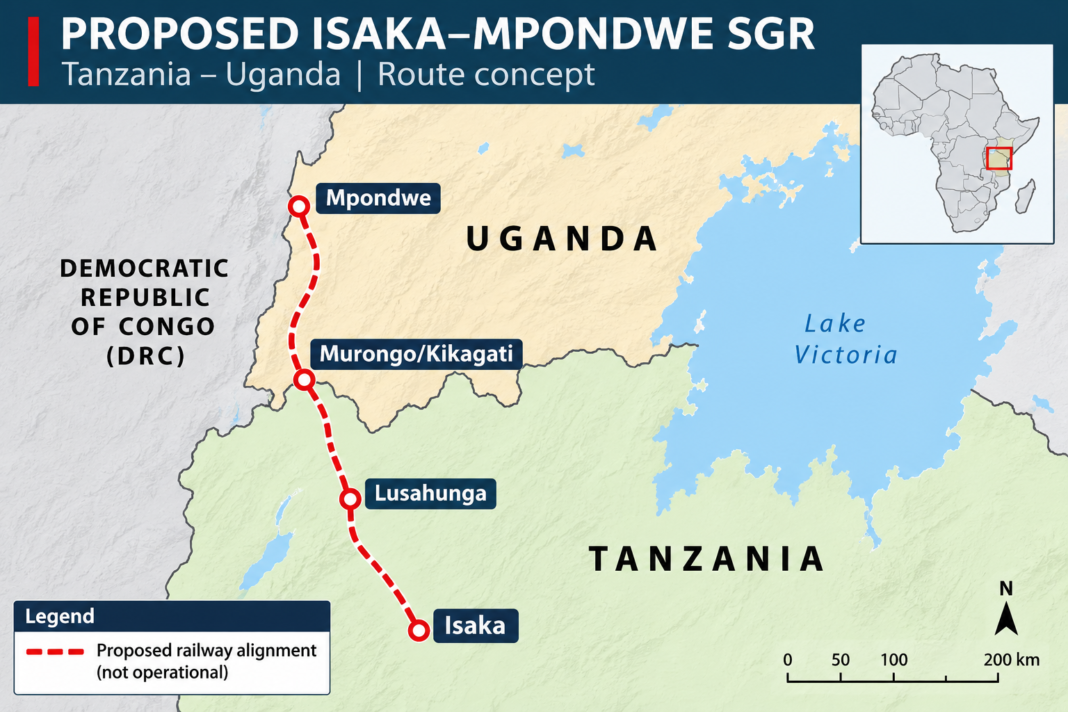
East Africa’s ambitions to strengthen cross-border freight connectivity are gaining momentum, with Tanzania and Uganda advancing plans for a proposed Standard Gauge Railway (SGR) that could extend transport access towards eastern Democratic Republic of Congo (DRC).
The proposed Isaka–Mpondwe railway is being positioned as a strategic infrastructure project that could expand the reach of regional transport corridors, improve cargo movement and create new trade opportunities across the Great Lakes region.
The framework agreement signed by Ugandan President Yoweri Museveni and Tanzanian President Samia Suluhu Hassan on November 18 places the proposed railway among the latest infrastructure initiatives aimed at strengthening economic cooperation between the two countries.
Rather than being an operational railway, the project remains at the preparatory stage, with feasibility studies, technical designs and financing arrangements still to be advanced.
A potential new freight corridor towards eastern DRC
The proposed railway would originate at Isaka in Tanzania and extend through Lusahunga and Murongo/Kikagati before reaching Mpondwe on the Ugandan side of the border with the Democratic Republic of Congo.
The proposed alignment could strengthen the connection between Tanzania’s inland transport network and Uganda’s western border, potentially creating a new route for cargo moving towards eastern DRC.
For the wider Great Lakes region, the strategic significance lies in the possibility of expanding the available transport corridors for goods, commodities and industrial cargo.
Eastern DRC has significant mineral and commercial potential, but transport infrastructure remains a major challenge in connecting many inland production areas with regional and international markets.
A rail connection reaching Mpondwe could provide a foundation for improved freight connectivity, although a further railway extension into eastern DRC would be necessary to establish a direct rail link into the Congolese market.
What the project could mean for East Africa’s logistics sector
The proposed railway could have implications beyond the two countries directly involved in its development.
Greater transport corridor competition
East Africa’s trade depends on a network of ports, road corridors, railways and inland logistics facilities.
Additional rail infrastructure could offer cargo owners and logistics providers more transport-routing possibilities, depending on the eventual network connections, operating costs and capacity.
The proposed link could strengthen the role of Tanzania and Uganda in facilitating freight movement towards the Great Lakes region and eastern DRC.
New opportunities for cross-border trade
Improved rail connectivity could support the movement of goods between inland economic centres and regional markets.
If the corridor is extended and integrated with other transport infrastructure, it could facilitate trade in agricultural products, industrial goods, construction materials and mineral-related cargo.
The potential benefits would depend on the development of supporting infrastructure, border processes and efficient freight operations.
Potential logistics cost reductions
The two governments have identified reducing transport and logistics costs as one of the objectives of the proposed railway.
Rail freight can offer cost advantages for suitable cargo volumes and distances, particularly where infrastructure, terminal operations and cargo handling are efficiently coordinated.
However, the project’s actual cost benefits will only become clearer after technical and economic assessments establish the railway’s operating model and investment requirements.
Infrastructure investment and logistics services
The development of a new railway corridor could create opportunities for investment in supporting infrastructure, including inland terminals, cargo handling facilities, warehousing, logistics parks and freight services.
Companies involved in railway construction, engineering, signalling, rolling stock, terminal equipment and logistics infrastructure could potentially participate in future project development, subject to procurement and financing arrangements.
Financing and project preparation remain critical
The proposed railway is still undergoing preparation, and its cost and construction timetable have not yet been established.
The governments have directed relevant institutions to accelerate feasibility studies, technical designs and financing arrangements.
These stages will be critical in determining the project’s commercial viability, engineering requirements, investment structure and implementation timeline.
The railway’s development will also depend on coordination between transport authorities, infrastructure institutions and stakeholders across the proposed corridor.
A broader regional connectivity ambition
The proposed Isaka–Mpondwe railway reflects a broader ambition to strengthen transport links across East Africa and the Great Lakes region.
If developed and connected to complementary infrastructure, the corridor could contribute to a more integrated regional freight network, potentially improving market access and creating additional opportunities for logistics operators and businesses involved in cross-border trade.
For now, the railway remains a proposed infrastructure project.
Its long-term significance will depend on how quickly preparation advances, how it is financed and whether the wider transport network develops the connections needed to support efficient cargo movement into eastern DRC and other regional markets.
Also Read
- CMA CGM Launches Dedicated Rail Freight Service Linking Mombasa Port to Nairobi ICD
- South Africa’s Private Rail Operators Go Live: What the First Open-Access Corridors Mean for African Freight
- Inside Cameroon’s Rail Upgrade Strategy: Modernising the Douala–Ngaoundéré Line

- East Africa Eyes New Rail Freight Corridor Linking Tanzania, Uganda and Eastern DRC - November 19, 2026
- South Africa’s R1.156 Trillion Logistics Bill: The Growing Cost of Moving Freight - November 18, 2026
- Inside Isuzu’s Plan to Make South Africa the Truck Manufacturing Hub for Africa - October 12, 2026


 that could extend transport access towards eastern Democratic Republic of Congo (DRC).)