
When the Trans-Cameroon Railway reached Ngaoundéré in 1987, completing a 667-kilometre mainline from Yaoundé, it did more than connect a northern city to the coast.
It stitched together a country of extraordinary geographic and ethnic diversity, and created the primary overland trade route for two landlocked neighbours — Chad and the Central African Republic — to the deep-water port of Douala.
Decades later, that corridor remains the backbone of Central Africa’s freight movement.
But the infrastructure that carries it has aged without a single comprehensive upgrade since it was built.
Train speeds on the ageing metric-gauge track are constrained by deteriorating sleepers, worn rails, and outdated signalling. Delays are routine. Safety incidents have occurred.
And the volume of trade passing through the corridor — estimated to account for 35 percent of the combined GDP of Cameroon and Chad — is straining a network that was never designed for current demand.
That is now changing. In a rare convergence of multilateral financing, diplomatic momentum, and private sector investment, Cameroon is executing an overhaul of its rail network on a scale it has never previously attempted.
Two Flagship Projects, One Strategic Corridor
Cameroon’s modernisation effort is organised around two distinct but complementary programmes, together covering approximately 568 kilometres of track between Douala and Ngaoundéré.
Both sit under the broader umbrella of the Regional Project for Improving the Performance of the Douala–N’Djamena Rail/Road Corridor (PCDN), a multi-country initiative that also encompasses critical road links inside Chad.
Project 1: The Douala–Yaoundé Line (238 km)
The southern anchor of the modernisation programme is the 238-kilometre Douala–Yaoundé section — the busiest and most commercially critical segment of the entire network.
This project is financed by the World Bank through an IDA credit facility and has been allocated CFA152 billion (approximately USD 250 million) from the broader USD 538 million Cameroon-Chad Transport Corridor project approved by the World Bank Board in February 2022.
The scope of works is extensive. According to Camrail’s preliminary consultation documents released in September 2025, the project covers:
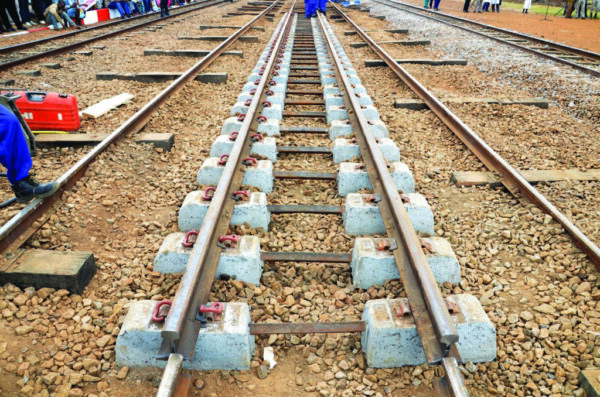
• Full replacement of rails and bi-block concrete sleepers along the 238 km corridor
• Automation of level crossings to improve road-rail safety
• Rehabilitation of engineering structures including viaducts, tunnels, bridges, and drainage systems
• Installation of centralised signalling and onboard signalling systems
• Deployment of automatic train protection and crossing control technology
The last point — signalling modernisation — is particularly significant. The 2016 Eseka derailment, which claimed more than 80 lives, exposed the vulnerability of a network operating without modern train control systems.
The introduction of automatic train protection represents a structural safety improvement that has long been overdue.
Project 2: The Bélabo–Ngaoundéré Line (330 km)
The second and longer of the two projects covers the 330-kilometre track between Bélabo in the Eastern Region and Ngaoundéré in the Adamawa plateau — the section of line that links central Cameroon to the north of the country and provides the rail gateway for transit goods destined for Chad and the Central African Republic.
This section has the more dramatic history. It was opened in 1974, and in over five decades of operation it has never undergone a comprehensive upgrade.
The consequences are visible: maximum speeds well below design parameters, frequent delays, and operational constraints that limit both freight capacity and schedule reliability.
The Bélabo–Ngaoundéré Line Renewal Project (PRBN) has attracted the most significant single injection of European development finance Cameroon has ever received.
The financing package totals CFA167.3 billion and draws on three sources: a EUR 106 million loan from the European Investment Bank (EIB), a EUR 17.1 million grant from the European Union, and co-financing from France’s Agence Française de Développement (AFD).
The EIB loan alone represents the bank’s largest ever single investment in Cameroon and its largest transport investment across sub-Saharan Africa.
“The agreements signed today mark a decisive step in the renewal programme for the entire operational rail network.
With the PRBN, we will have 330 additional kilometres of railway track renewed — approximately 30 percent of the national network.” — Ernest Ngallè Bibèhè, Cameroon Minister of Transport, May 2022
The financing agreements were signed on 6 May 2022 in Yaoundé in the presence of Prime Minister Joseph Dion Ngute, EIB Vice President Thomas Ostros, and the EU Ambassador to Cameroon. The EIB described the project as a flagship of sustainable transport investment for sub-Saharan Africa.
Once completed, the modernised Bélabo–Ngaoundéré line is designed to allow passenger trains to run at 90 km/h and freight trains at 70 km/h — dramatically faster than current operational speeds.
The project includes comprehensive renewal of track infrastructure, improvement of station facilities, and enhanced rail crossing safety across the full 330 km route. More than one million passengers a year are expected to benefit from the improved service.
Procurement in Motion: Where the Projects Stand
After several years of preparatory work, the procurement phase for both projects is now underway.
In September 2025, Camrail held a preliminary market consultation in Douala to outline project phases, identify technical requirements, map potential risks, and attract qualified international firms ahead of formal tenders.
According to Jacques Fansi, Camrail’s Director of the PQ2 Project, tenders for the initial supply packages — covering items such as rails, sleepers, and ballast — were scheduled to be launched between the second half of 2025 and the first half of 2026. Construction works are expected to begin in the first half of 2027.
That timeline was further reinforced by procurement activity visible in mid-2026. Camrail issued a formal tender under the PCDN project (IDA Credit N° 7036-CM) for the local manufacture and supply of 404,000 reinforced concrete bi-block sleepers — a volume that underscores the industrial scale of the track renewal planned across both segments.
Separately, a May 2026 notice called for expressions of interest to recruit a consultant to update Cameroon’s National Railway Master Plan.
On the governance side, the National Steering Committee (COPIL) of the PCDN project held its inaugural session in Yaoundé on 18 December 2025.
The meeting, chaired by the Minister of Transport, reviewed activity reports covering June 2024 through December 2025, validated strategic orientations for 2026, and approved the Annual Work Plan and Budget of CFA11.12 billion for 2026 — approximately 6.2 percent of the project’s total financing envelope.
The 2026 work plan priorities include procurement of equipment for the Douala–Yaoundé rehabilitation, consultancy services for project management and works supervision, and the rehabilitation of the Ngaoundéré rail/road intermodal platform — a critical logistics hub that connects the national rail terminus to road transport networks serving Chad and the CAR.
The Operator at the Centre: Camrail and the PQ2 Programme
Operating at the heart of this modernisation drive is Camrail, the private concessionaire that has managed Cameroon’s national railway network since 1999.
A subsidiary of Africa Global Logistics (AGL), formerly Bolloré Africa Logistics, Camrail operates the entire metre-gauge network under a government concession and invests an average of CFA12 billion per year in the railway.
It also pays an average of CFA10 billion annually to the Cameroonian state in royalties, taxes, and duties.
The current round of major investment — which Camrail terms its second five-year railway investment programme (Programme Quinquennal N°2, or PQ2) — represents a step change in the scale of capital being deployed.
The combined CFA500 billion investment across both track renewal projects dwarfs anything the concessionaire has previously managed.
In early 2025, Camrail’s ownership structure gained a new dimension when Australian mining company Camalco acquired an initial stake in the company.
By May 2026, Camalco had raised its stake to 26.9 percent, with the funds explicitly earmarked to support rail network modernisation under the PQ2 programme.
The strategic rationale is straightforward: Canyon Resources, Camalco’s parent, is developing the Minim Martap bauxite deposit and intends to use Cameroon’s railway to transport bauxite from mine to port as part of an integrated logistics chain.
This convergence of commercial mining interest and infrastructure modernisation is significant.
It signals that the railway upgrade is not merely a government infrastructure project but one that is increasingly attracting private capital from resource sector operators who see long-term freight volumes in Cameroon’s growth trajectory.
Strategic Context: The Douala–N’Djamena Corridor
To understand why this modernisation programme matters beyond Cameroon’s borders, it is necessary to situate the rail projects within the wider Douala–N’Djamena corridor — one of the few fully operational intermodal corridors in Central Africa.
The corridor connects the port of Douala to N’Djamena, the landlocked capital of Chad, through a combination of rail (Douala to Ngaoundéré) and road (Ngaoundéré to N’Djamena and beyond). The combined corridor carries freight for Chad, which has no coastline, and for the Central African Republic.
It accounts for 35 percent of the combined GDP of Cameroon and Chad, concentrates approximately 20 percent of Chad’s population within its catchment, and serves about 35 percent of Cameroon’s population. An estimated 12 million people live within the corridor.
The World Bank framed the scale of the challenge clearly when it approved USD 538 million in IDA financing for the Cameroon-Chad Transport Corridor Project in February 2022: reducing costs and transport time from Douala to N’Djamena was presented not only as an economic imperative but as a development and resilience priority for a region affected by climate change, political instability, and population displacement.
The African Development Bank has reinforced this assessment. In March 2025, a high-level AfDB mission to Cameroon culminated in the signing of a EUR 330.48 million loan agreement to upgrade the 246-kilometre Ngaoundéré–Garoua road — the road section of the corridor that connects the rail terminus at Ngaoundéré to northern Cameroon and the Chad border.
The AfDB described the investment as part of its commitment to supporting Cameroon’s National Development Strategy to 2030.
Looking Beyond Ngaoundéré: The Chad Rail Extension
The current modernisation programme upgrades existing track, but a longer-term ambition looms over the planning horizon: extending the railway beyond Ngaoundéré to reach N’Djamena itself, eliminating the road component of the transit journey entirely.
The Ngaoundéré–N’Djamena railway extension has been on the drawing board for over a decade.
In December 2011, Cameroon and Chad formally agreed to study the feasibility of completing the Douala–N’Djamena rail corridor by building the missing link between Ngaoundéré and the Chadian capital — a distance of between 700 and 800 kilometres depending on the route chosen.
A feasibility study, financed by the African Development Bank with a loan of 2 million units of account secured in February 2021, was completed in 2024. The study evaluated three principal routes:
• Route 1: Ngaoundéré to N’Djamena via Garoua, Maroua, and Kousseri — estimated cost CFA4,829 billion
• Route 2: Ngaoundéré to N’Djamena via the Chadian cities of Moundou, Kélo, and Bongor — estimated cost CFA2,988 billion
• Route 3: Ngaoundéré to N’Djamena via Garoua, Figuil, Kéré, Pala, Kélo, and Bongor — estimated cost CFA4,948 billion
As of mid-2026, no definitive route agreement had been reached between the two governments, though expressions of interest were being sought for the implementation of various rail enhancements including the new line — with approximately 170 kilometres of the proposed 700 km extension falling within Cameroonian territory.
Financing for a project of this magnitude remains the central challenge, but the completion of the feasibility study and the active procurement of capacity for the National Railway Master Plan update suggest that planning is advancing.
Implications for the Construction and Civil Engineering Sector
The scale of work involved in Cameroon’s rail modernisation programme represents a significant opportunity for construction and civil engineering contractors operating in Central Africa. The projects are not minor maintenance programmes — they are comprehensive infrastructure renewals requiring substantial mobilisation of plant, materials, and specialist expertise.
Key Civil Engineering Scope
Major works planned across Cameroon’s rail modernisation programmes include:
- Track renewal and rail replacement across 568 km of single-track railway.
- Supply and installation of 400,000+ concrete bi-block sleepers.
- Rehabilitation of bridges, viaducts, and tunnels.
- Repair and upgrading of drainage infrastructure.
- Modernisation of station facilities at multiple locations.
- Installation of new signalling and train control systems.
- Automation of level crossings and road–rail interface improvements.
- Rehabilitation of the Ngaoundéré intermodal rail/road platform.
The tender process, managed through World Bank and EIB procurement frameworks, requires compliance with international standards.
Pre-qualification and works tenders are expected to attract both established European contractors familiar with EIB procurement requirements and regional contractors with local presence and logistical capability.
The broader civil engineering context is also expanding. Around 2024, construction began on a new 510-kilometre standard-gauge railway connecting iron ore mining operations in the Mbalam area of southeastern Cameroon with a new Atlantic port near Kribi, with completion anticipated in 2030.
Camrail is separately exploring a road-rail solution for a link between Edéa and the new Kribi deep-water port to maintain its freight position as cargo patterns shift.
Cameroon Rail Modernisation: Key Data
| Track Length | 568 km |
| Total Investment | ~CFA500bn (≈US$820m) |
| Douala–Yaoundé Funding | CFA152bn (World Bank) |
| Bélabo–Ngaoundéré Funding | CFA167.3bn (EIB, EU & AFD) |
| PCDN Budget | ~CFA181bn |
| Target Speeds | 90 km/h (passenger), 70 km/h (freight) |
| Tenders | H2 2025 – H1 2026 |
| Construction Start | Planned H1 2027 |
| Completion Target | 2028 |
| Annual Beneficiaries | Over 1 million passengers |
| Economic Importance | 35% of Cameroon–Chad GDP corridor |
| Operator | Camrail (AGL subsidiary) |
A Corridor Coming of Age
Cameroon’s rail modernisation strategy is, at its core, a bet on the long-term primacy of the Douala–N’Djamena corridor as the arterial route of Central African trade.
The investments being made — by European development banks, the World Bank, the Cameroonian government, and increasingly by private mining capital — reflect a shared assessment that the corridor is structurally underserved by infrastructure that has not kept pace with the economic weight it carries.
The practical implications will be felt across the supply chain.
Faster, more reliable rail freight between Douala and Ngaoundéré will reduce logistics costs for Chadian and Central African importers, improve the competitiveness of Cameroonian agricultural exports, and offer heavy industry — particularly mining operations in Mbalam and Minim Martap — a viable rail logistics pathway to port.
For contractors and equipment operators, the construction phase represents a pipeline of civil engineering and infrastructure work that is now moving from feasibility to procurement to execution.
The Bélabo–Ngaoundéré works alone — 330 kilometres of comprehensive track renewal in challenging terrain — will require sustained mobilisation of plant, ballast equipment, tamping machines, and specialist rail-laying machinery over the construction period.
The story of Cameroon’s railway is entering a new chapter, five decades after the Trans-Cameroon line reached Ngaoundéré.
The question is no longer whether the upgrade will happen, but how effectively the procurement machinery will translate committed finance into track on the ground — and whether the extension to N’Djamena will follow.
Also Read
Traxtion Secures $86 Million Equity Investment to Accelerate Rail Expansion in Southern Africa
Mozambique Pushes Ahead With US$160M Rail Upgrade to Strengthen Maputo Corridor

- Inside Isuzu’s Plan to Make South Africa the Truck Manufacturing Hub for Africa - October 12, 2026
- UPF Group Expands African Logistics Network with New Rwanda Office - September 18, 2026
- DP World’s Africa Network Is Growing While Jebel Ali Takes a Heavy Hit - August 15, 2026

