
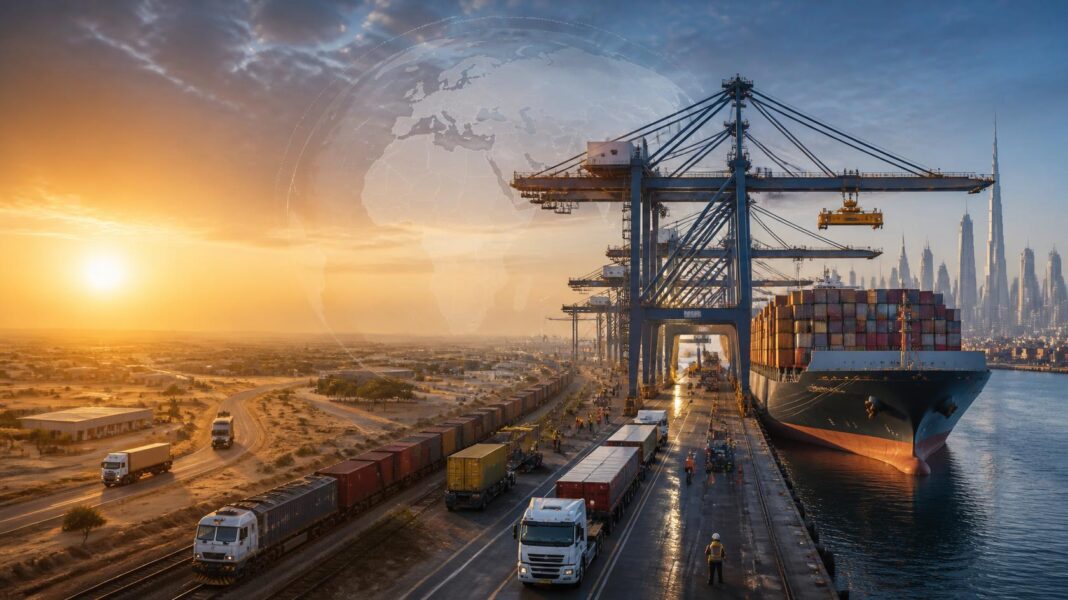
DP World’s first-half 2026 results tell two very different stories. Revenue surged 13.1% to $12.7 billion, yet adjusted EBITDA fell 5.6% and global container throughput declined 5.7%. The biggest drag came from Jebel Ali.
But strip out the UAE gateway and the picture changes dramatically — and Africa is part of the growth story.
For DP World, the results are therefore about more than a difficult six months at one of the world’s most important ports.
They provide an unusually clear test of the company’s strategy of building a geographically diversified, end-to-end logistics network.
The question is whether that network can continue generating growth when its flagship gateway is under pressure.
So far, the answer appears to be yes.
A results set that reads two ways at once
On the surface, DP World’s first-half numbers look uneven.
Revenue reached $12.7 billion, up 13.1% year on year. But adjusted EBITDA declined 5.6% to about $2.86 billion, while gross container throughput fell 5.7% to 42.8 million TEUs, compared with 45.4 million TEUs a year earlier.
The biggest drag came from Jebel Ali, DP World’s flagship UAE gateway.
Regional conflict has suppressed vessel traffic through the port. Jebel Ali itself has not been physically damaged and remains operational, but the reduction in shipping activity has been large enough to affect DP World’s global throughput figures.
Then comes the more revealing part of the results.
Excluding Jebel Ali, DP World’s like-for-like container volumes increased 6.5%. Adjusted EBITDA excluding Jebel Ali increased 9.7%.
DP World says growth was recorded across Africa, the Americas, Asia Pacific and Europe.
That completely changes the way the results should be read.
This is not simply a story about a Middle Eastern port absorbing a geopolitical shock. It is a live test of whether DP World’s strategy — building a distributed logistics network rather than depending on a small number of mega-gateways — is providing the resilience the company expected.
DP World H1 2026: The numbers that matter
Source: DP World H1 2026 results.
The distinction between total and ex-Jebel Ali performance is crucial.
It would be wrong to conclude that Africa’s container volumes rose 6.5%. DP World has not published a standalone Africa-wide growth figure for the first half.
What it has said is that Africa is among the regions contributing to the growth outside Jebel Ali.
That is a narrower claim — but arguably the more interesting one.
What the numbers do — and don’t — say about Africa
Africa is not being presented by DP World as a single homogeneous growth market.
Its network stretches across very different economies, trade corridors and infrastructure environments.
That makes the company’s decision to continue investing on the continent particularly significant.
DP World invested $1.5 billion globally during the first half of 2026 and expects to invest approximately $3 billion for the full year.
The company has also identified the Democratic Republic of Congo among its growth markets while continuing major investment in Senegal.
This matters because infrastructure investment on this scale is a long-term decision.
A port operator does not spend billions because of one strong quarter.
It does so because it expects the underlying trade corridor to become more valuable over many years.
And that is where Africa fits into DP World’s wider strategy.
Related Stories
Africa’s Container Shipping Outlook: Why Freight Capacity Could Stay Tight Through 2026
U.S. Truck Freight Prices Fall 1.8% in July as Diesel Costs Slide
Africa’s Shipping Map Is Changing: Asia–West Africa Capacity Jumps 34% in 2026
Africa’s Trucking Industry Is Changing. Here’s What Fleets Are Buying and Why
Why Africa matters to DP World’s diversification strategy
Africa offers something that mature logistics markets cannot always provide: a long runway for trade infrastructure development.
Containerisation is still developing across many African markets. Intra-African trade remains constrained by transport costs and border friction.
Industrialisation is creating new cargo flows, while agricultural, mineral and manufactured exports increasingly require reliable connections to global markets.
For DP World, this creates opportunities at several levels simultaneously. A new port can generate terminal revenue. But the bigger opportunity is what surrounds the port.
A deep-water gateway can support:
port → terminal → customs → trucking/rail → inland depot → warehouse → industrial zone → final customer
That is much closer to the business DP World increasingly wants to operate.
The company is not simply positioning itself as a terminal operator.
It is positioning itself as a supply-chain infrastructure provider.
That distinction is critical to understanding its African expansion.
Banana Port is a bet on Central Africa’s future trade map
The clearest example is Banana Port in the Democratic Republic of Congo.
This is not an incremental expansion of an existing container terminal.
It is a new deep-water gateway on the DRC’s Atlantic coast, designed to change how the country’s international cargo moves.
The first phase is planned for 450,000 TEUs of annual capacity, with a 600-metre quay designed to accommodate some of the world’s largest container vessels.
The strategic logic goes well beyond capacity.
For the DRC, geography is a major logistics challenge. Cargo moving into or out of the country’s large interior market can face lengthy inland journeys and multiple logistical handoffs.
A deep-water Atlantic gateway creates the possibility of a more direct connection between international shipping networks and Central African markets.
That could improve vessel economics, reduce dependence on some existing routing arrangements and potentially shorten supply chains.
But the real prize is not the port itself. It is the corridor that develops behind it.
If roads, inland logistics, customs processes, warehouses and distribution networks develop alongside Banana Port, the facility could become a much more important node in Central African trade.
Banana Port is therefore better understood as a bet on the future geography of Central African commerce than as simply another container terminal.
Senegal shows what the next stage can look like
West Africa provides an even clearer example of how DP World is thinking about infrastructure.
At Ndayane in Senegal, DP World completed major dredging in July 2026, thirteen months ahead of schedule.
The project represents an investment of approximately $1.2 billion and is expected to be completed in 2028.
Once operational, Ndayane is intended to become Senegal’s principal deep-water container gateway.
But the most interesting part of the story is not the new port.
It is what has already happened at Dakar.
DP World says container throughput at its Dakar operation increased from 265,000 TEUs in 2008 to approximately 850,000 TEUs in 2025.
That is more than a threefold increase. At the same time, average vessel waiting times have fallen from around 35 hours to near zero. Ndayane therefore isn’t simply a speculative greenfield project.
It represents the next phase of an existing logistics ecosystem that has already demonstrated substantial growth.
The strategy appears straightforward:
build capacity ahead of demand, then connect that capacity to a broader inland logistics network.
The competition is moving inland
This may ultimately be the most important part of DP World’s African strategy.
Africa’s logistics challenge has never been purely about port capacity.
A container can be discharged efficiently from a vessel and still spend days moving through congestion, customs procedures, border crossings or inadequate inland transport networks.
A modern terminal cannot compensate indefinitely for a weak hinterland.
This is why the competitive battle is moving inland.
DP World’s broader network includes ports and terminals alongside freight forwarding, contract logistics, marine services and economic zones.
Its 2025 annual report describes a freight-forwarding network of nearly 300 branches worldwide, while its contract logistics operations extend across more than 500 locations.
That creates a fundamentally different proposition from simply owning a port.
The company can potentially capture value at multiple stages of the supply chain.
And that becomes particularly valuable when cargo flows are disrupted.
Jebel Ali is revealing the value of the network
This is where the current results become particularly interesting.
Jebel Ali’s importance is precisely why disruption there has such a large impact on DP World’s headline numbers.
But the same disruption provides an accidental stress test for the company’s diversification strategy.
If one major gateway experiences a shock, how much of the wider network can continue generating growth?
The answer from the first half appears encouraging.
Outside Jebel Ali, container volumes grew 6.5% on a like-for-like basis and adjusted EBITDA grew 9.7%.
Africa was among the regions contributing to that performance.
That doesn’t mean Africa replaced Jebel Ali.
It means something more subtle.
DP World’s expanding international network is becoming large enough that the performance of individual gateways no longer tells the entire story.
DP World is not abandoning Jebel Ali
There is another important signal in the company’s strategy.
DP World is not responding to the Jebel Ali disruption by reducing its dependence on the UAE and simply moving capital elsewhere.
It is doing both.
The company plans to develop two new terminals in Fujairah under a 50-year concession, strengthening the wider UAE maritime ecosystem.
That suggests a strategy built around both concentration and diversification.
Jebel Ali remains a critical global gateway.
At the same time, DP World wants alternative infrastructure, additional regional gateways and a broader international network.
For Africa, that matters because African ports can increasingly function as nodes within a global system rather than isolated gateways serving narrowly defined hinterlands.
The next opportunity is bigger than container handling
If DP World’s African network continues expanding, the economic opportunity will extend well beyond the terminal itself.
More cargo through African gateways creates demand for:
- trucking
- rail freight
- inland container depots
- bonded warehousing
- cold-chain facilities
- customs and clearance services
- freight forwarding
- regional distribution
- industrial parks
- agricultural export logistics
- digital supply-chain services
This is why the port-versus-port comparison is becoming outdated.
A port’s competitiveness increasingly depends on everything surrounding it.
The winning infrastructure will not necessarily be the terminal with the largest cranes.
It will be the corridor that can move a container from ship to customer with the fewest delays, handoffs and unexpected costs.
Africa’s port competition is becoming corridor competition
For years, African maritime competition was often framed around individual ports.
- Mombasa versus Dar es Salaam.
- Durban versus Maputo.
- Lagos versus Tema.
- Dakar versus Abidjan.
But that framework is becoming too narrow.The emerging competition is between integrated trade corridors.
A corridor combines:
deep-water port + terminal + customs + road/rail + inland depot + warehouse + industrial zone + distribution network.
That is a much more difficult competitive advantage to replicate.
It also explains why infrastructure investment around African ports could become as important as investment inside the terminals themselves.
The investment race is moving into the hinterland
There is an important implication here for African governments.
Building a deep-water port is only the first half of the equation.
If the roads leading from the port remain congested, if rail connections are inadequate, if customs procedures are slow, or if there is insufficient warehousing capacity, the economic benefit of the port can be sharply reduced.
This creates an unusual situation.
Private infrastructure operators such as DP World can invest billions in ports and logistics facilities.
But governments still control many of the infrastructure and regulatory conditions that determine whether those investments reach their full potential.
That makes the next phase of African logistics investment particularly interesting.
The question is no longer simply:
Who is building the next big African port?
It is:
Who is building everything that makes the port useful?
The open question for Africa
The easy version of this story is:
Jebel Ali is down. Africa is up.
The data does not support that conclusion.
The stronger and more defensible interpretation is that DP World’s non-Jebel Ali network is growing, Africa is explicitly among the regions contributing to that growth, and the company continues to commit significant capital to African trade infrastructure.
That combination is important.
Banana Port is being developed to reshape Central African maritime access.
Ndayane is being developed to expand Senegal’s deep-water capacity.
Existing terminals are being integrated into a wider logistics platform.
And DP World is increasingly competing on the basis of connected supply chains rather than individual port assets.
But Africa now faces its own test.Can inland infrastructure grow fast enough to support the capacity being built at the coast?
That means roads, railways, border posts, customs systems, warehouses, inland depots and distribution networks.
If they do, the new generation of African ports could become powerful engines of regional trade.
If they do not, some of the additional capacity could simply move the bottleneck from the quay to the hinterland.
The bigger bet: Africa as a network, not a destination
The most important takeaway from DP World’s H1 2026 results is therefore not that the company is investing in African ports.
That has been happening for years.
The more important development is the type of network DP World is building around those ports.
The company increasingly wants to connect maritime gateways with inland logistics, freight forwarding, warehousing and industrial activity.
That changes the economics.
The port becomes the entry point into a much larger supply-chain system.
And Africa is potentially one of the most important places for that model because the continent still has enormous room to improve the movement of goods between ports, production centres and consumers.
Jebel Ali’s disruption has exposed the risks of concentration.
But the growth of DP World’s wider network is demonstrating the potential value of diversification.
Africa sits somewhere between those two forces.
It is both a growth market and a strategic diversification opportunity.
Africa Logistics verdict
DP World’s first-half results should not be reduced to a disappointing quarter caused by weakness at Jebel Ali.
They offer a much more revealing picture of how global logistics is changing.
A single gateway can still move the numbers. But an integrated network can increasingly determine the outcome.
Jebel Ali remains enormously important. Its disruption was significant enough to pull DP World’s overall container throughput down 5.7%.
Yet outside Jebel Ali, the company’s like-for-like container volumes grew 6.5%, while adjusted EBITDA increased 9.7%. Africa was among the regions contributing to that performance.
At the same time, DP World is continuing to put substantial capital behind African trade infrastructure, from Ndayane in Senegal to Banana Port in the DRC.
The strategic message is becoming clearer.
DP World does not want Africa to be simply another destination on a shipping schedule. It wants African ports, logistics facilities and trade corridors embedded in its global supply-chain network.
That could have consequences far beyond container throughput.
It could reshape where distribution centres are built, how regional cargo moves, where manufacturers locate, how agricultural exports reach international markets and which African corridors become the preferred routes for global trade.
But there is one final condition.
Africa is building bigger ports. The next battle is whether it can build the logistics systems needed to make those ports matter.
That battle will be fought several kilometres beyond the quay — on the roads, railways, borders, warehouses and industrial corridors connecting Africa’s new gateways to its economies.
Also Read
- Africa’s Container Shipping Outlook: Why Freight Capacity Could Stay Tight Through 2026
- U.S. Truck Freight Prices Fall 1.8% in July as Diesel Costs Slide
- Africa’s Shipping Map Is Changing: Asia–West Africa Capacity Jumps 34% in 2026
- Africa’s Trucking Industry Is Changing. Here’s What Fleets Are Buying and why

- Inside Isuzu’s Plan to Make South Africa the Truck Manufacturing Hub for Africa - October 12, 2026
- UPF Group Expands African Logistics Network with New Rwanda Office - September 18, 2026
- DP World’s Africa Network Is Growing While Jebel Ali Takes a Heavy Hit - August 15, 2026

