

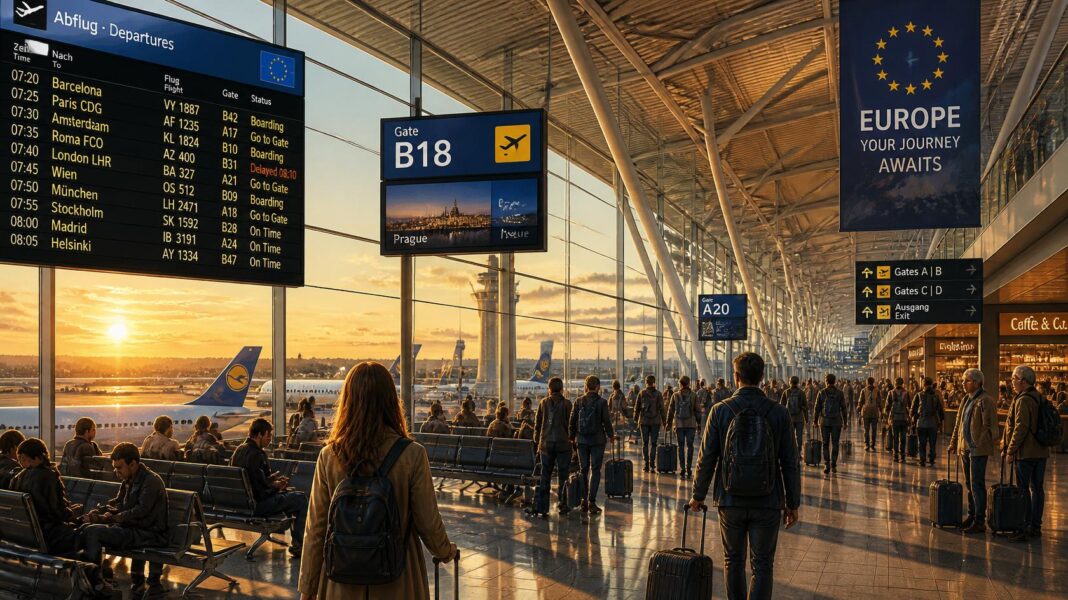
Flying to Europe this summer? You’ve probably heard the horror stories: five-hour border queues, planes leaving half-empty, passengers stranded at the gate because they never made it through passport control in time.
It’s all tied to the EU’s new Entry/Exit System (EES) — and as of July 2026, it’s the single biggest factor that could derail your travel plans this year.
Here’s what’s actually happening, which airports are worst affected, and how to build your itinerary so you don’t become the next missed-flight headline.
What Is the EES, Quickly
EES is the EU’s new digital border system. It replaced manual passport stamping for most non-EU travelers, recording fingerprints, a facial photo, and entry/exit data every time you cross into or out of the Schengen Area.
It rolled out gradually from October 2025 and became fully operational across all 29 participating countries on 10 April 2026.
The idea is sound — automated, biometric tracking instead of an officer flipping through stamps. The problem is capacity: many airports simply weren’t built, staffed, or equipped for how long first-time biometric registration actually takes.
Why It’s Causing Chaos
Registering biometrics for the first time takes roughly 70–90 seconds per traveler at busy checkpoints — double the time of a standard stamp.
Multiply that across a full flight, let alone a bank of long-haul arrivals landing at once, and queues back up fast.
Industry groups representing Europe’s airports and airlines (ACI Europe, Airlines for Europe, and IATA) went as far as calling the situation a “critical point” in a joint letter to the European Commission, describing passengers facing five-hour queues and planes departing half-empty because so many travelers were still stuck in line.
Ryanair has been the most vocal critic, publicly demanding the system be suspended until after peak summer season — a request the European Commission rejected, arguing that pausing EES in some places but not others would risk travelers being wrongly logged as overstayers.
The Commission’s own position: of roughly 1,500 border crossing points across the EU, only around 20 are officially acknowledged as serious “difficult spots.”
The EU hasn’t published an official named list — but cross-referencing airline and airport complaints, industry letters, and on-the-ground reporting makes it pretty clear which ones they mean.
Where the Delays Are Concentrated
Based on repeated, corroborated reporting through mid-2026, the pressure points fall into three rough categories.
1. Leisure and charter airports overwhelmed by tourist volume
These are smaller or mid-sized airports that handle huge non-EU (especially UK and Irish) holiday traffic but don’t have the floor space or booth count to process it.
This is where some of the worst individual incidents have happened — including one small airport where roughly 3,000 passengers arrived within an hour with only four biometric booths available.
- Palma de Mallorca
- Alicante–Elche
- Málaga–Costa del Sol
- Tenerife South
- Fuerteventura
- Lanzarote (César Manrique)
- Faro
- Toulouse–Blagnac (site of a 150-passenger missed-flight incident in late May)
- Athens International (dozens of Ryanair passengers missed a London flight here in June)
2. Major international hubs hitting technical sync bottlenecks
Big-name airports aren’t immune — reports describe “spaghetti-like” queues at some of Europe’s largest hubs, driven by sync issues between local systems and the central EU database rather than pure passenger volume.
- Paris Charles de Gaulle (Terminal 2E in particular — waits running roughly 25% longer than pre-EES, with 2–4 hour peaks during long-haul arrival banks)
- Amsterdam Schiphol
- Lisbon Humberto Delgado (queues have since eased after extra staff were deployed)
- Rome Fiumicino
- Brussels Airport (currently being reinforced with 50 additional Frontex officers)
3. Channel crossings with dual UK–French border control
These have their own unique bottleneck: French border checks happen on British soil, in tight, high-density pedestrian spaces never designed for biometric kiosks.
- Port of Dover
- Eurotunnel/Folkestone
- London St Pancras International (Eurostar departures)
How Long Should You Actually Budget?
There’s no single number that applies everywhere, but based on current patterns:
- Off-peak arrivals at most airports: still clearing in under an hour.
- Peak long-haul arrival banks (typically afternoons) at busy hubs like CDG: budget 90 minutes minimum, and up to 3–4 hours as a worst-case buffer during summer.
- Connections through a Schengen hub: allow at least a 3-hour layover this summer if you’re transferring through any of the airports listed above.
- First-time EES registration specifically: this is what eats the extra time. Once you’re enrolled, subsequent crossings should be faster, since the system just verifies your existing biometric record.
Practical Ways to Protect Your Trip
- Route around it if you can. If your itinerary is flexible, connecting through a non-Schengen hub (Dubai, Doha, Istanbul, London Heathrow) means you only go through EES once, at your final destination, instead of mid-journey.
- Check for the Travel to Europe app. A pre-registration app that lets you submit your fingerprints and photo up to 72 hours before arrival is live in Sweden and being piloted in Portugal, with wider rollout expected. Worth checking before you fly if your route touches either country.
- Arrive earlier than you think you need to. Airlines are now recommending arriving at least 3 hours before departure for affected routes — not the old 2-hour rule of thumb.
- Keep documents in your hand luggage. Hotel confirmations, return tickets, and proof of funds can speed up individual interactions if you’re pulled aside for extra questioning.
- Know your airline’s rebooking policy in advance. EES-related missed connections may not be treated the same as a standard weather delay, so it’s worth confirming what support you’re entitled to before you travel, not after you’ve missed your flight.
The Bottom Line
The European Commission has made clear EES isn’t going anywhere — officials have called a full suspension “not needed” and “not possible,” even while admitting the system is “not perfect.”
Airports are getting extra staff and Frontex reinforcements at the worst-hit locations, and queues have already started easing in places like Lisbon.
But with the flexibility that lets individual airports pause biometric checks during unmanageable queues set to expire in September 2026, the next few weeks are likely to remain the roughest stretch.
If your summer itinerary touches any of the airports above, the safest move is simple: build in the buffer time now, rather than finding out the hard way at the gate.
Also Read
Air Zimbabwe Targets July 2026 Return to London Through ACMI Partnership With Plus Ultra
Uncover South Africa’s Hidden Travel Gems: Explore the Unseen Wonders


