
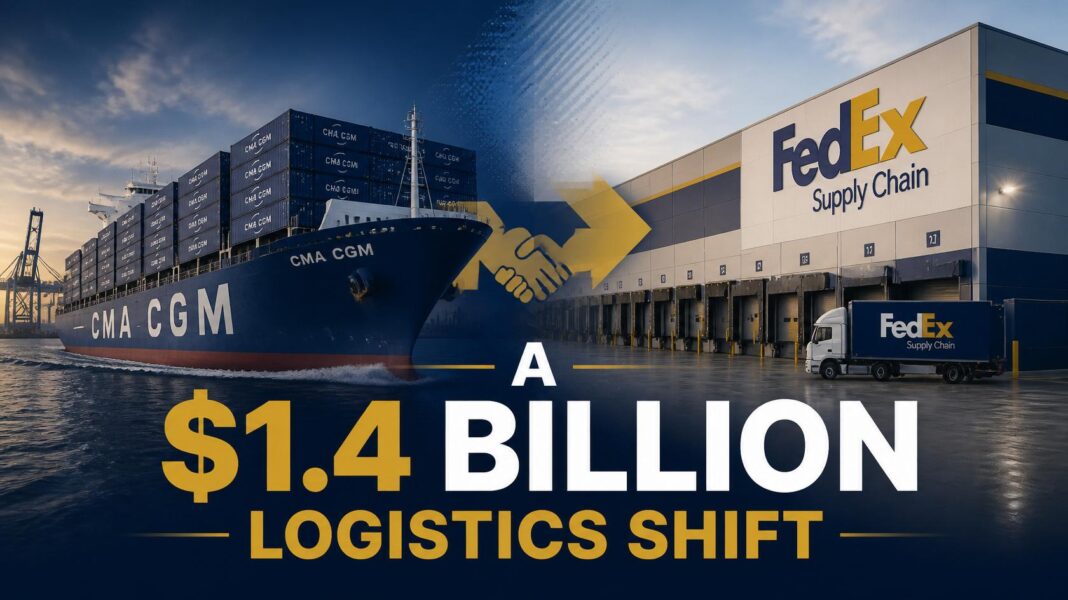
Oslo,July 3, 2026: Container shipping giant CMA CGM Group has confirmed a deal to acquire FedEx Supply Chain, the contract logistics arm of FedEx Corp, at an enterprise value of $1.4 billion.
The agreement, announced on July 1, 2026, will fold FedEx‘s warehousing and contract logistics operations into CEVA Logistics, CMA CGM’s logistics subsidiary, and is expected to close later this year.
On the surface, this is a North American warehousing story. Underneath it, however, is a much bigger shift: the world’s third-largest ocean carrier is doubling down on its bet that owning the entire supply chain — ports, ships, trucks, warehouses, air cargo and data — beats owning just the ships.
For freight buyers, forwarders and logistics planners in Africa, that bet matters more than it might first appear.
| Quick Facts: The CMA CGM–FedEx Supply Chain Deal ● Buyer: CMA CGM Group, via its logistics subsidiary CEVA Logistics ● Seller: FedEx Corp (FedEx Supply Chain unit) ● Deal value: $1.4 billion enterprise value ● Announced: July 1, 2026 ● Expected close: Later in 2026, subject to regulatory approval ● Workforce added: Nearly 10,000 FedEx Supply Chain employees join CEVA ● Combined footprint: Approximately 150 warehouses and 20,000 people across 240+ North American locations ● Related agreements: Phased-in air and ocean freight commercial arrangements between CMA CGM and FedEx, rolling out through 2028 |
Confirming the Details
The acquisition was jointly announced by CMA CGM Group and FedEx Corp on July 1, 2026, and confirmed through official statements published by both companies alongside coverage from Axios, the Journal of Commerce, FreightWaves and Global Trade Magazine.
FedEx Supply Chain — the unit being sold — handles contract warehousing, fulfillment and value-added logistics services, distinct from FedEx’s core parcel and express delivery network, which FedEx retains.
Once the deal closes, CEVA Logistics will absorb FedEx Supply Chain’s assets and close to 10,000 team members.
Combined with CEVA’s existing North American operations, the enlarged unit will operate roughly 150 warehouses and employ around 20,000 people across more than 240 locations — nearly tripling the size of CEVA’s contract logistics business in North America.
| “The acquisition and partnership with FedEx represent a major step in the development of CEVA Logistics and our logistics activities in North America. We are strengthening our ability to provide customers with integrated supply chain solutions.”
— Rodolphe Saadé, Chairman and CEO, CMA CGM Group |
On the FedEx side, the divestment is explicitly framed as a sharpening of focus. FedEx president and CEO Raj Subramaniam said the move allows the company to increase its focus on high-value verticals including healthcare, automotive, aerospace and data centers, streamlining its core parcel and express business rather than running a sprawling contract logistics arm alongside it.
Beyond the warehousing handover, the two companies have also agreed to phase in commercial air and ocean freight arrangements between now and 2028 — a signal that this deal is not a clean break between CMA CGM and FedEx, but the start of a longer commercial relationship spanning multiple transport modes.
Why This Is Bigger Than a Warehousing Deal
CMA CGM’s move into contract logistics did not start with FedEx Supply Chain. T
he French carrier acquired CEVA Logistics outright in March 2019, then spent the following years building it out through a string of acquisitions: Ingram Micro’s Commerce & Lifecycle Services and Colis Privé, along with GEFCO and Spedag Interfreight in 2022, and Bolloré Logistics in 2024.
Today, CEVA ranks among the world’s top five third-party logistics providers, running roughly 1,000 warehouses globally and processing 15 million shipments in 2025 alone.
The FedEx transaction fits squarely into that pattern, and it also reinforces a pledge CMA CGM chairman Rodolphe Saadé made to U.S. President Donald Trump during a 2025 Oval Office meeting: to invest $20 billion in the United States over four years.
Buying FedEx Supply Chain is one of the more concrete steps yet toward that commitment, and it lands at a moment when ocean carriers globally are racing to control more of the supply chain, not just the leg between two ports.
That strategic logic is the real story here. Ocean freight margins are volatile and cyclical, tied tightly to global trade volumes and vessel capacity. Contract logistics — warehousing, fulfillment, inland distribution — is stickier, contract-based, and less exposed to freight rate swings.
By controlling more of a shipment’s journey from factory floor to end customer, including the data generated along the way, CMA CGM can deepen customer relationships and capture margin at multiple points in the chain rather than just the ocean leg.
The Numbers at a Glance
| Metric | Before the Deal | After the Deal (Expected) |
| CEVA North America warehouses | ~50 (estimated, pre-deal share) | ~150 combined |
| CEVA North America workforce | ~10,000 (estimated, pre-deal share) | ~20,000 across 240+ locations |
| Deal structure | — | $1.4B enterprise value, cash acquisition |
| Expected closing | — | Later in 2026, pending regulatory approval |
| Related commercial pacts | — | Air & ocean freight agreements phasing in through 2028 |
Note: Pre-deal North American figures are derived from the reported post-deal totals (approximately 150 warehouses and 20,000 employees) and the disclosed near-tripling effect of the acquisition; CMA CGM and CEVA have not published a separate pre-deal North American breakout.
What It Means for FedEx
For FedEx, the sale is consistent with a broader trend among global express and parcel carriers: narrowing focus rather than trying to be everything to everyone.
Running a large contract logistics and warehousing arm alongside a global parcel network ties up capital and management attention that could otherwise go toward FedEx’s core express business and the higher-margin vertical specializations Subramaniam highlighted — healthcare, automotive, aerospace and data center logistics.
Divesting Supply Chain also brings in $1.4 billion in enterprise value that FedEx can redeploy.
What It Means for CMA CGM and CEVA
For CMA CGM, the deal instantly makes CEVA one of the dominant contract logistics operators in North America, a market it has been building toward for years through the GEFCO, Bolloré and Spedag Interfreight acquisitions.
It also gives CEVA a much larger US customer base and warehousing footprint just as nearshoring and supply chain diversification continue to reshape North American freight flows.
Combined with the phased air and ocean freight agreements running through 2028, CMA CGM is positioning itself less as a shipping line that also does logistics, and more as an integrated logistics operator that happens to own ships.
| CMA CGM’s Logistics Buildout: A Quick Timeline
● 2019 — CMA CGM acquires CEVA Logistics outright, moving CEVA’s HQ to Marseille ● 2020 — CEVA acquires AMI Worldwide, expanding into East and Southern Africa ● 2022 — CEVA integrates Ingram Micro CLS, Colis Privé, GEFCO and Spedag Interfreight ● 2024 — CEVA absorbs Bolloré Logistics, strengthening its Maghreb and Sub-Saharan Africa footprint ● 2025 — Saadé pledges $20 billion in US investment over four years ● 2026 — CMA CGM agrees to acquire FedEx Supply Chain for $1.4 billion, nearly tripling CEVA’s North American contract logistics business |
The Africa Angle: Why This Still Matters on the Continent
CMA CGM is not a distant player in African trade — it is arguably the most entrenched global carrier on the continent, with more than 50 years of presence, over 90 offices across more than 50 African countries, and calls at more than 80 African ports.
CEVA Logistics, its logistics arm, now operates in 40 African countries with a direct presence in 23 of them across more than 60 locations, and has been actively expanding its West, Central and East African networks through new agencies in Guinea, Gabon and the Republic of the Congo, alongside earlier moves in Ethiopia, Egypt, Mauritania and Cameroon.
None of the FedEx Supply Chain assets are in Africa — this is a North American transaction. But scale acquired anywhere in CMA CGM’s logistics network tends to filter down into the group’s broader integrated-logistics playbook, the same playbook CEVA has been applying to African port-to-hinterland corridors, warehousing hubs like the new Kribi facility in Cameroon, and multimodal rail and road solutions across the continent.
A financially stronger, more diversified CEVA — one with a much larger US contract logistics base and deeper ties to a major US parcel carrier — has more capital and expertise to keep investing in African infrastructure, from the group’s reported €700 million Mombasa terminal modernization to its Abidjan regional office consolidating commercial and intermodal operations for the whole continent.
For African importers and exporters, the more immediate takeaway is structural: the world’s largest logistics groups are consolidating around end-to-end control of freight — ocean, air, inland transport, warehousing and the data that ties it together.
Shippers who rely on fragmented, single-mode providers may increasingly find themselves competing for capacity and service levels against customers plugged into these integrated networks.
Understanding how carriers like CMA CGM are restructuring globally is, increasingly, a prerequisite for planning African supply chains intelligently.
Risks and Open Questions
- Regulatory approval: The deal is expected to close later in 2026, but remains subject to customary regulatory clearances in the US and potentially other jurisdictions.
- Integration risk: Merging FedEx Supply Chain’s nearly 10,000 employees and its warehouse network into CEVA’s systems, technology stack and client relationships is a significant operational undertaking, and past large-scale 3PL integrations in the industry have had mixed track records.
- Customer transition: FedEx Supply Chain’s existing clients will need to adjust to a new corporate parent with different systems, pricing structures and service models.
- Competitive response: Rivals such as DHL Supply Chain, DSV, Kuehne+Nagel and Maersk’s logistics arm are likely to respond with their own consolidation moves, intensifying competition for large contract logistics accounts globally.
The Bottom Line
The CMA CGM–FedEx Supply Chain deal is a $1.4 billion transaction on paper, but its real significance lies in what it confirms about the direction of global logistics: ocean carriers are becoming end-to-end supply chain operators, express carriers are narrowing back toward their core networks, and scale in contract logistics is increasingly seen as a strategic necessity rather than a side business.
For a group with CMA CGM’s depth of investment in Africa, a stronger, more capitalized CEVA Logistics is a development worth watching well beyond North America’s warehouses.
Also Read
Top AI Warehouse Management Software Solutions in 2026: Features, Pricing & Use Cases
Ceva Logistics seeks to become major player in Africa

- Maersk and Viaservice Target Working Capital Challenge in Kenya’s Container Logistics Sector - August 20, 2026
- South Africa’s Special Economic Zones: 2026 Guide to SEZs, Ports, Logistics and Investment - August 16, 2026
- Africa’s Container Shipping Outlook: Why Freight Capacity Could Stay Tight Through 2026 - August 15, 2026

