

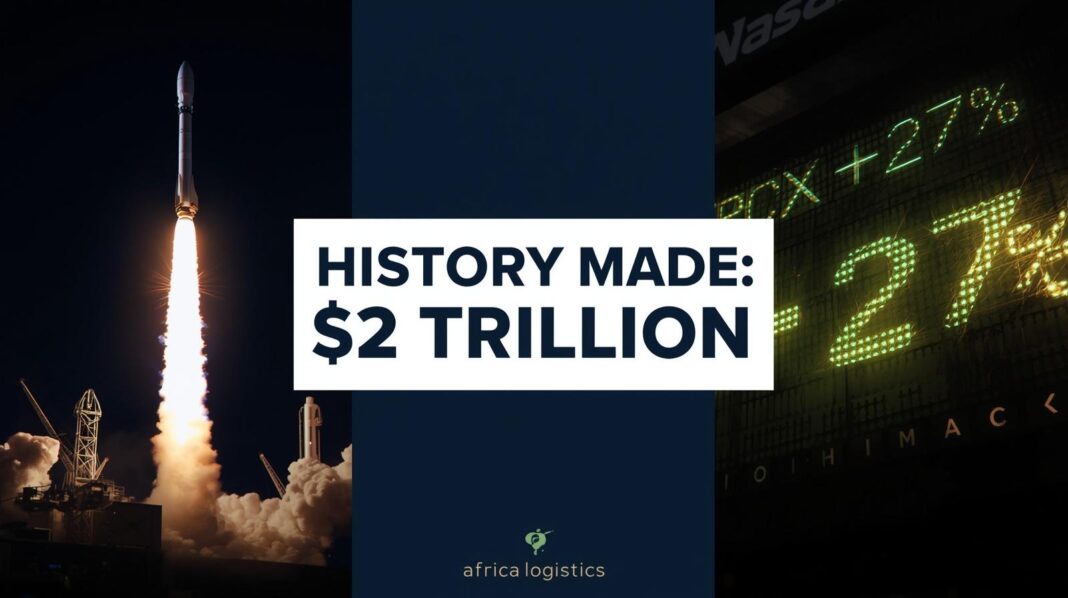
FAST FACTS: SPCX DEBUT
| Metric | Value |
|---|---|
| IPO Price | $135 per share |
| Opening Trade | $150 per share (+11%) |
| Intraday High | $176.52 |
| Current Trading | ~$171 |
| Valuation at Open | $2 trillion+ |
| Capital Raised | $75 billion (record) |
| Shares Sold | 556 million |
| Retail Allocation | ~30% (vs. typical 5–10%) |
| Ticker / Exchange | SPCX / Nasdaq |
The largest initial public offering in stock market history has arrived. Elon Musk’s Space Exploration Technologies Corp — SpaceX — began trading on the Nasdaq on Friday, 12 June 2026, under the ticker SPCX, setting off a frenzy of retail and institutional buying that pushed the company’s market capitalisation above $2 trillion and created the world’s first trillionaire.
For Africa’s construction, infrastructure, and logistics sectors, the debut is more than a Wall Street spectacle.
Starlink, the satellite internet division that drives more than half of SpaceX’s revenues, is expanding aggressively across the continent — and its future growth trajectory is now publicly accountable in ways it has never been before.
“SpaceX wants to be able to take you to the moon. I am confident, with the incredible team we have here, that we will do that for you.” — Elon Musk, Nasdaq opening bell, 12 June 2026
The Numbers That Made History
SpaceX priced its IPO at $135 per share on 11 June, selling 556 million shares and raising $75 billion — nearly triple the $29 billion raised by Saudi Aramco in 2019, the previous record-holder.
At that pricing, the company entered public markets valued at roughly $1.77 trillion, already surpassing Tesla on day one.
Trading opened at $150 per share just after 11:46 AM Eastern time, an immediate 11% premium over the IPO price, and the stock subsequently climbed to an intraday high of $176.52 before retreating to trade around $171 in afternoon sessions. SpaceX’s valuation at peak trading comfortably exceeded $2 trillion.
Citadel Securities reported that it processed more retail investor activity for the SpaceX IPO auction than for any other IPO on record. Robinhood, the popular retail trading app, experienced outages from the surge of traffic — an indicator of the exceptional retail participation the offer generated.
Musk Becomes the World’s First Trillionaire
With SpaceX’s market capitalisation crossing the $2 trillion mark, Elon Musk’s personal net worth surged above $1 trillion, a milestone no individual had previously reached in recorded financial history.
Musk jointly rang the Nasdaq opening bell from SpaceX’s Starbase headquarters in Texas, addressing a crowd of employees who witnessed the culmination of a 24-year journey from a startup he gave less than a 10% chance of survival.
SpaceX was incorporated in 2002 with an ambition to reduce the cost of space access and ultimately make humanity multi-planetary.
Today, it is the operator of the world’s most reliable orbital rocket, the Falcon 9 Block 5, the builder of the Starship V3 — the largest rocket ever flown — and the operator of the world’s largest satellite constellation.
Starlink: The Engine Beneath the Rocket
For investors and Africa watchers alike, understanding SpaceX’s IPO means understanding Starlink.
According to figures disclosed in the company’s S-1 prospectus filed with the US Securities and Exchange Commission on 20 May 2026, Starlink’s Connectivity segment generated approximately $7.2 billion in adjusted EBITDA — up 86% year over year — and represented the dominant earnings contributor to the overall business.
Starlink reached more than 10.3 million subscribers across more than 155 countries by the end of 2025, doubling its subscriber base for two consecutive years.
Total SpaceX revenue for 2025 came in at $18.67 billion, with Starlink contributing an estimated 67% of that figure.
However, a notable pressure point was disclosed: average revenue per Starlink user fell to $66 per month in Q1 2026, down from $86 a year earlier and $99 in 2023.
The decline reflects a deliberate expansion strategy into price-sensitive markets including Africa, South-East Asia, and Latin America, where subscriptions are priced below US rates to match local purchasing power. The strategy has delivered volume growth but compresses margins.
What This Means for Africa
Buried within SpaceX’s 277-page IPO prospectus is a stated mission to bridge the digital divide — and Africa sits squarely at the centre of that ambition.
The continent’s connectivity gap is not primarily a coverage problem; it is an affordability problem. Satellite internet has generated substantial interest across African markets precisely because terrestrial fibre buildout has been slow and uneven.
For African operators in construction, agriculture, and logistics, Starlink’s public listing changes the calculus in important ways.
As a publicly traded company, SpaceX will now face quarterly earnings scrutiny, and the pressure to grow Starlink revenues will translate directly into competitive pricing and service expansion across emerging markets — including Kenya, South Africa, Nigeria, and Uganda, where CCE News’s readership is concentrated.
A competitive threat is also emerging. China’s Spacesail satellite internet company, which launched its reusable rocket on 1 June 2026 and has registered trademarks in South Africa, is eyeing the same price-sensitive African markets that Starlink is pursuing.
As subscriber competition intensifies, African users and businesses could benefit from further price reductions and improved service levels.
xAI, Grok, and the Controversy Investors Are Watching
SpaceX’s IPO carries a complexity that goes beyond launch vehicles and satellite internet. In February 2026, SpaceX acquired Elon Musk’s artificial intelligence startup, xAI, folding in its Grok AI models, data centres, and the X social media platform.
This merger means SPCX investors are also exposed to xAI’s liabilities — including ongoing regulatory investigations and lawsuits related to Grok’s AI-generated content.
Protest groups in New York were visible on the eve of the IPO, with critics warning that investors were effectively underwriting AI liabilities that remain unquantified.
The S-1 prospectus acknowledged that the AI business generated a net loss of nearly $2.6 billion in 2025.
For construction and infrastructure sector investors considering SPCX as part of a diversified portfolio, these AI-related risk factors warrant careful scrutiny alongside the core space and connectivity business.
Related Stocks and Market Spillover
The SpaceX IPO created significant waves across adjacent equities. EchoStar Corporation, which holds an estimated 3% stake in SpaceX, surged 11% on Thursday and extended those gains by a further 5% in Friday’s session, with options volume running more than eleven times its 30-day average.
AST SpaceMobile, a competitor in the satellite broadband space, jumped 12% Thursday on nearly $140 million in options activity.
Broader market rotation was also visible. According to data provider VandaTrack, retail investors pulled back from AI-adjacent stocks including Micron, Advanced Micro Devices, and Marvell Technology ahead of the SpaceX debut, redirecting capital into SPCX-related positions.
Investor Outlook: Opportunity and Caution
At its IPO pricing, SpaceX was valued at approximately 94 times 2025 revenues — a premium that reflects future growth expectations rather than current earnings.
The company’s core connectivity business is highly profitable, but the AI and xAI integration has introduced losses that weigh on net income.
Retail investors in Africa and globally who participated in the 30% retail allocation should weigh the long-term infrastructure thesis against near-term valuation risk.
For African construction and logistics operators, SpaceX’s transition to a public company is ultimately welcome news: it introduces competitive accountability into the satellite broadband market, incentivises service expansion into underserved regions, and provides a mechanism — through public shareholding — for participating in the infrastructure buildout that is transforming connectivity on the continent.
With over $75 billion raised and a valuation north of $2 trillion, SpaceX’s Nasdaq debut is not just the biggest IPO in history — it is a defining event for the future of African digital infrastructure.
Key Dates and Context
- April 2026: SpaceX confidentially filed with the US SEC
- 20 May 2026: Public S-1 prospectus filed; SpaceX revenues and Starlink metrics disclosed
- 1 June 2026: China’s Spacesail launched its first reusable rocket with 200 satellites in orbit
- 8 June 2026: SpaceX roadshow kicked off with strong demand from institutional investors
- 11 June 2026: IPO priced at $135 per share; 556 million shares sold; $75 billion raised
- 12 June 2026: SPCX begins trading on Nasdaq — opens at $150, peaks at $176.52
This article is for informational purposes only and does not constitute financial advice. CCE News does not hold positions in SPCX or related securities.
Also Read
Air Zimbabwe Targets July 2026 Return to London Through ACMI Partnership With Plus Ultra

- The Mega Logistics Behind FIFA World Cup 2026:How Three Countries Coordinate a Single Tournament - June 12, 2026
- SpaceX Goes Public: $2 Trillion Debut Makes History — And Rewrites the Rules for Africa’s Digital Future - June 12, 2026
- SASSA JULY 2026 GRANT PAYMENT DATES: Full Schedule Confirmed Older Persons, Disability, Children’s Grants and SRD - June 12, 2026

 made its Nasdaq debut on 12 June 2026, raising a record $75 billion and valuing the company above $2 trillion, making Elon Musk the world's first trillionaire. CCE News examines what Africa's construction, logistics, and infrastructure sectors need to know about Starlink's growing role on the continent.)