
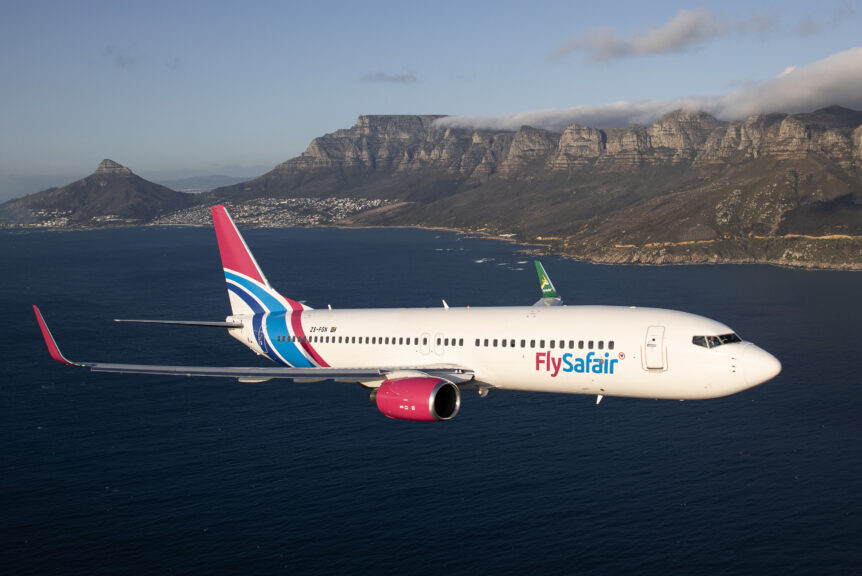
South Africa’s most popular low-cost airline is back with its annual birthday giveaway — but the small print on this year’s sale tells a much bigger story about the state of African aviation economics.
FlySafair launched its Birthday Sale on Wednesday, 6 May 2026, placing 50,000 one-way seats at a base fare of R12 across its domestic network, available exclusively through flysafair.co.za from 9am.
The sale has become one of the most anticipated consumer events in South Africa’s aviation calendar.
This year, however, it arrives with a significant structural change that signals the financial pressures squeezing the industry.
The Fuel Surcharge That Changes Everything
For the first time, airport taxes and applicable fuel surcharges will be added on top of the R12 base fare, a departure from previous years driven by jet fuel shortages linked to the ongoing Middle East conflict.
FlySafair confirmed that all charges will be clearly displayed throughout the booking process, consistent with its commitment to transparent pricing.
For Africa Logistics readers, this detail deserves more than a footnote.
The decision to separate the base fare from fuel costs is not a gimmick — it is a direct reflection of the cost volatility that has been reshaping air cargo, charter, and business aviation across the continent throughout 2025 and into 2026.
When South Africa’s most efficient domestic carrier — one built on a model of lean operations and competitive pricing — has to restructure a flagship promotional event around fuel costs, it confirms what freight and logistics operators have been experiencing on the ground for months.
What the Waiting Room Reveals About Demand
The sale uses a randomised waiting room system to manage traffic volume. Customers who gain entry are allocated a 10-minute window to complete their booking; missing that window means losing the spot.
The system is designed to prevent website crashes and ensure fair access, with FlySafair describing entry as entirely based on chance rather than login time.
The intensity of demand this system is built to manage is itself a data point. South African consumers are under significant airfare pressure, and with regular ticket prices having climbed sharply — economy fares to London reportedly reaching R50,000 in some cases — the appetite for deeply discounted domestic travel remains extreme.
For logistics companies operating mixed fleets of road and air freight, the implication is clear: route economics that once made air viable for time-sensitive domestic cargo are under sustained pressure.
The Broader Aviation Cost Picture
FlySafair’s birthday sale has always functioned as a kind of annual temperature check on South African aviation.
The airline pioneered ultra-low-cost domestic flying when it launched in 2014, and its pricing discipline has historically forced competitors to sharpen their own fares.
That discipline is now being tested by the same global forces affecting every carrier on the continent.
Middle East supply disruptions have pushed jet fuel costs higher across African aviation markets, compounding already elevated costs from rand volatility and infrastructure levies at major South African airports.
These pressures do not stay contained to passenger travel. Air cargo rates, charter costs, and the economics of rapid-delivery logistics corridors — Johannesburg to Cape Town, Johannesburg to Durban, Cape Town to George — all move in the same direction when jet fuel moves.
Logistics Implications
For supply chain planners and freight operators watching this space, the FlySafair sale offers three practical insights for 2026 planning:
First, domestic air freight cost bases will remain elevated.
If a carrier optimised for low-cost passenger operations cannot absorb fuel surcharges into promotional pricing, operators of cargo and charter services will face even steeper challenges in holding rates steady.
Second, demand for road freight alternatives on short-haul corridors may increase. As air becomes more expensive, shippers will reassess the cost-versus-speed calculation on routes where trucking or rail can deliver within acceptable windows.
Third, South Africa’s airport infrastructure costs remain a structural issue. The taxes and levies added to FlySafair’s R12 base fare reflect charges that apply equally to every aircraft movement — commercial, cargo, or charter — at South African airports.
These are not temporary surcharges; they are a fixed cost layer built into every logistics decision involving air.
Sale Details for Reference
For staff or business travellers looking to take advantage of the offer: the sale runs exclusively on flysafair.co.za, with 50,000 one-way seats available.
The FlySafair app remains available for standard bookings. Customers are advised to use only official FlySafair channels and to avoid third-party links or social media promotions, which may be fraudulent.
The Birthday Sale will run until all R12 seats are sold — historically a matter of hours.
Also Read
Delta Air Lines Quietly Axes Snacks and Drinks on Short-Haul Flights

- Inside Isuzu’s Plan to Make South Africa the Truck Manufacturing Hub for Africa - October 12, 2026
- UPF Group Expands African Logistics Network with New Rwanda Office - September 18, 2026
- DP World’s Africa Network Is Growing While Jebel Ali Takes a Heavy Hit - August 15, 2026

