
On 11 June 2026, at the 83,000-seat Estadio Azteca — the only stadium to host World Cup matches across three editions — the opening whistle marked the start of what is widely regarded as the most complex sporting logistics operation ever staged.
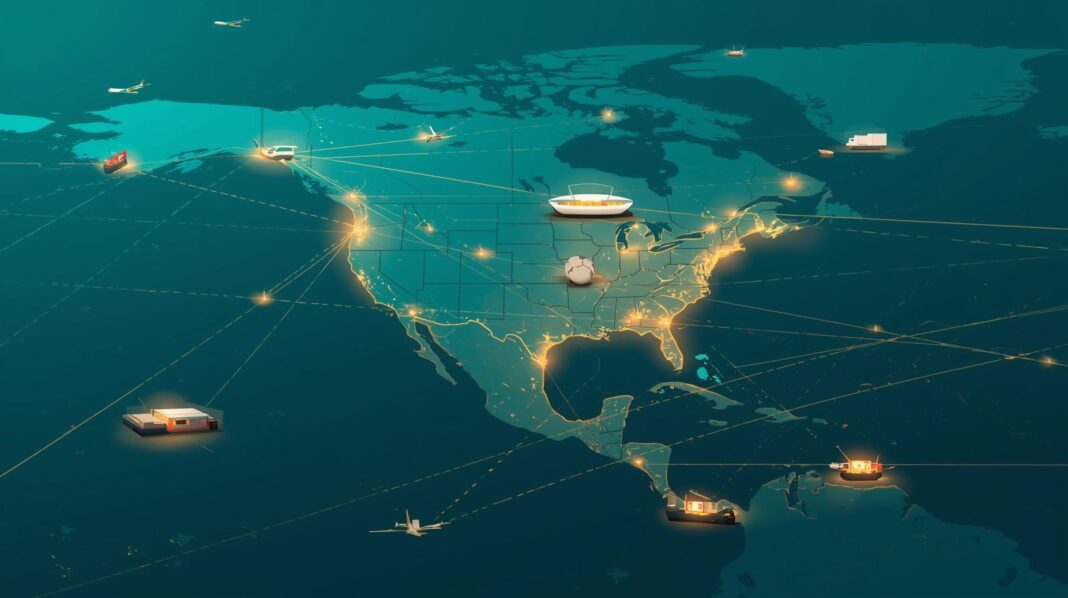
The FIFA World Cup 2026 is not only the largest tournament in football history; it is a live, continental-scale stress test of tri-national supply chains, customs systems, aviation networks, security coordination, and digital infrastructure.
For the first time, a single World Cup spans three sovereign nations — the United States, Canada, and Mexico — across 16 cities, 16 stadiums, 48 teams, and 104 matches, a 63% increase on Qatar 2022.
Ticket demand is projected at around 6 million, nearly double the previous tournament. But unlike Qatar, where venues were within short travel distance, 2026 stretches across a continent.
Fans moving between New York, Los Angeles, Toronto, Mexico City, and Kansas City must rely on air travel spanning thousands of kilometres and multiple time zones.
The result is a tournament where logistics is not a supporting function — it is the backbone. Freight, immigration, transport, security, and broadcasting systems must operate in sync across three regulatory environments simultaneously.
As one logistics executive put it, this is “the largest coordinated sporting operations network ever assembled.”
1. Tri-Nation Logistics Coordination
Cross-Border Freight and Customs
The backbone of the tournament is the movement of broadcasting equipment, staging systems, medical supplies, merchandise, and infrastructure across three customs regimes. FIFA appointed Rock-it Cargo as its primary logistics partner, reflecting the scale of cross-border freight complexity.
Each shipment must navigate US, Canadian, and Mexican customs frameworks, each with different documentation rules, tariff systems, and inspection protocols. To reduce friction, organisers are relying heavily on temporary import systems such as ATA Carnets, allowing equipment to move without triggering full customs duties.
Even minor delays can cascade across venues because infrastructure is deployed on tight, rotating schedules. Customs coordination between US Customs and Border Protection, Canadian authorities, and Mexico’s immigration and trade agencies has required unprecedented pre-event alignment.
Immigration and Fan Mobility
Fan movement is equally complex. Mexico has introduced visa exemptions for travellers holding valid visas or residency from several major regions, reducing administrative bottlenecks. Canada has streamlined entry through eTA and visitor visa systems, while also expanding use of trusted traveller programs like NEXUS.
Digital platforms such as ArriveCAN and Mexico’s Viajero Confiable system allow pre-clearance before arrival, turning border processing into a largely digital workflow. Despite these improvements, the scale of simultaneous arrivals across six weeks will test immigration systems continuously.
2. Security and Multi-Jurisdiction Risk
Security coordination spans three national governments, multiple federal agencies, and 16 local host-city command structures. Each venue operates integrated systems combining police, federal security bodies, private contractors, and FIFA security units.
The challenge is interoperability. US, Canadian, and Mexican security agencies operate under different legal frameworks and communication protocols. Aligning them into a real-time shared response system across continents is unprecedented in sport.
Analysts often compare the footprint to managing dozens of Super Bowls simultaneously across different countries. Each host city maintains a dedicated command centre, supported by shared intelligence platforms and coordinated escalation procedures.
3. Stadium Network and Infrastructure
The tournament uses 16 existing stadiums across North America — 11 in the United States, 3 in Mexico, and 2 in Canada. Unlike Qatar 2022, which required large-scale construction, 2026 leverages existing NFL, MLS, CFL, and Liga MX venues.
However, upgrades remain significant. Several stadiums require temporary natural grass systems installed over artificial turf bases, engineered for FIFA pitch standards. These hybrid systems must be installed, maintained, and removed within strict time windows across multiple venues simultaneously.
Total stadium-related and supporting infrastructure investment is estimated at around $2 billion, including transport upgrades, communications systems, and urban mobility enhancements.
Transport Investment
The US federal government has allocated hundreds of millions of dollars toward transit and security infrastructure. Cities like Seattle, Atlanta, and Kansas City have accelerated rail and shuttle expansions to handle large match-day crowds.
Kansas City alone expects up to 650,000 visitors and has invested heavily in healthcare, transit, and event logistics systems. Across host cities, private vehicles are restricted near stadium zones, shifting demand toward public transport and structured shuttle networks.
4. Broadcast and Commercial Supply Chains
Global Broadcasting Infrastructure
World Cup broadcasting is one of the largest temporary media deployments in global sport. Each stadium requires fibre connections, satellite uplinks, production zones, and commentary infrastructure for global media partners.
Shipping, customs clearance, installation, and breakdown cycles must be precisely timed across 16 venues. This makes broadcasting logistics a parallel mega-operation within the tournament itself.
Sponsor and Merchandise Networks
Global sponsors including major sportswear and technology brands must distribute branded materials, retail stock, and activation assets across three countries under compressed timelines.
The official match ball — the Adidas Trionda — is part of a wider manufacturing and distribution chain involving millions of replicas, apparel items, and licensed merchandise.
Retail logistics face particular pressure due to customs delays, cross-border replenishment constraints, and high demand concentration in host cities.
Food and Hospitality Systems
Food and beverage supply chains represent one of the most stressed logistics segments. Feeding millions of fans across fan zones, stadiums, and hospitality venues requires tightly coordinated cold-chain logistics and just-in-time delivery systems.
Hotels and restaurants in host cities are operating at near-maximum occupancy levels, placing additional strain on staffing, inventory, and distribution networks.
5. Fan Mobility Across a Continent
Air Travel Dependency
Unlike compact tournaments, 2026 depends heavily on aviation. Fans following teams across cities may take multiple domestic flights spanning time zones. This creates one of the largest temporary demand spikes in North American airline history.
Airlines are responding with increased frequency, dynamic pricing, and partnerships between international carriers and domestic networks. Airports across host cities have expanded terminal capacity and passenger processing systems.
Ground Transport Systems
Urban mobility is being reshaped around the tournament. Federal transit funding supports match-day shuttle systems and rail expansions. Cities are prioritising public transport access over private vehicles near stadiums.
Last-mile connectivity is being enhanced through digital tools, shuttle coordination, and structured traffic exclusion zones.
6. Technology-Driven Operations
Technology is central to logistics coordination. Lenovo is providing digital twin systems for all 16 stadiums, allowing real-time simulation of crowd flows, security bottlenecks, and evacuation scenarios.
Artificial intelligence systems aggregate data from transport networks, stadium sensors, and security feeds to enable predictive operations. These systems help anticipate congestion, adjust staffing, and optimise match-day flows.
The tournament also integrates advanced ball-tracking technology. Sensor-equipped match balls feed real-time data into semi-automated officiating systems, making this one of the most technologically advanced sporting events ever staged.
Cybersecurity is equally critical. With interconnected digital systems across three countries, protecting ticketing platforms, broadcast feeds, and operational networks is a core logistics function rather than a back-end concern.
7. Economic and Environmental Logistics
Hospitality and Retail Pressure
Host cities are experiencing unprecedented demand for accommodation and retail services. Hotels are operating at sustained peak capacity, requiring large-scale coordination of food, linens, staffing, and logistics supply chains.
Retailers are pre-positioning inventory in local warehouses to avoid cross-border delays, as just-in-time systems become increasingly vulnerable under customs pressure.
Environmental Impact
The environmental footprint is significant. Studies estimate total emissions between 7.8 and 9 million tonnes of CO2 equivalent, with most emissions driven by fan travel.
Approximately 87% of the carbon footprint comes from transportation, particularly air travel between host cities. The absence of high-speed rail alternatives across North America is a key structural factor.
While stadium reuse reduces construction emissions compared to Qatar 2022, overall travel emissions dominate the footprint.
8. Security and Risk Management
Each host city operates multi-agency command structures integrating local police, federal agencies, and FIFA security teams. Coordinating responses across jurisdictions requires shared protocols and real-time communication systems.
Physical security includes restricted stadium perimeters, biometric ticketing, surveillance systems, and controlled access zones.
Emergency planning covers medical surges, weather disruptions, crowd evacuation scenarios, and transport breakdowns affecting thousands of passengers simultaneously.
9. The Largest Sporting Logistics System Ever Built
The 2026 World Cup represents a structural shift in how global sporting events are organised. Unlike previous tournaments concentrated within single cities or countries, this is a distributed continental network.
It combines tri-national customs systems, aviation-heavy fan mobility, digital twin stadium management, AI-driven operations, and real-time cross-border coordination across 16 cities.
From freight forwarding and immigration systems to broadcasting and hospitality logistics, nearly every operational layer is being tested at maximum global scale.
The infrastructure built for the tournament — transport upgrades, digital systems, and security coordination frameworks — will leave a lasting legacy.
But the defining feature of FIFA 2026 is not just what is being built, but how many systems must operate in perfect synchrony across three countries at once.
In the history of sport, no event has required this level of logistical integration across geography, governance, and technology. FIFA World Cup 2026 is not just a tournament — it is a continental logistics machine operating in real time.
Also Read
The Ports That Adapt Fast Have One Thing in Common
The Corridor That Could Rewrite West African Logistics

- Inside Isuzu’s Plan to Make South Africa the Truck Manufacturing Hub for Africa - October 12, 2026
- UPF Group Expands African Logistics Network with New Rwanda Office - September 18, 2026
- DP World’s Africa Network Is Growing While Jebel Ali Takes a Heavy Hit - August 15, 2026

