
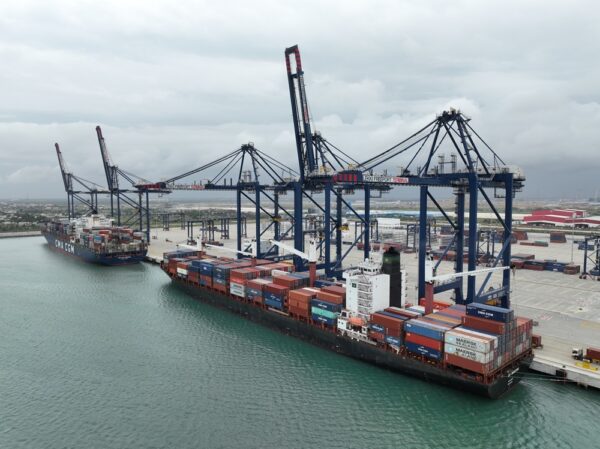
When the first vessels berthed at Lekki Deep Sea Port in early 2023, few in Nigeria’s maritime industry doubted that the facility would matter.
What has become clearer since is just how much it matters, and how quickly.
Built on 90 hectares inside the Lagos Free Zone at a reported cost of roughly $1.6 billion, Lekki Port is Nigeria’s first fully automated deep sea port and the country’s deepest, with a 16.5-metre draft that allows it to receive vessels no other Nigerian terminal can handle.
By 2025, according to the Nigerian Ports Authority’s Operational Performance Report, it had overtaken every legacy terminal — including Apapa and Onne — to become Nigeria’s leading port by cargo throughput, handling 40.6 percent of the nation’s total volumes.
This article examines what Lekki Port is, how it is specified, the economic effects it has produced since opening, its position in the broader West African port landscape, the operational challenges that remain, and where the project goes from here.
1. What Is Lekki Deep Sea Port?
Lekki Deep Sea Port is a multipurpose deep sea terminal located in the Lagos Free Zone, roughly 65 kilometres east of Lagos Island along the Lekki-Epe corridor.
It is Nigeria’s first fully automated port and its largest, and it is widely described as one of the biggest single private infrastructure investments in the country’s history.
Location
The port sits inside the Lagos Free Zone, a purpose-built industrial and logistics enclave that gives importers and exporters direct access to warehousing, light manufacturing, and free-zone tax incentives alongside quayside operations.
Ownership
Lekki Port LFTZ Enterprise Limited (LPLEL) holds the concession. Ownership is split primarily between Singapore-based Tolaram Group and China Harbour Engineering Company (CHEC), with the Lagos State Government and the Nigerian Ports Authority (NPA) holding minority stakes.
Container operations are run by Lekki Freeport Terminal, in which CMA CGM Group holds a controlling interest — a structure that gives the port a direct pipeline into one of the world’s largest container shipping networks.
Investment Cost
The project’s total investment is commonly cited at approximately $1.6 billion, funded through a mix of sponsor equity and debt, including financing support from the China Development Bank.
It stands as one of the largest single infrastructure investments — public or private — in Nigeria’s history.
Draft Depth
At 16.5 metres, Lekki’s draft is deeper than any other Nigerian port, and deeper than most terminals in West Africa.
This is the single specification that most differentiates Lekki from Apapa and Tin Can Island: it allows ultra-large container vessels to call directly rather than transshipping through hub ports outside the country.
Container Capacity
The container terminal is designed for a throughput of 2.5 million TEUs a year, delivered across a 1.2-kilometre quay served by super post-Panamax ship-to-shore cranes and rubber-tyred gantry cranes.
Why It Was Built
Nigeria’s older ports — chiefly Apapa and Tin Can Island — were constrained by shallow drafts, congested access roads, and decades of underinvestment, forcing much of Nigeria’s cargo to transship through Cotonou, Lomé, Tema, and other regional hubs before reaching Nigerian consumers and manufacturers.
Lekki Port was conceived to reverse that pattern: to let Nigeria receive large vessels directly, cut logistics costs, and recapture some of the cargo and revenue that had been leaking to neighbouring countries.
2. Key Specifications
| Feature | Details |
| Location | Lagos Free Zone, Lekki, approximately 65km east of Lagos Island |
| Draft | 16.5 metres — the deepest of any Nigerian port |
| Capacity | 2.5 million TEUs annually (container terminal) |
| Quay Length | 1.2 kilometres |
| Largest Vessel | 15,000+ TEU vessels; ultra-large container ships up to 61.5m beam |
| Operator | Lekki Freeport Terminal (CMA CGM Group, via its terminal operating arm) |
| Ownership | Tolaram Group and China Harbour Engineering Company (CHEC), with Lagos State Government and NPA stakes |
| Commercial Start | April 2023 |
3. Economic Impact Since Opening
The clearest evidence of Lekki Port’s impact is in the NPA’s own data. Nigeria’s total port cargo throughput rose 24.8 percent year-on-year in 2025, from about 103.6 million metric tons to over 129.3 million metric tons, with Lekki alone accounting for 40.6 percent of that volume — more than Onne (19.1 percent) and Apapa (16.7 percent) combined.
Container traffic nationally grew 25.7 percent to more than 2.1 million TEUs, and transshipment containers surged 205.8 percent, a strong signal that Lekki is starting to pull hub-port activity back into Nigeria rather than losing it to neighbours.
Reduced Congestion
Lekki’s automated, purpose-built layout has diverted a meaningful share of large-vessel calls away from the chronically congested Apapa and Tin Can Island complex, easing (though not eliminating) the gridlock that has historically plagued Lagos port access roads.
Lower Logistics Costs
By allowing ultra-large vessels to call directly rather than transship through regional hubs, Lekki has reduced per-unit shipping costs for many importers and exporters, and shipping lines including COSCO, ONE, and ZIM have added direct calls, improving Nigeria’s connectivity to global trade routes.
Foreign Investment
The port’s ownership structure — anchored by Tolaram, CHEC, and CMA CGM — has itself been a vehicle for foreign direct investment, and its presence has helped catalyse further investment in Lagos port infrastructure more broadly, including a reported $1.2 billion commitment from Denmark’s APM Terminals toward electrified container handling at Lagos ports.
Industrial Development
The surrounding Lagos Free Zone has attracted manufacturing, warehousing, and logistics tenants drawn by proximity to the port and the zone’s free-trade incentives, gradually turning the Lekki-Epe corridor into an industrial and logistics cluster in its own right.
Employment
Beyond direct port jobs in terminal operations, customs, and shipping agency work, the port has generated indirect employment across haulage, warehousing, freight forwarding, and free-zone manufacturing along the corridor.
Customs Revenue
The Nigeria Customs Service’s Lagos Free Trade Zone Command recorded ₦408.87 billion in revenue in the first half of 2026 alone, a 28.85 percent increase over the same period in 2025 — growth the command attributed directly to rising activity at Lekki Port and the surrounding Free Trade Zones.
4. Why It Matters for West Africa
Lekki Port’s deep draft and automation give it a structural advantage over most of its regional peers, positioning it as a genuine transshipment competitor rather than simply a national import gateway.
Competition With Tema
Ghana’s Tema Port has long served as West Africa’s most efficient container hub, drawing cargo bound for Nigeria and the wider Sahel.
Lekki’s deeper draft and larger vessel capacity directly challenge that role, giving shipping lines a reason to call Lagos first rather than routing Nigerian-bound cargo through Tema for onward feeder transport.
Competition With Lomé
Togo’s Lomé Container Terminal, operated with a very deep natural draft of its own, has built a strong transshipment business partly on cargo originally destined for Nigeria. Lekki’s growing transshipment volumes — up 205.8 percent in 2025 — suggest Nigeria is beginning to claw back some of that traffic.
Competition With Abidjan
Côte d’Ivoire’s Abidjan terminal remains a major West African gateway, particularly for francophone West Africa.
Lekki competes less directly here but adds to a broader regional trend: ports across the coast are racing to deepen berths and add automation to capture growing containerised trade tied to the African Continental Free Trade Area (AfCFTA).
5. Challenges
The port’s growth has not been friction-free, and honest coverage of Lekki’s story requires acknowledging where infrastructure has lagged terminal capacity.
Road Connectivity
For most of its operating life, Lekki Port has relied heavily on road haulage via the Lekki-Epe Expressway, the Ijebu-Ode-Epe-Eleko Junction-Coastal Road, and the Epe-Itoikin-Ikorodu Road.
These routes have improved since 2023, but the Lekki-Epe corridor was already congested before the port became fully operational, and researchers have warned that without continued road investment the port could simply relocate Lagos’s traffic problem rather than solve it.
Evacuation by Rail
Unlike Apapa, which connects to the Lagos-Ibadan standard gauge line, Lekki Port has had no direct rail link for most of its operating history.
That is now changing: the Nigerian Railway Corporation has outlined plans for a new line running through Ijebu-Ode, Sagamu, and Kajola to connect Lekki to the existing Lagos-Ibadan corridor and, eventually, a wider Lekki Corridor extending toward Maiduguri and the Niger Republic border.
Separately, Lagos State’s planned 68-kilometre Green Line metro rail would link the Lekki Free Zone to Marina. Both remain under construction rather than complete.
Customs Efficiency
Cargo dwell times at Nigerian ports have historically run far above global benchmarks, and clearance delays remain a recurring complaint from freight forwarders even at Lekki.
The Federal Government’s push to launch a national Port Community System in 2026 and cut clearance times from roughly 21 days to under seven by year-end is a direct response to this gap, though industry voices, including the National Association of Government Approved Freight Forwarders, have questioned how quickly reform will translate into practice.
Inland Logistics
Truck availability, driver capacity, and warehousing near the port have all had to scale rapidly to match the volumes now moving through Lekki, and bottlenecks in this inland layer can offset gains made at the quayside.
Hinterland Infrastructure
Much of Lekki’s long-term promise depends on efficient connections to Nigeria’s interior and to landlocked neighbours such as Niger.
Until rail and dry-port infrastructure catches up with berth capacity, a meaningful share of the port’s advantage remains on paper rather than fully realised in transit times.
6. Future Expansion
Lekki Port’s next phase of growth is planned around several parallel tracks:
- Additional berths and terminal phases to expand beyond the current 1.2-kilometre quay and lift annual capacity past 2.5 million TEUs.
- Logistics parks within the Lagos Free Zone, adding warehousing and light-manufacturing capacity adjacent to the terminal.
- Rail links connecting the port to the Lagos-Ibadan standard gauge via Ijebu-Ode, Sagamu, and Kajola, with a longer-term Lekki Corridor concept extending toward Maiduguri and into Niger Republic.
- Dry ports inland — at locations such as Ibadan and Kano — designed to move customs clearance and container storage away from the congested coastal zone.
- Continued growth of the Lagos Free Zone as an industrial and free-trade cluster, reinforcing the port’s role as an anchor for manufacturing and export-oriented investment.
Taken together, these projects point toward a port that is still in the early stages of realising its designed capacity, with most of the constraints lying in hinterland connectivity rather than in the terminal itself.
7. Frequently Asked Questions
Who owns Lekki Port?
Lekki Port LFTZ Enterprise Limited holds the concession, with ownership split mainly between Tolaram Group and China Harbour Engineering Company, alongside minority stakes held by the Lagos State Government and the Nigerian Ports Authority.
Container terminal operations are run by Lekki Freeport Terminal, controlled by CMA CGM Group.
How big is Lekki Port?
The port covers roughly 90 hectares within the Lagos Free Zone, with a 1.2-kilometre quay and a designed container capacity of 2.5 million TEUs a year.
Is Lekki Port the deepest port in Nigeria?
Yes. At 16.5 metres, Lekki has the deepest draft of any port in Nigeria, and one of the deepest in West Africa, allowing it to receive ultra-large container vessels that cannot call at Apapa or Tin Can Island.
How many containers can it handle?
The container terminal is designed for approximately 2.5 million TEUs annually. In 2025, Lekki accounted for the largest share of Nigeria’s national container and cargo throughput of any single port.
Why is Lekki Port important?
Lekki Port gives Nigeria the capacity to receive large container vessels directly rather than relying on transshipment through neighbouring hubs such as Tema and Lomé, reducing logistics costs, boosting customs revenue, and supporting Nigeria’s ambition to become West Africa’s leading maritime and logistics hub under the African Continental Free Trade Area.
Also Read
- How Ghana’s Tema Integrated Industrial Park Could Reshape West African Trade
- LAPSSET Corridor: How East Africa’s Mega Infrastructure Project Is Reshaping Regional Trade and Logistics

- Inside Isuzu’s Plan to Make South Africa the Truck Manufacturing Hub for Africa - October 12, 2026
- UPF Group Expands African Logistics Network with New Rwanda Office - September 18, 2026
- DP World’s Africa Network Is Growing While Jebel Ali Takes a Heavy Hit - August 15, 2026

