
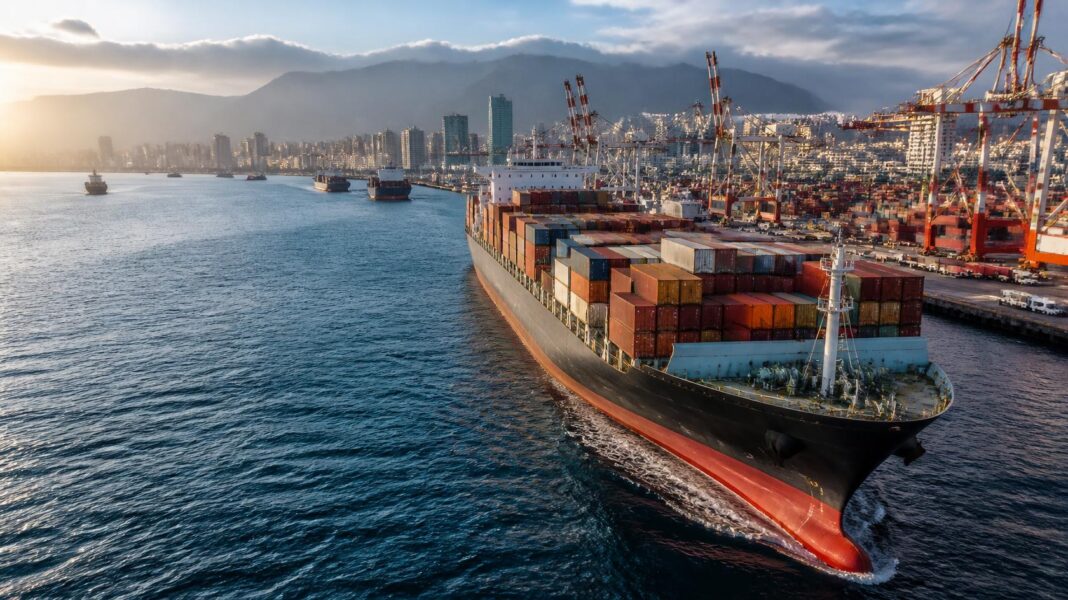
Africa’s container shipping market is heading into the second half of 2026 under continued pressure.
Global fleet capacity is growing, but congestion, geopolitical disruption, rerouting and strong Asian export demand are absorbing much of the additional capacity. For African supply chains, that could mean elevated freight rates, tighter container availability and less reliable shipping schedules through the rest of the year.
The global container shipping market is entering a strange phase.
More ships are being delivered. Carriers have large orderbooks. Some services are gradually returning to routes that were previously disrupted. Yet the additional vessels are not translating into an equivalent increase in usable capacity for shippers.
That distinction is becoming increasingly important for Africa.
According to the August 2026 Ocean Freight Market Update from DHL Global Forwarding, global container fleet capacity is expected to grow by 4% this year, below the roughly 6% average annual growth recorded over the past decade.
At the same time, container demand is up 5% year-to-date, while year-on-year demand growth remains around 4%.
The result is a market where demand is still absorbing available capacity faster than carriers can comfortably release it.
And for African businesses that depend heavily on imported machinery, vehicles, equipment, manufactured goods, industrial inputs and consumer products, that could keep shipping costs and delivery uncertainty elevated.
The capacity problem is bigger than the number of ships
At first glance, a 4% increase in fleet capacity might appear positive.
But container shipping capacity is not simply a calculation of how many vessels are operating globally.
A vessel stuck in congestion, diverted hundreds or thousands of nautical miles away from its normal route, or waiting for a berth is effectively less useful to the shipper.
This is why DHL distinguishes between nominal capacity and effective capacity.
The company estimates that global nominal capacity is being reduced by approximately 18%, largely because of congestion and the continued impact of Suez-related detours.
That creates a major problem.
A carrier can technically have more ships in its fleet while still struggling to provide enough slots on the routes where cargo demand is strongest.
This is one of the central reasons why freight rates have remained elevated.
Related Stories
- Africa’s Shipping Map Is Changing: Asia–West Africa Capacity Jumps 34% in 2026
- Top 10 Largest Container Ships in the World in 2026
- Global Air Cargo Demand Rises 8.5% in June as North America Leads Growth, Africa Faces Capacity Constraints
- Senegal Unveils New Maritime and Logistics Development Priorities in Bid to Become West Africa’s Leading Trade Hub
Asia is keeping pressure on the container market
The strongest source of demand remains Asia.
DHL says 2026 container demand growth has been driven by continued volume increases out of Asia, with Asian exports remaining strong across several trade corridors. Global demand increased 5% year-to-date in the company’s data, while year-on-year demand was up 4%.
The significance for Africa is considerable.
Much of Africa’s containerized import trade originates in Asia, particularly China, India and other major Asian manufacturing centres.
African markets are importing increasing volumes of:
- machinery and industrial equipment
- vehicles and spare parts
- solar and renewable-energy equipment
- electronics
- construction materials
- agricultural inputs
- household and consumer goods
- factory equipment
DHL also identifies strong Asian demand for renewable-energy products such as solar panels, electric-vehicle accessories and wind turbines as one of the factors supporting the current peak season.
For African importers, that creates competition for the same ships and container equipment being used by customers across the world’s major trade lanes.
Container Shipping by the Numbers
Source: DHL Global Forwarding, Ocean Freight Market Update, August 2026.
Freight rates have already demonstrated how quickly conditions can change
The current market is not simply experiencing a shortage of containers.
It is experiencing a shortage of reliable, available capacity at the right time and on the right trade lanes.
DHL’s August update shows freight rates more than 100% higher year-on-year and approximately 68% above their level three months earlier. Although rates have started to soften as peak-season intensity declines and additional capacity enters some markets, they remain well above 2025 levels.
That creates an important distinction for African businesses.
A small decline in freight rates does not necessarily mean the shipping market has normalized.
Rates can fall from a peak while remaining substantially higher than a year earlier.
That is precisely the environment facing shippers now.
Africa is caught in the spillover effect
One of the most important concepts in DHL’s latest assessment is the “spillover effect.”
When carriers move ships away from one trade to another because demand is stronger elsewhere, shortages can emerge on routes that previously had adequate capacity.
DHL says carriers are protecting rate levels by restricting contract space, blanking sailings and shifting capacity towards high-demand trades.
This is creating shortages on previously unaffected routes and expanding the number of trades exposed to peak-season surcharges.
Africa can be particularly vulnerable to this dynamic.
African trade lanes generally do not have the same volume as the world’s largest Asia–North America and Asia–Europe corridors. If carriers have an opportunity to deploy vessels where yields are higher, capacity can be redirected.
That means African shippers can feel the consequences of decisions being made thousands of kilometres away.
A vessel does not necessarily need to disappear from the global fleet for African capacity to become tighter.
It only needs to be deployed somewhere else.
Red Sea disruption continues to reshape global capacity
The other major issue is geography.
The Red Sea and Suez Canal remain central to the outlook for global container shipping, particularly for routes connecting Asia, Europe, the Middle East and Africa.
The DHL report says geopolitical disruption continues to constrain trade to, from and through the Middle East, while Suez detours are reducing effective capacity. It also highlights the continuing uncertainty surrounding the Strait of Hormuz and elevated oil prices.
The network has already been rearranged around the disruption.
Ships, containers, schedules and port calls have been repositioned. Returning services therefore involves operational adjustments rather than simply switching back to the old network overnight.
For African ports, the consequences can be significant because changes in global east-west services can alter vessel calls, transshipment patterns and feeder connections.
Port congestion is absorbing more capacity
There is another problem that African logistics operators should watch closely: congestion.
DHL estimates that more than 3.7 million TEU remain tied up in congested ports, with global congestion returning to levels seen around the 2022 post-Covid peak. The current congestion is particularly pronounced in Asia and Europe.
This matters because port congestion effectively removes ships from productive service.
A vessel waiting outside a port is not carrying another load somewhere else.
As congestion increases:
More waiting time → fewer vessel rotations → less effective capacity → tighter space → higher rates.
The problem can then compound itself.
A vessel arrives late, misses its scheduled berth, departs late, misses another port call and disrupts the next rotation. Cargo can be rolled, feeder connections missed and containers stranded in the wrong location.
DHL says schedule reliability has been declining as congestion increases, with the Middle East and Africa underperforming the global average because of the Hormuz situation and rerouting.
Africa’s shipping reliability problem deserves more attention
For African businesses, the issue may ultimately be bigger than freight rates.
It is reliability.
An importer may be able to absorb an additional freight charge. It is much harder to manage a shipment that arrives weeks later than expected.
For manufacturers, a delayed container can mean production downtime.
For construction companies, it can delay equipment deployment.
For retailers, it can create inventory shortages.
For agricultural businesses, delays can affect seasonal inputs and machinery.
For logistics companies, unpredictable vessel arrivals make trucking, warehousing and container positioning more difficult.
DHL’s data shows that carriers are dealing with blanked sailings, omitted port calls, feeder delays, schedule changes and rolled cargo.
That makes the reliability of the entire supply chain increasingly dependent on factors outside the control of individual African importers.
Bunker fuel is adding another layer of cost
The shipping capacity problem is also being amplified by energy costs.
DHL reports that bunker fuel prices are approximately 50% above the pre-war baseline. It also says diesel prices have increased by as much as 50% since December 2025 in some geographies.
That matters beyond the ocean leg.
Fuel is typically responsible for around 30% to 50% of inland transportation operating costs, according to the DHL report.
For Africa, where road freight plays a major role in moving containers from ports to inland markets, higher fuel costs can compound higher ocean freight charges.
The final logistics bill therefore has several potential pressure points: Higher bunker costs + higher ocean freight + inland fuel costs + congestion + surcharges.
That combination can eventually feed into the prices paid by consumers and businesses.
New ships will help — but not immediately
There is some good news for shippers.
The container shipping industry has an enormous vessel orderbook.
DHL’s August data shows that several major carriers have orderbooks equivalent to significant portions of their existing fleets. MSC’s orderbook, for example, is listed at 33% of its current fleet, while CMA CGM’s stands at 40% and COSCO’s at 45%.
But much of this capacity will arrive too late to solve today’s bottlenecks.
DHL notes that carriers’ orderbooks are full, but their impact will largely be felt from 2027 onwards.
That is an important point for African shippers planning beyond the current peak season.
The global shipping industry is adding capacity, but the market may have to navigate the rest of 2026 before much of that additional fleet meaningfully changes the balance.
What does this mean for African importers?
For businesses importing into Africa, the environment argues for a different approach to shipping procurement.
Book earlier
DHL advises early bookings while space remains tight and peak-season surcharges continue to affect an increasing number of trades.
Waiting until the last minute could become increasingly expensive when vessel space is constrained.
Build more flexibility into delivery schedules
A supply chain designed around exact vessel arrival dates becomes vulnerable when congestion and rerouting increase.
Importers should allow more time between expected arrival and the date when goods are actually required.
Watch the entire logistics chain
The cost of the container is only one part of the equation.
Importers should also monitor:
- port congestion
- inland trucking costs
- fuel prices
- container availability
- demurrage and detention exposure
- transshipment risks
- schedule reliability
Consider alternative sourcing
The current market also reinforces the importance of sourcing flexibility.
If a company depends entirely on one Asian supplier, one port and one shipping route, a disruption can quickly become a business problem.
What happens next?
The most likely scenario is not a return to the extreme conditions of the pandemic-era shipping crisis.
It is something more complicated: a structurally tighter market with periodic relief and renewed spikes in volatility.
DHL expects capacity to catch up with demand on some trades as additional sailings are introduced. But it also expects tight capacity to persist where carrier controls, vessel redeployment, congestion and equipment shortages remain.
That means African shippers should not assume that a decline in rates during the later part of the year will automatically signal a lasting normalization.
The market could move in waves.
Capacity improves on one route.
Congestion worsens on another.
A geopolitical disruption changes vessel deployment.
Asian exports accelerate.
Rates rise again.
That is increasingly becoming the nature of global container shipping.
Africa’s container shipping market is entering a more strategic era
The biggest lesson from the current market is that global container capacity cannot be measured simply by counting ships.
A 4% increase in nominal fleet capacity does not guarantee a 4% increase in usable capacity for an African importer.
- Ships can be delayed by congestion.
- Routes can be extended by geopolitical disruption.
- Capacity can be shifted to higher-yield corridors.
- Containers can end up in the wrong locations.
- Fuel costs can increase.
- And strong demand from Asia can absorb newly available space.
DHL’s August assessment captures the tension clearly: global demand remains resilient, capacity growth is slower than historical norms, congestion is absorbing effective capacity and geopolitical disruption continues to distort shipping networks.
For Africa, the implication is straightforward.
Freight capacity may become more available eventually — but African importers should prepare for a shipping market that remains expensive, selective and unpredictable through much of 2026.
The companies best positioned to navigate it will not necessarily be those paying the lowest headline freight rate.
They will be the ones with the best visibility, earlier booking decisions, flexible routing options and enough inventory and transport capacity to absorb disruption.
What this means for Africa Logistics
The emerging story is therefore bigger than container rates.
It is about whether African supply chains are becoming resilient enough to operate in a world where shipping capacity is available globally, but not always available where and when Africa needs it.
That is the question logistics operators, freight forwarders, importers and port authorities will increasingly have to answer as 2026 progresses.
Africa Logistics Intelligence
The key risk for African shippers is not a global shortage of ships — it is a shortage of usable capacity on the routes and at the time it is needed.
Strong Asian export demand, vessel rerouting, port congestion and carrier capacity controls are keeping effective capacity under pressure. For African importers, this means that even as new vessels enter the global fleet, freight costs, equipment availability and schedule reliability could remain volatile through 2026.
Also Read
- Global Air Cargo Demand Rises 8.5% in June as North America Leads Growth, Africa Faces Capacity Constraints
- Why Packaging Automation Matters More Than Ever for African Exporters
- Lamu Port Set to Become East Africa’s Next Maritime Hub as Global Investors Show Interest

- Beyond the Truck: How UD Trucks Is Redefining Fleet Performance in Southern Africa - October 12, 2026
- Maersk and Viaservice Target Working Capital Challenge in Kenya’s Container Logistics Sector - August 20, 2026
- South Africa’s Special Economic Zones: 2026 Guide to SEZs, Ports, Logistics and Investment - August 16, 2026

