
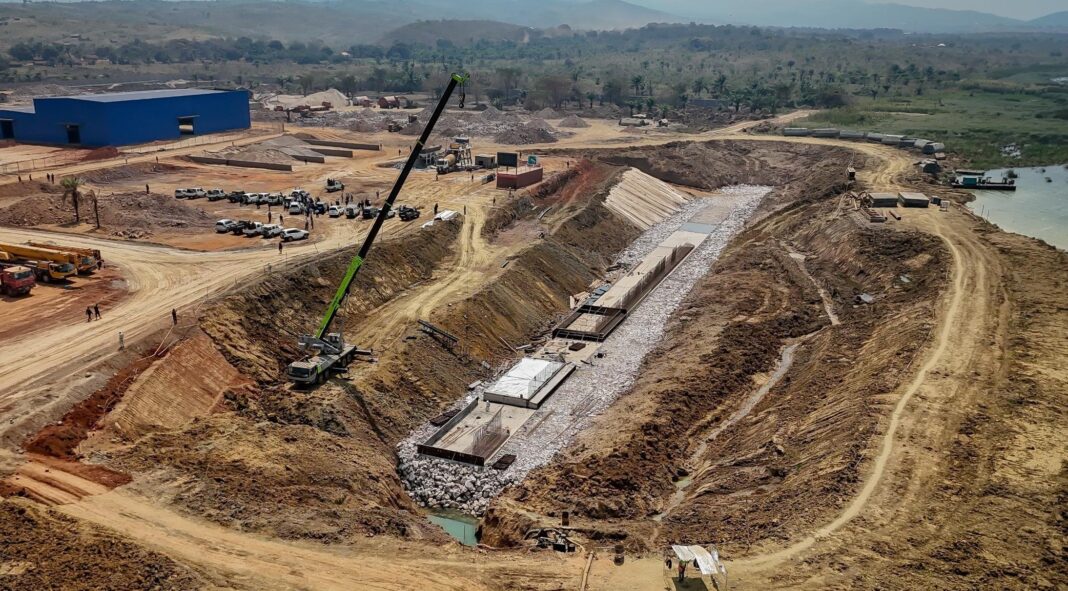
The Democratic Republic of Congo is moving ahead with the development of the Kalemie Industrial Port, a project that could significantly change the way minerals and other cargo move through the western side of Lake Tanganyika.
Construction is underway at Mutowa, around 30 kilometres from the city of Kalemie in Tanganyika Province, as the DRC seeks to build a modern industrial logistics gateway capable of handling substantially larger volumes of cargo.
The timing is significant. The port is being developed as the DRC’s mineral economy is increasingly looking toward eastern and southern transport corridors, while the emergence of lithium production at Manono is creating a new source of demand for reliable export infrastructure.
Construction moves into a more advanced phase
The latest progress update from the DRC’s Agency for Major Works and Infrastructure (ACGT) shows that the project is no longer simply at the preliminary construction stage.
During a June 2026 technical inspection, officials reviewed construction progress with Golden Lake Logistics SARL, identified as the concessionaire, alongside contractors CREC-7 and CREC-9.
Several components of the port are now progressing simultaneously.
The administrative building has moved beyond foundation works, with first-level columns completed and work advancing on the second level.
Commercial facilities have progressed through foundation and masonry works, while offices associated with customs warehousing are entering the fitting-out stage.
A second bonded warehouse has also progressed through foundation and peripheral works.
The port’s weighbridge is being installed and adjusted, while the electrical substation has already been completed.
Perhaps more importantly from a maritime logistics perspective, construction of the cofferdam for the first berthing area has been completed.
These works point to a project moving from site preparation toward the development of an operational logistics complex.
A new industrial gateway on Lake Tanganyika
The Kalemie Industrial Port is designed to be considerably more than a conventional lake port.
The first phase is planned to provide capacity of approximately 1 million tonnes of cargo per year, with a second phase expected to increase capacity to about 1.8 million tonnes annually.
The project includes berthing infrastructure, warehouses, storage areas, administrative and commercial facilities, weighing infrastructure and supporting utilities.
The objective is to create a modern logistics platform capable of supporting industrial and mineral cargo moving through the Lake Tanganyika corridor.
That could be particularly important for the DRC, whose mineral-producing regions have historically faced a major logistical challenge: abundant resources, but limited and expensive routes to international markets.
Lake Tanganyika offers an alternative.
From Kalemie, cargo can move across the lake toward Kigoma in Tanzania, where it can potentially connect with Tanzania’s wider rail, road and port network.
That makes the development relevant not only to the DRC but also to Tanzania and the broader East African logistics system.
Why Manono lithium changes the equation
The most important development around the corridor may not be the port construction itself.
It is the emergence of Manono lithium.
Manono, in Tanganyika Province, is one of the DRC’s major emerging lithium projects. As production develops, exporters need a dependable route capable of moving mineral concentrates from the interior toward international markets.
That is where Kalemie and Lake Tanganyika become strategically important.
In July 2026, the first shipment of Manono lithium spodumene concentrate reportedly departed from Mutowa toward Kigoma in Tanzania.
That movement provides an early indication of how the corridor could function once the Kalemie Industrial Port becomes fully operational.
Instead of relying exclusively on longer routes toward Atlantic or southern African ports, some mineral cargo could move eastward through Lake Tanganyika and into Tanzania.
For logistics operators, this creates an important question: can the lake corridor evolve from a secondary transport route into a competitive mineral-export corridor?
The Kigoma connection
The potential relationship between Kalemie and Kigoma is one of the most important elements of the project.
Kigoma provides access to Tanzania’s transport network and ultimately to the country’s Indian Ocean gateways.
The development of the Kalemie Industrial Port therefore needs to be viewed as part of a much larger chain:
Mine → road → Kalemie/Mutowa → Lake Tanganyika → Kigoma → Tanzania’s inland transport network → Indian Ocean export gateway
If that chain becomes reliable, it could provide mining companies operating in southeastern DRC with another option for reaching global markets.
The significance extends beyond lithium.
Copper, cobalt, agricultural products, construction materials and general cargo could potentially benefit from improved lake-port infrastructure.
The bigger logistics question
The challenge, however, is not simply building the port.
A port can only become a successful logistics gateway if the infrastructure around it works as an integrated system.
That means reliable road connections to mining and industrial areas, efficient cargo handling, customs coordination, lake vessel availability, storage capacity and onward connections from Kigoma.
Rail connectivity will also matter.
Tanzania has been investing heavily in its railway infrastructure, including the Standard Gauge Railway network, while the development of the Tanzania-Kigoma corridor could strengthen the case for moving more DRC cargo toward the Indian Ocean.
The success of Kalemie could therefore depend on how effectively multiple infrastructure projects across national borders are connected.
A potential shift in DRC’s export geography
For years, the DRC’s mining exports have been heavily dependent on a relatively small number of major corridors.
That makes logistics diversification strategically valuable.
The Kalemie Industrial Port offers the possibility of developing another route, particularly for minerals produced in the country’s eastern and southeastern regions.
For the DRC, that could mean more competition between export corridors.
For Tanzania, it could mean additional transit cargo.
For logistics companies, it could create demand for lake transport, warehousing, freight forwarding, customs services and multimodal transport.
And for mining companies, another viable export route could improve supply-chain resilience.
But Lake Tanganyika remains a challenging logistics environment
The opportunity should not be overstated.
Lake transport has its own constraints, including vessel availability, weather conditions, port infrastructure, navigation, cargo-handling capacity and the need for efficient coordination between different countries.
The DRC also needs to ensure that cargo moving through Kalemie can reach the port efficiently from production centres.
The Manono experience will therefore be closely watched.
If regular lithium shipments can move efficiently through Mutowa and Kigoma, it could provide an important proof of concept for the wider corridor.
Kalemie could become more than a DRC port
The strategic opportunity is ultimately regional.
Kalemie sits on one of Africa’s major inland waterways, and its location gives the DRC a potential connection into the transport systems of Tanzania, Burundi and Zambia.
That means the Kalemie Industrial Port could eventually serve not only as an export point for DRC minerals but also as part of a wider Lake Tanganyika logistics network.
The project’s progress is therefore worth watching beyond the construction statistics.
The real test will come when cargo begins moving at commercial scale.
If the infrastructure can connect efficiently with mines, lake shipping, Kigoma and Tanzania’s inland and maritime networks, Kalemie could emerge as an important new logistics gateway for the DRC.
For now, the cranes, warehouses, berthing infrastructure and utilities at Mutowa represent the physical beginning of that ambition.
But the more consequential development may already be happening on the water: the first lithium shipments are beginning to test the very corridor that the new port is being built to strengthen.
Also Read
- Africa’s Trucking Industry Is Changing. Here’s What Fleets Are Buying and why
- South Africa’s Truck Market Is Picking Up. Here’s What Fleets Are Buying
- DP World’s Mombasa SEZ: Why the Port’s Next Opportunity May Be Beyond the Terminal

- UPF Group Expands African Logistics Network with New Rwanda Office - September 18, 2026
- DP World’s Africa Network Is Growing While Jebel Ali Takes a Heavy Hit - August 15, 2026
- U.S. Truck Freight Prices Fall 1.8% in July as Diesel Costs Slide - August 13, 2026

