
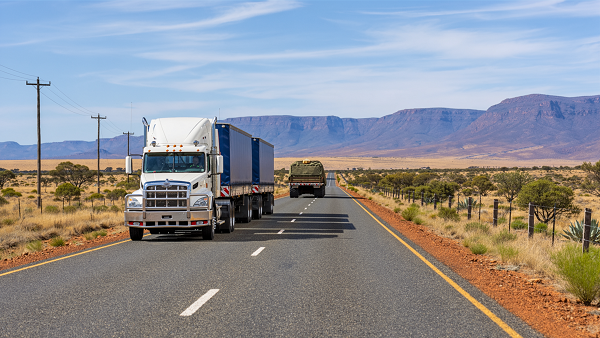
South Africa’s logistics expenditure is projected to reach R1.156 trillion in 2026, equivalent to 14.6% of gross domestic product (GDP), highlighting the growing cost pressures facing the country’s freight transport and supply-chain industry.
The projection, contained in the State of Logistics™ 2026 for South Africa, produced by GAIN Group, places the country’s logistics bill at its highest level relative to GDP in more than two decades.
The report estimates that national logistics costs reached R972 billion in 2024 before increasing to R1.009 trillion in 2025, with a further rise forecast for 2026.
While South Africa’s geographical structure and concentration of production centres create substantial freight transport requirements, the research identifies infrastructure constraints, inappropriate transport mode selection and operational inefficiencies as areas where significant costs could be avoided.
For an economy dependent on the movement of minerals, agricultural commodities, manufactured products and imported goods, the findings raise important questions about the efficiency of its freight network and the competitiveness of its supply chains.
Transport drives the rising logistics bill
Transport remains the largest component of South Africa’s logistics expenditure, accounting for approximately 59% of the projected 2026 total.
GAIN Group estimates transport costs at R683 billion, up from R566 billion in 2025. The increase of R117 billion represents approximately 80% of the projected annual growth in the national logistics bill.
The remaining expenditure is distributed across inventory carrying, warehousing and management and administration.
Inventory carrying costs are forecast at R191.4 billion, while warehousing and management and administration are estimated at R151.7 billion and R130 billion, respectively.
The figures illustrate how logistics inefficiencies extend beyond the physical movement of freight.
Unreliable transport services can force businesses to maintain higher inventory levels, tying up working capital and increasing storage requirements.
Delays and unpredictable delivery schedules can also increase the resources required to coordinate supply-chain operations.
South Africa’s rising logistics cost burden is therefore not simply a transport-sector concern.
It has implications for manufacturers managing production inputs, agricultural exporters moving commodities to ports, mining companies transporting bulk materials and retailers distributing finished products.
Road freight operators face mounting cost pressures
Road transport has become increasingly important in South Africa’s freight system, particularly as declining rail performance forced more commodities onto highways.
However, the cost of operating road freight fleets has increased across several expenditure categories.
GAIN Group’s analysis identifies fuel as the largest road freight cost component, with its share of total expenditure increasing from approximately 39.1% in 2015 to 43.4% in 2025.
Driver wages, vehicle depreciation, insurance, maintenance and the cost of capital also contribute significantly to fleet operating expenses.
The report highlights that road freight rates increased by approximately 82% between 2014 and 2025, compared with 68% for consumer price inflation and 53% for diesel prices over the same period.
This divergence indicates that fuel prices alone do not explain the rising cost of road transport. Vehicle ownership, financing, maintenance, labour and insurance have also contributed to the pressure on operators.
For transport companies, improving fleet utilisation, reducing empty running, optimising routes and strengthening preventive maintenance programmes will become increasingly important in controlling operating expenditure.
The report also highlights the importance of selecting appropriate vehicles, improving load factors and coordinating freight movements to reduce unnecessary vehicle kilometres.
Rail recovery offers an opportunity to reduce freight costs
The performance of South Africa’s freight rail network remains central to the country’s logistics competitiveness.
Transnet’s transported freight volumes declined from approximately 226.3 million tonnes in 2017/18 to 149.5 million tonnes in 2022/23.
The deterioration increased dependence on road transport, including for long-distance and high-volume freight traditionally suited to rail.
However, the latest report identifies signs of recovery, with rail freight volumes increasing to approximately 167.9 million tonnes in the 2025/26 financial year.
The economic consequences of rail underperformance have also declined. GAIN Group estimates that the overall economic impact fell from R410.7 billion in 2022 to R180.8 billion in 2025, equivalent to a reduction in the estimated daily economic burden from R1.125 billion to R495 million.
The 2025 figure comprises R88.4 billion in unachieved bulk mineral exports and R92.4 billion in transport inefficiencies.
These figures represent wider economic effects rather than direct logistics expenditure alone.
Despite the improvement, the remaining economic burden demonstrates the scale of the challenge facing the country’s freight system.
GAIN Group director Zane Simpson has emphasised the need to allocate freight to the most economically appropriate transport mode, arguing that long-distance, high-volume and rail-friendly commodities should move by rail where reliable and competitive services are available.
Road transport, meanwhile, remains essential for distribution, shorter-distance movements and first- and last-mile connectivity.
General freight remains a critical gap
While improvements in bulk commodity rail corridors have contributed to the recovery in freight volumes, the report identifies general freight as an important area requiring further attention.
Professor Jan Havenga of GAIN Group argues that South Africa’s longer-term freight requirements cannot be met without rebuilding competitive general freight rail services.
The report identifies containerised freight and other general freight movements as areas where the gap between current rail performance and the country’s potential freight requirements remains particularly significant.
Restoring these services will require investment in railway infrastructure, rolling stock, intermodal terminals and supporting logistics facilities.
Havenga has also highlighted the importance of restoring services on the corridors linking Gauteng with KwaZulu-Natal and the Western Cape.
The institutional framework governing the rail network will also influence the pace of recovery.
Priorities identified by Havenga include the full unbundling of Transnet’s Rail Infrastructure Manager, operationalising the Transport Economic Regulator and establishing a clearer legislative and strategic framework for freight rail.
The broader challenge is ensuring that private-sector participation is supported by an adequately maintained national railway network and reliable infrastructure access.
R149.3 billion in potential logistics savings
One of the report’s most significant findings is the potential to reduce national logistics expenditure through improvements in transport mode selection, capacity utilisation and operational efficiency.
GAIN Group estimates that South Africa could have avoided approximately R149.3 billion in logistics costs in 2026 under an improved logistics scenario.
The model combines improved rail performance, a 10% efficiency saving on road transport costs remaining after modal shift, and additional savings associated with reducing port-related road transport inefficiencies and delays.
Under this scenario, national logistics costs would have represented approximately 12.7% of GDP in 2026, compared with the baseline forecast of 14.6%.
The proposed improvements also extend to the development of inland terminals, freight consolidation hubs and more effective connections between production centres, distribution facilities and ports.
For road freight operators, better load consolidation, improved scheduling and more effective backhaul arrangements could reduce unnecessary vehicle movements.
Preventive maintenance, tyre management, route optimisation and improved driving practices could further lower operating costs.
These interventions would need to be coordinated across freight operators, infrastructure managers, cargo owners and government institutions.
Importantly, the R149.3 billion represents a modelled savings opportunity rather than an amount already achieved.
Preparing for a billion-tonne freight economy
South Africa’s long-term freight requirements add another dimension to the challenge.
According to GAIN Group’s Freight Demand Model, the country moved approximately 790.1 million tonnes of freight in 2024, including road, rail, pipeline and conveyor belt movements.
Demand is forecast to reach approximately 1.019 billion tonnes by 2055.
Accommodating this growth will require sustained investment in transport infrastructure and logistics facilities, alongside improvements in the productivity of existing assets.
The report’s central message is that increasing transport capacity alone will not resolve the country’s logistics cost challenge.
Freight must also be allocated to the appropriate transport mode, existing capacity must be used more effectively, and operational inefficiencies must be reduced.
For South Africa’s logistics industry, the ability to achieve these improvements will have implications extending well beyond transport operators.
Mining exports, agricultural trade, manufacturing competitiveness and access to regional and international markets all depend on reliable and economically sustainable freight services.
As the country moves towards a billion-tonne freight economy, reducing the unnecessary cost of moving goods will be essential to strengthening supply-chain performance and supporting long-term economic competitiveness.
Also Read
- Inside Isuzu’s Plan to Make South Africa the Truck Manufacturing Hub for Africa
- UPF Group Expands African Logistics Network with New Rwanda Office
- South Africa’s Truck Market Is Picking Up. Here’s What Fleets Are Buying

- South Africa’s R1.156 Trillion Logistics Bill: The Growing Cost of Moving Freight - November 18, 2026
- Inside Isuzu’s Plan to Make South Africa the Truck Manufacturing Hub for Africa - October 12, 2026
- UPF Group Expands African Logistics Network with New Rwanda Office - September 18, 2026


, highlighting the growing cost pressures facing the country's freight transport and supply-chain industry.)