
Africa’s rail sector is experiencing one of its most significant investment surges in decades.
Driven by geopolitical competition for critical mineral supply chains, urbanisation pressures, and renewed commitment from both African governments and international development partners, a clutch of landmark railway projects are now under active construction or entering key delivery phases across the continent.
In 2026, these projects are not just infrastructure — they are strategic anchors for trade integration, resource extraction, and long-term economic development.
CCE News examines the top rail projects reshaping the continent this year, from the mineral corridors of central-southern Africa to Egypt’s north-spanning high-speed network, and the East African standard gauge railway push that could finally link the Port of Mombasa to the Ugandan interior.
The Lobito Corridor — Angola, Zambia & DRC
Arguably the most consequential rail project on the continent, the Lobito Corridor spans approximately 1,300 kilometres from Angola’s Atlantic port of Lobito through the Copperbelt regions of the Democratic Republic of Congo and Zambia.
It is the first open-access transcontinental rail link in sub-Saharan Africa, and its development is attracting major investment from the United States, the European Union, and multilateral lenders.
In January 2026, the Africa Finance Corporation (AFC) announced the signing of key financing agreements for the Lobito Atlantic Railway project, including commitments from the US Development Finance Corporation (DFC), the Development Bank of Southern Africa (DBSA), and the Government of Angola.
The project has entered its EPC (engineering, procurement, and construction) bid evaluation phase, with bids now under assessment for the first two sections of the greenfield Zambia-Angola rail line — an 800-kilometre stretch being built entirely from scratch.
The Lobito Corridor is expected to cut transit times from the Copperbelt to Atlantic ports from 45 days to under 15 days — transforming mineral export economics across the region.
The Zambia-Lobito greenfield rail project is estimated to cost in excess of $6.6 billion for the full corridor, with the AFC mobilising $500 million through various financial instruments.
The economic rationale is compelling: current export routes from DRC and Zambian copper mines to Atlantic or Indian Ocean ports can take as long as 45 days, while the Lobito line is designed to reduce that to under 15 days.
The corridor is also expected to deliver a reduction of approximately 300,000 tonnes of annual CO₂ emissions by shifting freight from road to rail.
Beyond minerals, the corridor is attracting growing interest from agribusiness. Angola’s cereal production in the Huambo and Bié provinces rose sharply in the 2024/25 season, while Zambia recorded a 28 per cent increase in maize and soybean output since 2020.
Agro-processing zones are being planned along the rail alignment to support competitive agricultural exports to Europe and the Middle East.
The project is being developed by the Lobito Corridor consortium, comprising the AFC, Trafigura, Mota-Engil, and Vecturis SA under the Lobito Atlantic Railway Company, which holds a 30-year concession.
The EU and US have both signed a Memorandum of Understanding with Angola, Zambia and the DRC for partnership on the corridor. Flooding that disrupted the line in April 2026 has added urgency to the climate adaptation dimension of the project’s engineering standards.
Kenya-Uganda Standard Gauge Railway Extension
In one of East Africa’s most watched infrastructure milestones of 2026, Kenya formally launched construction of the Naivasha-Kisumu-Malaba Standard Gauge Railway (SGR) extension in March, with Ugandan President Yoweri Museveni joining Kenyan President William Ruto for the groundbreaking ceremony in Kisumu County.
The extension forms Phase 2B and Phase 2C of Kenya’s SGR programme, which was initiated in 2014 to replace the country’s century-old metre-gauge network.
The first phase — the Mombasa to Nairobi section — is operational, with an extension to Naivasha also running.
The new work adds a 264-kilometre main line from Naivasha to Kisumu, complemented by an 8.69-kilometre branch linking to a proposed new Kisumu Port facility on Lake Victoria. Phase 2C then extends 107 kilometres from Kisumu to Malaba at the Kenya-Uganda border.
The combined project will traverse nine counties — Narok, Bomet, Nyamira, Kericho, Kisumu, Siaya, Vihiga, Kakamega, and Busia — and is designed to support cargo flows from the Port of Mombasa to western Kenya and across the border into Uganda.
The Western Corridor is strategically important, hosting significant agricultural output including tea, maize, sugar, and rice, as well as a vibrant fisheries sector on Lake Victoria.
The $8.5 billion Kenya-Uganda SGR project aims to reduce freight costs by 35% and connect the Port of Mombasa to Kampala — a corridor that could unlock the entire East African interior.
On the sidelines of the 2026 IMF and World Bank Spring Meetings in Washington, finance ministers from Kenya, Uganda, and Rwanda reached a trilateral consensus to prioritise SGR financing, positioning the project as critical to closing the ‘missing links’ on the Northern Corridor.
The agreement marks a significant step after years of delays that had stalled the Malaba-Kampala section on the Ugandan side.
Once complete, the corridor is anticipated to reduce freight transport costs by 35 per cent and significantly ease cargo movement along one of East Africa’s busiest trade arteries.
It also forms a key building block within the broader East African Railway Master Plan.
Egypt’s 2,000km High-Speed Electric Rail Network
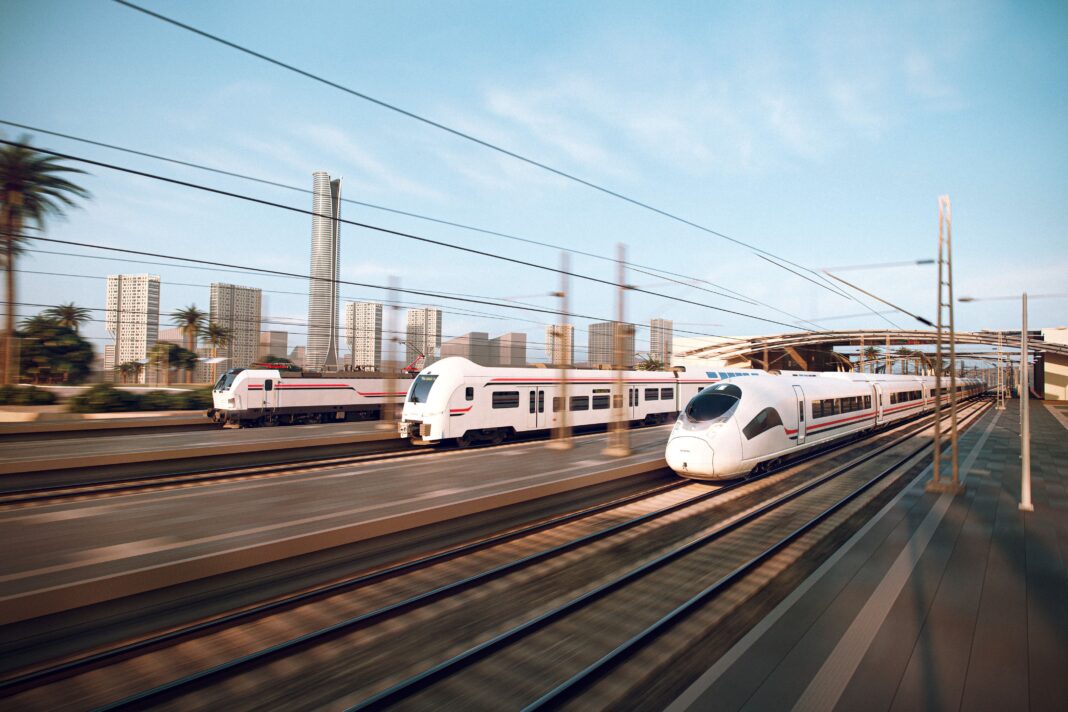
Egypt is advancing what its own transport minister has described as a ‘new Suez Canal on rails’ — a 2,000-kilometre high-speed electric rail network that will, when complete, connect every major seaport, industrial zone, agricultural development area, and urban centre in the country.
The project is one of the largest rail construction programmes underway anywhere in Africa or the Middle East.
The network’s first line stretches 660 kilometres from Ain Sokhna on the Red Sea to Marsa Matrouh on the Mediterranean, passing through the New Administrative Capital east of Cairo and 6th of October City to the west.
This line is the furthest advanced: by early 2026, 88.3 kilometres of track had been installed in the East Nile sector, with additional progress in the West Nile and North sectors.
Portions of the route have been handed over for ballast works and catenary mast installation. The Siemens-led consortium — alongside Orascom and Arab Contractors — is handling track installation, signalling, power supply, and control systems.
The second line extends approximately 1,100 kilometres from October City south to Aswan and Abu Simbel, while a third line will link Qena with Hurghada and Safaga on the Red Sea.
A planned fourth line will eventually connect Port Said and Alexandria. The total network budget, contracted in 2021, stands at approximately $8.7 billion (€8.1 billion), extended in May 2022 to cover the full 2,000-kilometre scope.
Egypt’s Deputy Prime Minister for Economic Affairs described the project as one of the country’s most significant strategic initiatives, linking governorates with major development projects across industrial, agricultural, and tourism sectors.
The network is designed to move up to 15 million tonnes of freight annually while carrying up to 2 million passengers per year — double the capacity of Egypt’s existing conventional rail system.
Operation and maintenance has been awarded to DB International Operations, a subsidiary of Deutsche Bahn, in consortium with Egyptian firm Elsewedy Electric.
The project is directly relevant to construction and logistics operators: the high-speed line will serve major industrial zones including Helwan, 6th of October, New Minya, and New Assiut, while providing rail access to raw material production areas in Abu Tartour, Qena, and Aswan.
South Africa — PRASA Recovery & Transnet Freight Liberalisation
South Africa’s rail sector is undergoing its most significant structural transformation in decades, with the 2026 national budget placing transport and logistics at the centre of the government’s infrastructure-led recovery strategy.
Finance Minister Enoch Godongwana allocated R21.9 billion through the Budget Facility for Infrastructure for five major projects, including upgrades to Transnet’s coal and iron ore corridors aimed at restoring export capacity to 77 million tonnes on the coal line and 60 million tonnes on the ore line.
The Passenger Rail Agency of South Africa (PRASA) is simultaneously implementing a corridor recovery programme that by end-2025 had recommissioned 35 of its 40 passenger corridors, achieving 77 million annual passenger journeys.
The government’s target is to increase annual passenger trips to between 250 and 450 million over the medium term. An additional R5.8 billion has been allocated under the Special Appropriation Bill for PRASA’s rolling stock fleet renewal programme.
On the freight side, South Africa took a landmark step in August 2025 when the Ministry of Transport granted conditional network access rights to 11 private freight train operators, the first such market opening in the country’s history.
These operators have been granted access to 41 routes and six key corridors covering coal, iron ore, chromium, manganese, sugar, and fuel. Rail freight volumes had declined 34 per cent between 2017 and 2022, costing South Africa its position as the world’s third-largest iron ore exporter.
Transnet obtained a $1 billion corporate loan from the African Development Bank in 2024 to support its business recovery plan.
The 2026 budget also announced new PPP regulations for municipalities and the upcoming launch of a tender for a 25-year concession of the Richards Bay dry bulk terminal.
In addition, South Africa announced its National Rail Master Plan this year, with a planned budget of R1.3 trillion allocated to modernising the country’s network.
Algeria — Béchar to Gâra Djebilet Iron Ore Railway
Algeria’s Béchar-Gâra Djebilet Iron Ore Railway is among the most closely watched resource-driven rail projects in North Africa in 2026.
The project connects the vast Gâra Djebilet iron ore deposit — one of the largest untapped iron ore reserves in the world — with the national rail network at Béchar, providing the infrastructure required to unlock an estimated 3.5 billion tonnes of ore reserves.
The railway traverses harsh Saharan terrain and represents a major engineering and logistical challenge.
It forms a cornerstone of Algeria’s ambition to develop its industrial and mining sector, reducing dependence on hydrocarbon revenues.
The line is also part of a broader strategic vision for Algerian rail connectivity into sub-Saharan Africa, with the Béchar junction providing a potential future link toward Trans-Saharan trade routes. Active construction was underway in early 2026, with the project listed among the key African rail projects to watch by the International Railway Journal.
The Bigger Picture: Track Gauge, Financing, and Continental Integration
One of the persistent structural challenges facing African rail integration is the diversity of track gauges across the continent.
Southern and Central Africa predominantly uses Cape gauge (1,065-1,067mm), metre gauge is common in East and West Africa, while standard gauge (1,435mm) is being adopted in North Africa and across new SGR projects in East Africa.
Interoperability between these systems remains a complex engineering and policy challenge that will require continent-wide coordination.
Financing models have also diversified significantly. The Lobito Corridor draws on US, EU, African Development Bank, and private consortium capital.
Kenya’s SGR relied heavily on Chinese financing for its first phase but is now navigating a more multilateral funding structure for the extension.
Egypt’s network is anchored by Siemens with European export credit.
South Africa is pioneering rail private sector participation in freight. This diversification of finance reduces dependency on any single partner but adds complexity to project governance.
The rail investment wave of 2026 reflects a convergence of factors: the global energy transition driving demand for African critical minerals, urbanisation creating passenger demand, climate pressures making rail’s efficiency advantages more compelling, and geopolitical competition ensuring that the financing community remains engaged.
For construction and logistics operators across the continent, the buildout of these corridors represents both a procurement opportunity and a fundamental shift in the cost and feasibility of regional supply chains.
Also Read
Mozambique Pushes Ahead With US$160M Rail Upgrade to Strengthen Maputo Corridor
Why the Trump Administration Is Backing Africa’s $4 Billion Lobito Rail Corridor

- Inside Isuzu’s Plan to Make South Africa the Truck Manufacturing Hub for Africa - October 12, 2026
- UPF Group Expands African Logistics Network with New Rwanda Office - September 18, 2026
- DP World’s Africa Network Is Growing While Jebel Ali Takes a Heavy Hit - August 15, 2026

