

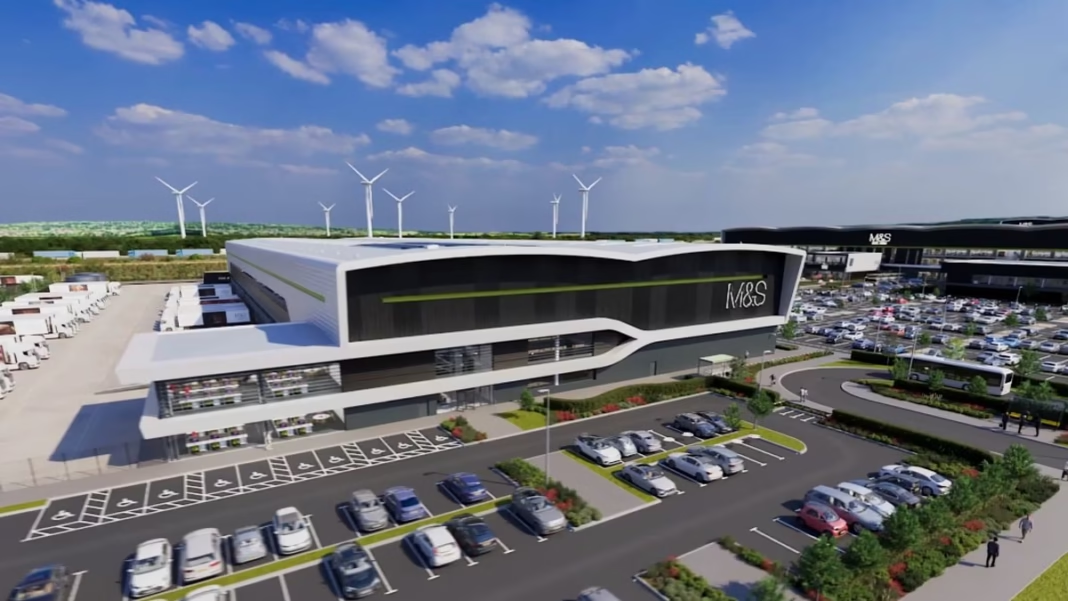
When Winvic Construction secured the £340 million contract to build Marks & Spencer’s flagship distribution centre at DIRFT, the headline was the size: 1.3 million square feet, Britain’s largest food warehouse, the retailer’s biggest supply chain investment ever.
But for logistics property professionals, the real story lies in the technical complexity Winvic has committed to delivering—and the audacious sustainability target that could define the next era of UK warehouse construction.
If completed to specification, this facility is expected to become the largest building in the world to achieve BREEAM Outstanding certification.
That’s not marketing hyperbole. That’s a technical gauntlet thrown down by a mid-sized contractor that has built its reputation as the UK’s leading “shed specialist” but now finds itself attempting something no one else has done at this scale.
The Technical Challenge: Two Warehouses, One Vision
The M&S facility isn’t a single massive box—it’s two low carbon single-storey warehouses with multi-storey office accommodation, a security hub connected by a pedestrian bridge, and a dedicated vehicle maintenance unit.
This dual-building approach reflects the operational complexity of modern food logistics, where temperature zones, automation systems, and workflow optimization demand architectural flexibility.
Over a 52-week build programme starting in 2026, Winvic faces the challenge of coordinating tri-temperature storage (frozen, chilled, ambient), automated fulfilment systems, returns processing, and recycling operations—all while hitting sustainability targets that less than one percent of UK buildings have ever achieved.
The temperature-controlled environments alone represent substantial technical complexity.
The Avonmouth M&S facility Winvic is currently building includes a 900 square metre freezer section operating at -18°C to -20°C. Scale that up to 1.3 million square feet with multiple temperature zones, add advanced automation, and you begin to understand the engineering challenge.
Winvic’s Temperature-Controlled Portfolio: Building Credibility
Winvic’s selection for this project wasn’t accidental. The contractor has systematically built expertise in complex temperature-controlled logistics over the past several years, creating a portfolio that positioned it perfectly for the M&S opportunity.
At Avonmouth’s Axis Works, Winvic is delivering a £74 million, 390,000 square foot logistics facility for M&S, targeting BREEAM Excellent and EPC A ratings, with internal temperature-controlled environments comprising a 900 square metre freezer section.
That project, due for completion in summer 2026, serves as proof-of-concept for the larger DIRFT facility.
The contractor has also delivered major projects for Panattoni, including a 915,000 square foot warehouse at Panattoni Park Swindon targeting BREEAM Excellent and EPC A ratings, designed to Net Zero Carbon in Construction standards aligned with the UK Green Building Council 2019 Framework Definition.
Winvic has completed 27 Net Zero Carbon in Construction projects to date, totaling 72 individual facilities, with a further nine underway, alongside 12 low carbon projects.
This track record in sustainable construction gave Prologis confidence that Winvic could deliver on the BREEAM Outstanding ambition.
The BREEAM Outstanding Reality Check
To understand what Winvic is attempting, you need to understand what BREEAM Outstanding actually means in practice.
The rating evaluates buildings across nine categories: management, health and wellbeing, energy, transport, water, materials, waste, land use and ecology, and pollution. Achieving “Outstanding” requires scores exceeding 85%—a threshold that demands innovation across every aspect of design and construction.
Looking at precedents, the first logistics warehouse to ever achieve BREEAM Outstanding was Gazeley’s G Park Blue Planet in Staffordshire in 2009.
That 34,000 square metre facility featured a biomass plant for heating and electricity, photovoltaics, and electro-kinetic road plates capturing energy from vehicle movements. It achieved a carbon-negative development status with a guaranteed minimum 100% reduction in CO2 emissions.
More recently, a logistics unit at Magna Park Lutterworth achieved what’s believed to be the highest BREEAM score ever recorded for an industrial building in the UK.
The 388,872 square foot facility secured a 95.6% design stage score, later improved post-construction.
Features included 100% PV readiness, WELLness compliance, and extensive sustainability measures developed through bi-monthly BREEAM-focused meetings between contractor and developer.
BGO’s 350,000 square foot logistics development at Longmoor, Hampshire, achieved both BREEAM Outstanding and EPC A+ ratings in August 2025, setting a benchmark for sustainable logistics construction.
The redevelopment of a former Ministry of Defence facility demonstrated that Outstanding certification is possible even with complex brownfield constraints.
What makes the M&S facility different is scale. At 1.3 million square feet—nearly four times larger than the Longmoor development—achieving Outstanding certification requires sustaining excellence across a vastly larger building envelope, more complex systems, and exponentially more construction activity.
The BIM Advantage: Stage 2 Modeling as Risk Mitigation
Winvic is utilizing stage 2 Building Information Modeling to its full potential to assist with achieving the BREEAM Outstanding and Low Carbon in Construction credentials.
This isn’t just digital drafting—it’s a comprehensive approach to risk mitigation and performance optimization.
Stage 2 BIM enables detailed clash detection before construction begins, reducing waste from design conflicts. It allows real-time tracking of embodied carbon across all materials and construction activities.
It provides the documentation framework necessary to prove compliance with BREEAM criteria.
And critically, it enables coordination across the dozens of specialized contractors who will work on temperature control systems, automation technology, building envelope, and infrastructure.
For a project targeting Outstanding certification, BIM isn’t optional—it’s the only viable way to manage the complexity and maintain the documentation trail that BREEAM assessors will scrutinize.
The Strategic Rail Freight Context
While sustainability credentials dominate the technical specifications, Winvic is also delivering critical infrastructure that enables M&S’s logistics strategy.
DIRFT’s rail connectivity isn’t just a location amenity—it’s fundamental to the facility’s operational model and carbon reduction potential.
Prologis’ leased or committed space at DIRFT has reached over 75%, reinforcing the site’s role as one of the UK’s most mature intermodal logistics hubs.
The site currently employs more than 10,000 people across a growing range of logistics operations and technical roles, generating £219 million in annual gross value added for the region.
DIRFT provides access to the West Coast Main Line—the UK’s primary freight route—enabling direct rail connections to Scotland, the Midlands, and channel tunnel access for European goods.
The facility’s tri-temperature capability in a single rail-connected location is rare in UK grocery logistics, allowing supply chain consolidation that reduces both complexity and carbon emissions.
For context, Tesco currently operates seven daily rail services linking DIRFT with terminals across the UK, with one service alone saving 6,000 tonnes of CO2 equivalent per year. M&S’s facility will have similar capabilities when it opens in 2029.
Winvic’s Strategic Rail Freight Portfolio
The M&S DIRFT project isn’t Winvic’s first experience with strategic rail freight interchanges. The contractor has built deep expertise in these complex developments, which combine rail infrastructure, large-scale industrial buildings, and sophisticated highway connections.
Winvic was appointed as design stage delivery partner for West Midlands Interchange, a 734-acre strategic rail freight interchange at M6 Junction 12, offering more than eight million square feet of commercial space with units ranging from 200,000 to 1.2 million square feet, supported by a dedicated rail hub.
The project, financed by Oxford Properties in partnership with Logistics Capital Partners, is anticipated to create 8,500 jobs during development, construction, and operation.
The contractor also won the £107 million main infrastructure contract for SEGRO Logistics Park Northampton Gateway, a 450-acre multi-modal logistics hub designated as a Nationally Significant Infrastructure Project.
Infrastructure works included construction of a 35-acre rail freight interchange, new rail connections, and major improvements to the strategic road network, including upgrades to M1 Junctions 15 and 15a, a new bridge over the West Coast Mainline, and construction of a bypass around Roade.
This experience with rail infrastructure, highway engineering, and large-scale industrial construction creates a competency stack that few UK contractors can match.
Understanding how to integrate rail freight operations with warehouse functionality, how to coordinate with Network Rail and Highways England, and how to deliver complex civils works alongside vertical construction gives Winvic a significant competitive advantage.
The Prologis Partnership: Mutual Ambition
Prologis selected Winvic based on the contractor’s experience delivering complex large-scale logistics projects designed to meet the highest environmental standards. But this is also a relationship of mutual ambition.
Prologis has committed to achieving net zero across its global operations by 2030. The M&S facility represents a flagship demonstration of how that commitment translates into built assets.
By pushing for BREEAM Outstanding on a 1.3 million square foot building, Prologis signals to the market that sustainability at scale isn’t just feasible—it’s becoming the baseline expectation.
For Winvic, successfully delivering this project would cement its position as the UK’s premier contractor for sustainable industrial construction.
The company has already delivered 27 Net Zero Carbon in Construction projects totaling 72 facilities. Adding the world’s largest BREEAM Outstanding building to that portfolio would represent a quantum leap in capability and market positioning.
The 52-Week Programme: Aggressive but Achievable
A 52-week build programme for 1.3 million square feet might seem aggressive, but it reflects Winvic’s confidence in its delivery methodology and Prologis’ site preparation capabilities.
For comparison, Winvic’s 915,000 square foot Panattoni Park Swindon unit followed completion of extensive enabling works including demolition of over 15 buildings from the former Honda manufacturing facility and earthworks of approximately 800,000 cubic metres to create development plateaus.
That experience with complex site preparation informs the DIRFT timeline.
The contractor’s approach emphasizes circularity and on-site efficiency. At Panattoni Park Swindon, on-site recycling of 6F2 aggregate and a balanced earthworks strategy significantly reduced vehicle movements and associated environmental impact.
Demolition materials were recycled to minimize waste sent to landfill. These practices will be critical at DIRFT, where construction waste management contributes directly to BREEAM scoring.
The Competitive Landscape: Raising the Bar
Winvic’s pursuit of BREEAM Outstanding at unprecedented scale raises the bar for the entire UK logistics construction sector.
If successful, it will pressure competitors to demonstrate similar capabilities or risk being shut out of the most prestigious projects.
The contractor’s recent wins demonstrate market momentum. Beyond the M&S DIRFT facility, Winvic secured the £74 million Avonmouth M&S project and continues to work with Panattoni on major developments.
The company’s focus on sustainability credentials, BIM capabilities, and complex industrial projects has created differentiation in a competitive market.
Other major contractors like GMI Construction (which delivered the BREEAM Outstanding Longbridge 155 facility) and TSL (which achieved the highest-ever BREEAM score for a UK logistics facility at Magna Park) are also pushing sustainability boundaries.
This competitive dynamic benefits developers and occupiers by normalizing high environmental performance across the sector.
The 2029 Opening: Perfect Timing or Regulatory Gamble?
The facility’s 2029 opening positions M&S to meet mid-2030s carbon targets with infrastructure designed from the ground up for a decarbonizing economy.
But it also means three years of construction during a period of rapid change in building regulations, carbon accounting standards, and sustainability certification criteria.
BREEAM standards evolve over time. What qualifies as Outstanding today may be different from what qualifies in 2029.
Winvic and Prologis are betting that by targeting the highest current standards and building in margin through innovation, they’ll maintain Outstanding certification even as criteria tighten.
The UK government has set regulated targets to grow rail freight by 7.5% in England and Wales by 2029. Zero emission vehicle mandates will increasingly affect logistics operations. Supply chain emission reporting will become more granular and mandatory.
The DIRFT facility’s rail connectivity and on-site renewable energy will position M&S to navigate these regulatory shifts more easily than competitors operating from conventional, road-only facilities.
What Success Looks Like
If Winvic delivers the M&S DIRFT facility on time, on budget, and achieves BREEAM Outstanding certification, it will represent a watershed moment for UK logistics construction.
The industry will have proof that world-class sustainability can be achieved at massive scale, that mid-sized contractors can compete on technical complexity with the largest players, and that rail-connected, highly automated, ultra-sustainable warehouses are viable at the 1.3 million square foot scale.
For M&S, success means operational efficiency that supports doubling the food business, carbon emissions aligned with 2030 targets, and a flagship facility that demonstrates corporate sustainability commitments in concrete terms.
For Prologis, it means showcasing development capabilities that justify premium rents and attract tenants seeking best-in-class logistics infrastructure.
For DIRFT, it means further cementing the site’s position as the UK’s premier intermodal logistics hub and demonstrating that rail-connected developments can deliver on sustainability as well as operational efficiency.
The Risk Factors
The project isn’t without risks. BREEAM Outstanding at this scale has never been attempted. Supply chain disruptions could affect material availability for specialized sustainable systems.
The 52-week programme leaves limited float for addressing unforeseen issues
. And the integration of complex automation with temperature-controlled environments while maintaining construction timelines and sustainability targets represents genuine technical risk.
Winvic’s experience mitigates these risks but doesn’t eliminate them. The contractor’s 27 completed Net Zero Carbon projects provide methodology and lessons learned.
The BIM approach enables early problem detection. The Prologis partnership brings development expertise and financial resources to solve problems as they emerge.
But the ambition is real, the technical challenge is substantial, and the execution margin is tight.
The Industry Implications
Whether Winvic succeeds or struggles with the BREEAM Outstanding target will influence the UK logistics construction sector for years to come.
Success will accelerate the shift toward sustainability as a non-negotiable requirement for major facilities. Difficulty achieving the target will temper ambitions and potentially slow the industry’s environmental progress.
What’s clear is that the conversation has shifted. BREEAM Excellent and EPC A are becoming table stakes for major logistics developments.
The question increasingly isn’t whether to pursue high sustainability standards, but how ambitious to be in chasing the highest certifications.
Winvic’s £340 million contract with Marks & Spencer represents the UK logistics construction industry placing a bet on ambitious sustainability at unprecedented scale.
The world will be watching when the first goods start moving through those two low-carbon warehouses in 2029.
Project Quick Facts:
- Developer: Prologis UK
- Contractor: Winvic Construction
- Tenant: Marks & Spencer
- Size: 1.3 million sq ft (two separate warehouses)
- Investment: £340 million
- Build Duration: 52 weeks (2026-2027)
- Opening: 2029
- Target Certifications: BREEAM Outstanding, EPC A+
- Jobs: 2,000 during construction, 1,000 permanent roles
- Key Features: Tri-temperature storage, advanced automation, rail connectivity, low carbon construction, Stage 2 BIM
Also Read
Africa’s Warehouses are Full: What’s Driving the Boom?
Inside Africa’s Warehouse 4.0: The Rise of Automated Storage Solutions

- Kaleido Advances Mining Logistics in Southern Africa with Walvis Bay Operation - April 9, 2026
- Top 10 Material Handling Equipment Every Modern Warehouse Needs - April 2, 2026
- What Is a Pick and Pack Warehouse? A Complete Guide for Online Retailers - February 18, 2026

