

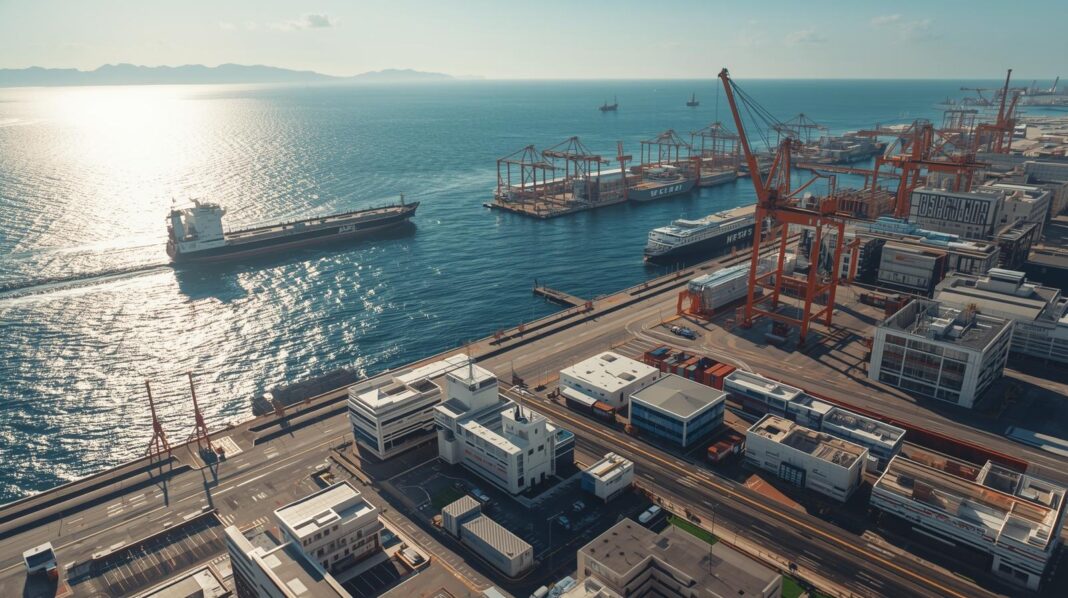
Morocco is positioning itself as a critical maritime hub connecting Europe, Africa, and global markets through an ambitious infrastructure initiative that will see two state-of-the-art deepwater ports come online within the next four years.
Equipment and Water Minister Nizar Baraka recently unveiled plans that could fundamentally reshape North African trade dynamics and establish Morocco as the continent’s premier logistics gateway.
Twin Ports, Dual Coasts
The kingdom’s strategy centers on two major facilities positioned on opposite coastlines. Nador West Med, scheduled to open in late 2026 on the Mediterranean shore, will serve as Morocco’s industrial powerhouse.
Meanwhile, the Dakhla Atlantic Port, slated for 2028 completion on the country’s southern Atlantic coast, aims to unlock trade routes deep into the African continent.
These additions will bring Morocco’s deepwater port count to four, complementing the already successful Tanger Med and Jorf Lasfar facilities.
The expansion reflects Morocco’s determination to replicate and exceed the Tanger Med success story, which has attracted 1,400 companies and created 130,000 jobs since its establishment.
Nador West Med: Industrial Ambition Meets Energy Innovation
The Nador West Med port represents more than just another shipping terminal. Starting with 800 hectares dedicated to industrial activity, the facility’s masterplan envisions eventual expansion to 5,000 hectares, potentially surpassing even Tanger Med’s industrial footprint.
What sets Nador apart is its pioneering energy infrastructure. The port will host Morocco’s first liquefied natural gas terminal, featuring a floating storage and regasification unit that will connect via pipeline to industrial centers throughout the country’s northwest region.
This infrastructure positions Morocco to diversify its energy mix and strengthen industrial competitiveness through improved access to natural gas.
The Mediterranean location offers strategic advantages for European trade, while the planned industrial zones could attract manufacturers seeking proximity to both European and African markets.
The port’s design incorporates modern logistics capabilities aimed at reducing transit times and handling costs for businesses operating across multiple continents.
Dakhla: The Billion-Dollar Southern Gateway
The Dakhla Atlantic Port, carrying a price tag of approximately one billion dollars, represents an even bolder vision.
Located in the disputed Western Sahara region, this facility will become Morocco’s deepest port, with waters reaching 23 meters in depth to accommodate the largest cargo vessels in operation today.
Moroccan officials are marketing Dakhla as a transformative gateway for landlocked Sahel countries, offering these nations reliable access to global shipping lanes.
The port’s strategic southern positioning could provide faster routes for commodities moving between central Africa and international markets, potentially reducing dependence on more distant alternatives.
The facility is being purpose-built to support heavy industries focused on processing raw materials from Sahel nations, creating value-added opportunities before materials reach global markets.
This approach could stimulate economic development both in Morocco and across its southern neighbors, though the port’s location in disputed territory adds diplomatic complexity to its development.
Green Hydrogen: Building Tomorrow’s Energy Economy
Perhaps the most forward-looking aspect of Morocco’s port strategy involves renewable energy. Both Nador West Med and Dakhla Atlantic Port will feature dedicated quays for exporting green hydrogen, positioning Morocco at the forefront of the emerging clean energy economy.
Green hydrogen, produced through renewable energy-powered electrolysis, is increasingly viewed as crucial for decarbonizing heavy industry and long-distance transportation.
Morocco’s abundant solar and wind resources make it an ideal production location, and these specialized export facilities could establish the kingdom as a leading supplier to European markets pursuing carbon neutrality goals.
The timing aligns with the European Union’s growing demand for clean energy imports and its efforts to diversify supply chains away from traditional fossil fuel dependencies.
Morocco’s geographic proximity to Europe provides natural advantages that these port facilities are designed to exploit.
Regional Implications and Economic Impact
The dual port strategy signals Morocco’s intent to serve as Africa’s primary logistics bridge to global markets.
By offering Mediterranean and Atlantic access points with world-class infrastructure, the kingdom aims to capture growing trade volumes as African economies expand and regional integration deepens.
Success could catalyze broader economic transformation, attracting manufacturers, logistics providers, and energy companies while creating tens of thousands of jobs.
The ports also represent significant infrastructure investments that could spur development in their surrounding regions, particularly in Morocco’s less developed southern territories.
As these facilities move from blueprint to reality over the next four years, they will test Morocco’s ability to execute complex megaprojects while navigating the diplomatic, environmental, and economic challenges inherent in reshaping regional trade geography.
The stakes are high, but so too are the potential rewards for a nation betting heavily on its maritime future.
Also Read
Africa’s Warehouses are Full: What’s Driving the Boom?
Africa to Lead Air Travel Growth in 2026, Says IATA

- What Is a Pick and Pack Warehouse? A Complete Guide for Online Retailers - February 18, 2026
- Rhenus Powers South Africa’s First ScreenX Cinema with Complex Global Logistics Operation - February 18, 2026
- Yusen Logistics Expands into East Africa with Strategic Kenyan Joint Venture - February 17, 2026

