
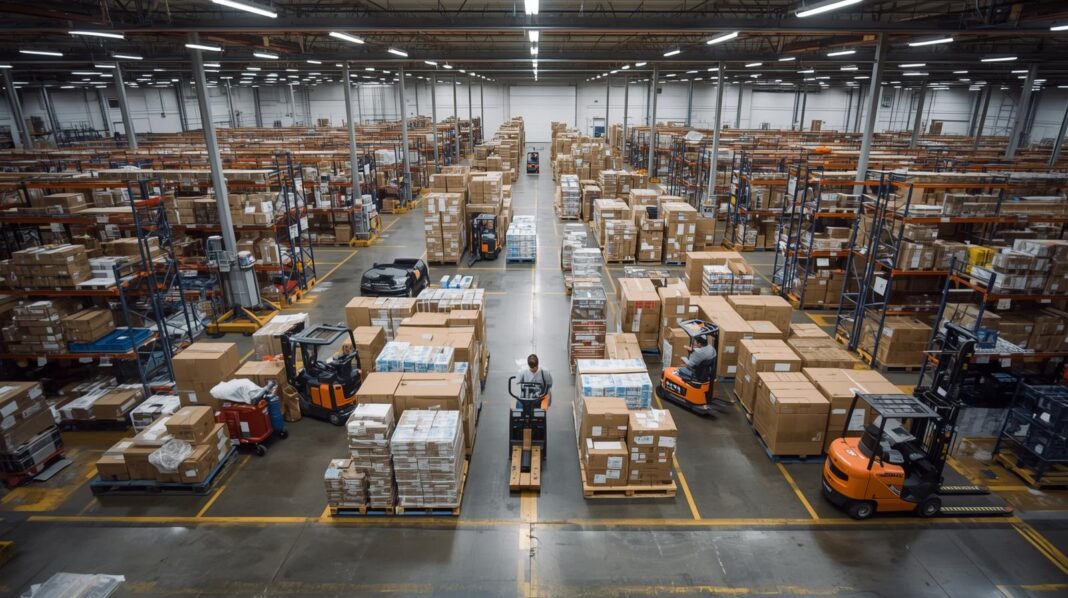
Every time a customer clicks “buy” and a package arrives at their door two days later, a quietly efficient operation has taken place behind the scenes.
At the heart of that operation is a pick and pack warehouse — the unsung engine of modern e-commerce fulfillment. But what exactly happens inside one, why does it matter, and how can it make or break your online business?
What Is a Pick and Pack Warehouse?
A pick and pack warehouse is a fulfillment facility where individual customer orders are assembled by selecting (“picking”) specific products from storage and preparing them for shipment (“packing”) — all under one roof, often within hours of an order being placed.
Unlike traditional bulk warehousing, which focuses on storing and moving large pallets of goods from one business to another, pick and pack warehouses are built for speed and precision at the individual order level.
They’re designed to handle thousands of unique orders per day, each potentially containing a different combination of products, quantities, and packaging requirements.
The concept sounds straightforward, but executing it at scale — with minimal errors, maximum speed, and tight cost control — is one of the most complex logistical challenges in retail.
The world’s most sophisticated pick and pack operations, like those run by Amazon and Zappos, have spent billions of dollars and decades of iteration getting it right.
The Pick and Pack Process, Step by Step
Understanding the full lifecycle of an order inside a pick and pack warehouse reveals just how many moving parts must align seamlessly.
Order Receipt: When a customer completes a purchase, the order flows into a Warehouse Management System (WMS). This software is the brain of the entire operation — it tracks inventory locations, assigns picking tasks to workers or robots, and monitors the status of every order in real time.
Slotting: Before picking even begins, products must be strategically positioned within the warehouse. Fast-moving items are placed close to packing stations. Slow movers go to higher shelves or remote aisles. Complementary products are often stored near each other to reduce travel time. This pre-arrangement, called slotting, can dramatically cut the time it takes to fulfill each order.
Picking: A picker receives a task — either via a printed pick list, a handheld scanner, a wearable device, or voice instructions through a headset. They travel through the warehouse, locating each item by its bin, shelf, or SKU code, scanning items to confirm accuracy, and placing them into a tote or cart. Speed matters here enormously, since picking typically accounts for 50–70% of all warehouse labor costs.
Quality Check: Before packing begins, many operations include a verification step — either a manual check or an automated scan — to confirm that the right items in the right quantities have been collected. This is where errors are caught before they become costly returns.
Packing: The packer selects the appropriate box or mailer size (choosing the smallest suitable option to reduce dimensional weight charges from carriers), adds protective materials like bubble wrap or air pillows if needed, inserts any required documentation such as packing slips or promotional inserts, and seals the package. Many operations use automated carton selection software that determines the optimal box size based on the order’s dimensions.
Labeling: A shipping label is generated and applied, containing the carrier information, tracking number, and delivery address. Some warehouses integrate this step directly into the pack station for maximum efficiency.
Staging and Shipping: Completed packages are sorted by carrier, region, or shipping service and moved to an outbound staging area. Carrier trucks arrive at scheduled intervals for pickup, and the packages enter the broader logistics network — trucks, sortation centers, and last-mile delivery — on their way to the customer.
Picking vs. Packing vs. Shipping: What’s the Difference?
These three terms are often lumped together, but each represents a distinct function with its own staffing, equipment, and performance metrics.
Picking is purely about location and retrieval. Pickers work inside the warehouse, navigating aisles or directed by automation, pulling specific products. Their performance is measured in units picked per hour, and accuracy rates are tracked meticulously — even a 99% accuracy rate means one error in every hundred orders, which adds up fast at scale.
Packing is about presentation and protection. Packers transform a loose collection of items into a shipment-ready package. They need to balance speed with care — a crushed item or a box that bursts open in transit is a failed customer experience and an expensive return. Packers often have the most customer-facing impact because the unboxing experience begins with their work.
Shipping is the handoff. This is where the warehouse’s responsibility ends and the carrier’s begins. Shipping coordinators manage carrier relationships, negotiate rates, schedule pickups, and ensure compliance with each carrier’s labeling and packaging requirements. They also handle exceptions — damaged packages, missed pickups, or address corrections — before orders leave the building.
In smaller operations, one person might handle all three functions. In high-volume fulfillment centers, these are specialized roles with dedicated teams, separate workstations, and distinct performance goals.
The Three Major Types of Picking Methods
Not all warehouses pick orders the same way. The method a warehouse uses has enormous implications for speed, accuracy, and staffing, and the right choice depends on order volume, product mix, and warehouse layout.
Batch Picking
In batch picking, a single picker collects items for multiple orders at the same time during one trip through the warehouse.
Instead of fulfilling one order, walking back, and then starting the next, the picker carries a multi-compartment cart or tote system and pulls items for 10, 20, or even 50 orders simultaneously, depositing each item into the correct slot as they go.
The payoff is reduced travel time — the single biggest inefficiency in any warehouse. When a picker is walking, they’re not picking. Batch picking minimizes the total distance traveled per unit.
The tradeoff is complexity: the picker must manage multiple orders at once, and errors in sorting items to the wrong slot can cascade into multiple incorrect shipments. Batch picking works best for operations with high volumes of small, similar orders with relatively few line items each.
Zone Picking
Zone picking divides the warehouse into geographic sections — zones — and assigns pickers to work exclusively within their zone.
When an order requires items from multiple zones, each zone’s picker pulls their portion, and the partial orders are consolidated (either by passing totes along a conveyor or by collecting them at a central pack area) before packing.
This approach shines in large warehouses with vast product catalogs where a single picker couldn’t realistically cover the entire floor efficiently.
It also reduces congestion, since pickers aren’t crossing each other’s paths constantly.
The challenge lies in synchronization — if Zone A finishes picking quickly but Zone B is slow, incomplete orders pile up waiting for the final items. Balancing workloads across zones is an ongoing management task.
Wave Picking
Wave picking adds a scheduling dimension to the equation. Rather than releasing orders to pickers continuously throughout the day, the warehouse manager releases batches — “waves” — of orders at set intervals, often coordinated around carrier pickup times.
A morning wave might be released at 6 a.m. to meet a 10 a.m. carrier truck; an afternoon wave is released at noon for a 4 p.m. pickup.
Within each wave, picking might be organized by batch, by zone, or by a combination of both.
The key advantage is control: waves allow managers to optimize picking routes across the entire batch of orders simultaneously, ensure all orders in a wave are completed before the carrier arrives, and balance workload across the shift.
The downside is that orders received just after a wave launches may sit idle until the next one — which can extend processing times if waves aren’t frequent enough.
Many modern high-volume warehouses use a hybrid approach, blending all three methods. Zone picking handles the macro organization, batch picking handles individual picker efficiency within each zone, and wave scheduling governs when and how work is released.
The exact combination depends on order patterns, carrier schedules, and the warehouse management system’s capabilities.
Why Pick and Pack Warehouses Matter for Online Retailers
The rise of e-commerce didn’t just change how consumers shop — it fundamentally rewired the supply chain. And pick and pack warehousing has emerged as one of the most powerful levers online retailers can pull to compete.
Speed as a competitive advantage. Customer expectations around delivery have been permanently reset. Two-day shipping, once a premium perk, is now table stakes in most categories. Same-day delivery is increasingly common in urban markets.
A well-run pick and pack operation — particularly one integrated with a national network of fulfillment centers — makes these timelines achievable. Retailers who fulfill quickly retain more customers; those who don’t lose them to competitors who do.
Order accuracy that protects margins. Every mis-shipped order generates a cascade of costs: return shipping, replacement inventory, customer service labor, and potential review damage.
Industry estimates suggest that a single incorrect order can cost anywhere from $15 to $50 to resolve, before accounting for the lifetime value of a frustrated customer who doesn’t return.
Disciplined pick and pack operations — with scanning verification, quality checks, and performance tracking — drive error rates below 0.1%, dramatically reducing these costs.
Scalability without proportional cost increases. One of the hardest problems in e-commerce is handling demand spikes — Black Friday, product launches, viral moments — without either over-staffing year-round or collapsing under peak pressure.
Modern pick and pack operations are designed for elasticity: flexible labor pools, modular workflows, and increasingly, automation that can scale throughput without scaling headcount at the same rate.
Outsourcing as a growth enabler. Not every online retailer needs to own a warehouse. Third-party logistics providers (3PLs) operate pick and pack facilities that serve hundreds of merchants simultaneously, spreading fixed costs across their entire client base.
For small and mid-sized retailers, outsourcing fulfillment to a 3PL means accessing professional-grade pick and pack infrastructure — sophisticated WMS software, carrier relationships, and experienced labor — without a multi-million dollar capital investment.
It frees founders and operators to focus on product development, marketing, and customer experience rather than warehouse management.
Data and inventory visibility. Modern pick and pack operations generate rich operational data: which SKUs are picked most frequently, where errors cluster, which packing stations are bottlenecks.
This data, surfaced through WMS dashboards and reporting, gives retailers actionable intelligence about their business — what’s selling, what’s out of stock, what needs to be reordered — in real time.
The Future of Pick and Pack
Automation is steadily reshaping the pick and pack landscape.
Autonomous mobile robots (AMRs) that bring shelving units to stationary pickers, goods-to-person systems, and AI-powered pick path optimization are moving from cutting-edge novelties to mainstream infrastructure in high-volume operations.
Voice-directed picking, where workers receive instructions through a headset and confirm picks verbally, has become standard in grocery and pharmaceutical fulfillment.
But even as technology advances, the fundamentals remain unchanged: get the right product, to the right customer, in the right condition, as fast as possible.
For online retailers of every size, understanding how pick and pack warehouses operate — and making deliberate choices about picking methods, quality controls, and fulfillment partnerships — is one of the highest-leverage decisions they can make.
The click happens in a moment. The pick and pack operation is what makes the promise real.
Also Read
Africa’s Warehouses are Full: What’s Driving the Boom?
Inside Africa’s Warehouse 4.0: The Rise of Automated Storage Solutions

- Inside Isuzu’s Plan to Make South Africa the Truck Manufacturing Hub for Africa - October 12, 2026
- UPF Group Expands African Logistics Network with New Rwanda Office - September 18, 2026
- DP World’s Africa Network Is Growing While Jebel Ali Takes a Heavy Hit - August 15, 2026

