

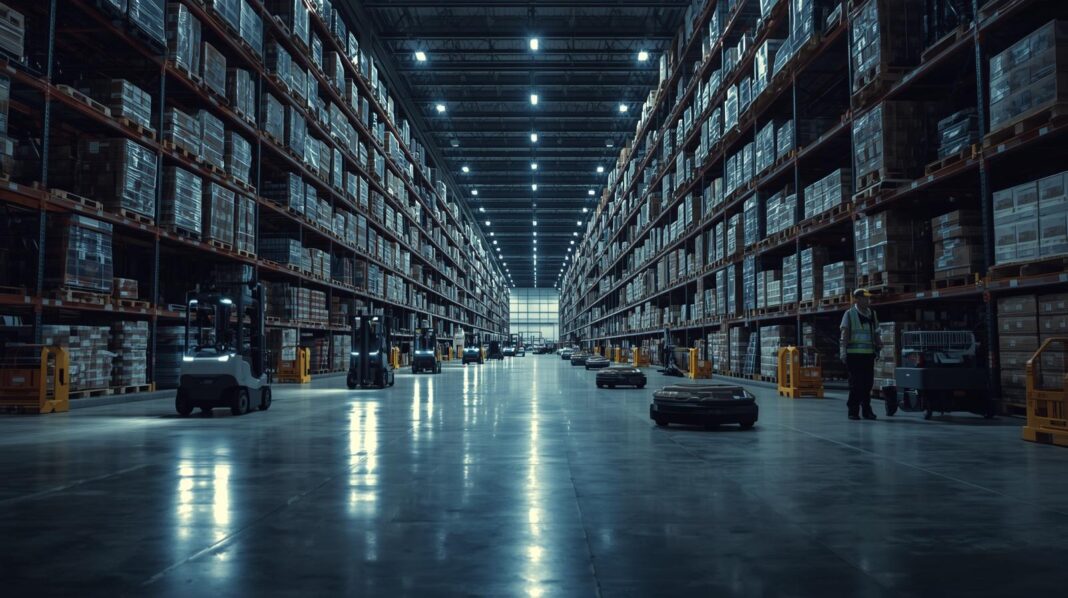
Walk the floor of any high-performing distribution center today and one thing becomes immediately clear: the era of purely manual warehousing is over.
Forklifts that drive themselves, robots that pick and sort with sub-second precision, and software systems that monitor every pallet in real time have transformed what was once a labor-intensive business into a technology-driven operation.
The global material handling equipment (MHE) market underscores the scale of this transformation.
Valued at approximately USD 259 billion in 2025, it is projected to reach nearly USD 471 billion by 2035 — a compound annual growth rate of 6.14%, according to Precedence Research.
Automated handling systems now account for nearly half of all installed warehouse equipment worldwide, up from 55% of facilities in 2021 to more than 76% today.
The message is loud and clear: warehouses that fail to modernise are falling behind.
But with the explosion of products on the market, operators face a genuine challenge in identifying which equipment delivers real-world value versus which constitutes expensive novelty.
To cut through the noise, The Africa Logistics has surveyed the landscape and compiled the definitive list of ten material handling equipment categories that every modern warehouse should have — ranked by their operational impact.
1. Forklifts — The Indisputable Backbone of Warehouse Logistics
No piece of equipment has more comprehensively defined warehouse logistics than the forklift.
From loading docks to high-bay racking, forklifts move the goods that keep global supply chains running — and while the concept has not changed in decades, the capabilities have undergone a remarkable evolution.
Today’s fleet choices span counterbalance trucks, reach trucks, order pickers, side-loaders, and turret trucks — each engineered for a specific operational environment.
Narrow-aisle reach trucks, for instance, can operate in aisles as tight as 8 to 10 feet, increasing storage density by as much as 25 to 40 percent compared to traditional wide-aisle layouts, according to industry analysts at ASC Software.
The biggest shift in forklifts is the accelerating move toward electrification. Electric forklifts now represent approximately 62 percent of total global forklift deployment, driven by emission control regulations and the operational advantage of lower running costs.
Hydrogen-powered forklifts are also gaining traction, offering rapid refuelling times without emissions — a compelling proposition for high-throughput facilities running multiple shifts.
For warehouses dealing in oversized or long materials, side-loader forklifts have become indispensable, enabling lateral loading that standard machines simply cannot achieve.
When compiling any warehouse equipment plan, forklifts — and the correct variant for the operation — must sit at the top of the list.
2. Pallet Racking Systems — Unlocking Vertical Space
If forklifts are the workhorses of warehouse logistics, pallet racking is the architecture that makes systematic storage possible.
Without structured racking, even the best equipment has nowhere purposeful to deposit its loads.
Selective pallet racking remains the industry standard for operations managing a high number of SKUs, offering 100 percent accessibility to every pallet.
For denser storage at the cost of selective access, drive-in and push-back racking configurations can dramatically reduce the floor space required per unit stored.
High-density configurations, when implemented alongside the right forklift type, routinely increase usable storage by a factor that justifies significant capital investment.
Modern racking systems have also incorporated digital load monitoring and structural sensors that feed data directly into warehouse management platforms, giving operators real-time visibility of weight distribution and structural integrity — a critical safety advancement in high-bay facilities.
The bottom line:
a warehouse without systematic racking is operating at a fraction of its potential.
Storage and handling equipment represented approximately USD 11.55 billion
of the total MHE market in 2025, underlining its continued centrality.
3. Conveyor Systems — The Lifeline of Product Flow
Ask any seasoned warehouse manager to identify the single piece of equipment that most visibly separates a modern facility from a traditional one, and the answer is almost always the conveyor.
These systems do not merely move products — they eliminate the bottlenecks that define manual operations.
Modern conveyor systems range from gravity-fed roller lanes used to guide inbound pallets off dock levellers, to sophisticated motorised belt systems with integrated sortation that can direct individual parcels to specific dispatch zones with pinpoint accuracy.
The most advanced configurations incorporate smart sensors and computer vision that identify, orient, and route products without human intervention — a capability that has made conveyors inseparable from e-commerce fulfilment.
The case for conveyors is also economic. Industry research consistently indicates that inefficient material handling can account for up to 50 percent of total warehouse operating costs.
Automated conveyors directly attack that figure by reducing manual touches on every unit that passes through a facility.
Leading integrators including Daifuku, SSI Schaefer, and Honeywell Intelligrated have pushed conveyor technology further still, developing intelligent sorting conveyors that integrate with warehouse execution systems (WES) and adjust routing dynamically based on real-time order data.
4. Autonomous Mobile Robots (AMRs) — The New Face of Warehouse Automation
No technology has generated more industry excitement — or delivered more genuine operational results — in recent years than autonomous mobile robots.
Unlike their predecessor, the automated guided vehicle (AGV), which requires fixed floor infrastructure such as magnetic tapes or reflectors to navigate, AMRs use onboard cameras, LiDAR, and AI-powered mapping to navigate dynamically and work safely alongside human staff.
The growth numbers are extraordinary. The global AMR market for logistics and warehousing was valued at approximately USD 4.44 billion in 2025 and is projected to reach USD 22.70 billion by 2033, growing at a CAGR of 22.6 percent — one of the fastest growth rates of any equipment category in the industry.
Amazon alone had deployed more than 750,000 mobile robots across its fulfilment centres by 2025, and reported a 25 percent reduction in fulfilment costs as a result.
Goods-to-person (GTP) AMRs have proven particularly transformative for order picking. Rather than sending human pickers on long, inefficient walks through warehouse aisles, GTP systems bring shelves and totes directly to stationary pick stations, collapsing pick-and-pack cycle times dramatically.
For high-SKU e-commerce operations, AMRs have become less of a luxury and more of an operational necessity.
The practical barrier is reducing. Advances in vision guidance technology now allow AMRs to deploy with minimal facility modification, and declining hardware costs are placing them within reach of small and mid-sized operators, not just the enterprise tier.
5. Automated Guided Vehicles (AGVs) — Reliable Workhorses for Structured Environments
While AMRs attract the headlines, automated guided vehicles continue to power some of the world’s most productive warehouses and manufacturing facilities — particularly in environments where predictable, high-volume movement along fixed routes is the operational priority.
AGVs excel at long-distance internal transport tasks: moving pallets from production lines to storage, replenishing picking stations from bulk storage, and shuttling loads between dock doors and staging areas.
In a large distribution centre where thousands of identical movements must happen reliably over 24-hour periods, AGVs’ disciplined, fixed-path behaviour becomes an asset rather than a limitation.
The distinction between AGVs and AMRs is becoming increasingly nuanced as manufacturers blur the line.
Modern AGVs increasingly incorporate laser guidance and limited obstacle-avoidance capabilities, while some AMR deployments in repetitive-route applications effectively operate as sophisticated AGVs.
The right choice depends on the facility’s layout stability, the volume of predictable versus variable movement, and the total cost of infrastructure modification.
Automated guided vehicles accounted for approximately 29 percent of all intralogistics investments globally in 2024, a figure that speaks to their continued relevance even as AMR technology advances.
6. Automated Storage and Retrieval Systems (AS/RS) — Engineering Maximum Density
For high-volume operations where storage density and retrieval speed are the paramount concerns, automated storage and retrieval systems represent the apex of warehouse engineering.
These computer-controlled configurations — which include unit load cranes, mini-load systems, vertical lift modules (VLMs), and horizontal carousels — can locate, retrieve, and deliver a stored item in seconds, with virtually zero error.
Vertical lift modules, in particular, have attracted growing interest from mid-sized operators.
A VLM operates as a sealed tower of trays that automatically delivers the requested tray to an ergonomic access point at ground level. Beyond the retrieval speed advantage, the space efficiency is compelling: a VLM can store materials in the same footprint as a fraction of conventional shelving, while reclaiming vertical space that standard rack systems cannot efficiently reach.
AS/RS systems reduce not only retrieval times but picking errors. Industry figures suggest that well-integrated AS/RS deployments can push inventory accuracy to 99.5 percent or higher, a standard that manual picking operations struggle to match.
The investment is significant, but the returns are well documented. Daifuku, a global leader in AS/RS technology, has expanded its mini-load and unit-load systems to serve industries from automotive to pharmaceuticals, demonstrating the broad applicability of these systems beyond pure e-commerce fulfilment.
7. Pallet Jacks and Electric Pallet Trucks — The Everyday Essential
Amid the understandable excitement over robotics and automation, it is easy to overlook the humble pallet jack — a piece of equipment that has remained fundamentally essential to warehouse operations for decades, and shows no sign of becoming obsolete.
Manual pallet jacks are the workhorses of short-distance movement within facilities, offering a simple, economical, and highly flexible solution for tasks where a forklift is simply overkill.
For loading docks, staging areas, and cross-docking operations, the manual pallet jack remains irreplaceable in terms of its cost-per-task efficiency.
The more significant development, however, has been the electric pallet truck.
These battery-powered variants extend the reach of pallet movement without requiring a licensed forklift operator, reduce physical strain on workers, and integrate readily into operations that are transitioning toward electrification.
Semi-electric and fully autonomous pallet trucks are increasingly available, with companies such as Toyota Material Handling and Jungheinrich offering platforms that can be remotely controlled or programmed for routine movement routes.
As one warehouse logistics veteran noted in a recent industry interview: ‘Pallet jacks aren’t glamorous, but the day you don’t have enough of them is the day you understand exactly how critical they are.’
8. Warehouse Management Systems (WMS) — The Brain Behind the Operation
Equipment alone does not make a modern warehouse. Without the software intelligence to direct it, even the most sophisticated automation investment operates below its potential.
The warehouse management system has evolved from an inventory database into the central nervous system of the contemporary distribution facility.
Modern WMS platforms do far more than track stock levels. They direct picking activities, optimise storage locations through intelligent slotting algorithms, integrate with conveyor and robotics systems via warehouse execution software, and deploy barcode scanning, RFID readers, and voice-directed picking to eliminate paper processes and reduce human error.
Research cited by ASC Software indicates that implementing WMS solutions typically reduces labour costs by 15 to 20 percent while driving inventory accuracy to 99.5 percent through systematic verification procedures.
The trend toward cloud-based and AI-enabled WMS platforms has accelerated sharply in 2025.
Real-time analytics, predictive restocking, and dynamic labour allocation are now standard features of leading platforms, allowing managers to identify and respond to bottlenecks before they impact throughput.
The warehouse management system segment is expected to grow at one of the fastest rates within the automated material handling market for the remainder of the decade.
Key players including Honeywell Intelligrated, SSI Schaefer, and Daifuku have embedded WMS capabilities directly into their automation hardware, creating end-to-end platforms where equipment and software operate as a single, coordinated system.
9. Stretch Wrapping and Palletising Machines — Securing the Last Mile of the Warehouse
A pallet of goods that arrives at its destination with damaged, shifted, or compromised loads represents a direct hit to both the bottom line and the customer relationship.
Stretch wrapping and palletising machines are the final, critical checkpoint in the warehouse workflow — and their automation has delivered measurable gains in both throughput and load security.
Automated stretch wrappers apply consistent, calibrated film tension that manual wrapping simply cannot replicate, producing loads that are more resistant to movement during transit and more efficiently wrapped per metre of film.
For high-volume operations, the speed differential is significant: a fully automated turntable wrapper can process dozens of pallets per hour without operator fatigue or variability.
Robotic palletisers have become a particular focus of investment in food and beverage, consumer goods, and e-commerce operations.
These systems stack mixed or uniform loads to precise, pre-programmed configurations, integrating with conveyor end-of-line systems for a seamless transition from picking to despatch.
The global material handling equipment market’s data is clear: the combination of palletising and wrapping automation directly improves product integrity, shipping accuracy, and customer satisfaction.
10. Ergonomic Positioning and Lifting Equipment — Protecting the Human Element
For all the automation that is reshaping the warehouse industry, human workers remain central to operations — and the equipment designed to protect their physical wellbeing deserves a place on this list alongside every robotic system.
Ergonomic positioning equipment, including lift-tilt tables, pallet positioners, scissor lifts, and articulating arm assist devices, reduces the physical demands of repetitive lifting and placing tasks that remain too variable or value-intensive to automate fully.
The business case is well established: workplace injuries in warehousing operations cost billions in lost productivity, workers’ compensation claims, and staff turnover annually.
OSHA data consistently shows that musculoskeletal disorders account for the largest share of warehouse-related injuries, the majority of which are directly preventable through appropriate ergonomic equipment investment.
As automation investments raise the stakes for remaining human workflows — which tend to be the most complex and variable tasks — the ergonomic quality of the environment those workers operate in becomes more critical, not less.
The forward-thinking warehouse operator recognises that technology and human welfare are not competing priorities. Positioning and lifting equipment is the interface between the two — ensuring that the human element of the operation remains safe, sustainable, and productive.
Build for Now, Scale for Tomorrow
The ten equipment categories outlined above are not equally relevant to every operation. A small regional distribution centre serving a single retail client has profoundly different needs from a multi-client 3PL running round-the-clock e-commerce fulfilment.
The discipline lies in understanding which equipment addresses your biggest operational constraints — and investing accordingly.
What is consistent across the industry, however, is the direction of travel. Automation penetration is rising.
Labour costs and labour availability pressures continue to intensify. Customer expectations for order accuracy and delivery speed have moved the goalposts permanently.
The warehouses that will lead their sectors over the next decade are the ones making considered, strategic investments in the right mix of these technologies today.
The global material handling equipment market is not growing at 6 percent annually because of trend-chasing.
It is growing because operations that invest in the right equipment measurably outperform those that do not — and in a sector where margins are thin and competition is relentless, that outperformance compounds.
Also Read
Inside Africa’s Warehouse 4.0: The Rise of Automated Storage Solutions
Warehouse Storage Solutions: Optimizing Space with Racking and Mezzanine Systems

- Top 10 Material Handling Equipment Every Modern Warehouse Needs - April 2, 2026
- What Is a Pick and Pack Warehouse? A Complete Guide for Online Retailers - February 18, 2026
- Rhenus Powers South Africa’s First ScreenX Cinema with Complex Global Logistics Operation - February 18, 2026

