

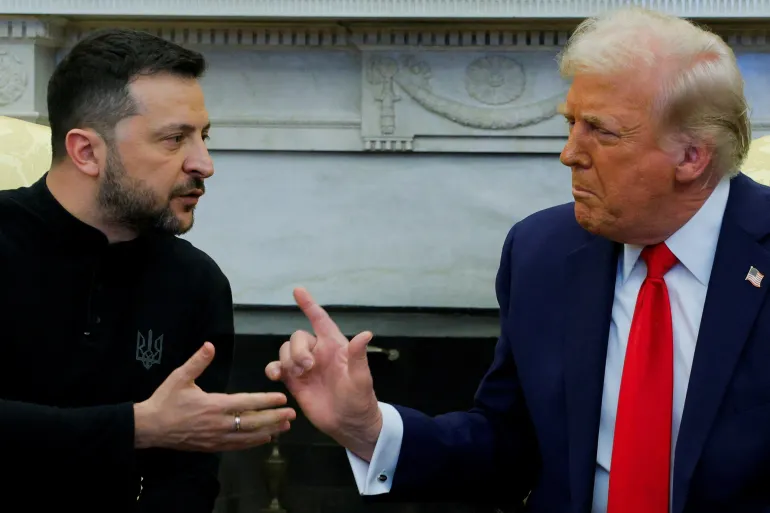
The recent meeting between U.S. President Donald Trump and Ukrainian President Volodymyr Zelenskyy in the Oval Office on February 28, 2025, unexpectedly turned into a heated argument.
This encounter, intended to culminate in the signing of a deal granting the U.S. access to Ukraine’s rare earth and critical minerals, quickly devolved into a public confrontation.
The tension began when Trump criticized Zelenskyy for not showing sufficient gratitude for U.S. support during the ongoing conflict with Russia.
Trump accused Zelenskyy of being “disrespectful” and suggested that Ukraine was “gambling with World War III” by not accepting a ceasefire. Vice President JD Vance joined the criticism, accusing Zelenskyy of conducting a “propaganda tour” and failing to express appreciation for U.S. assistance.
Zelenskyy responded by highlighting the severity of Ukraine’s situation and the need for U.S. support. He challenged Vance on the issue of diplomacy with Russia, emphasizing that previous deals with Putin had been broken.
The exchange became increasingly contentious, with both sides raising their voices and engaging in cross-talk in front of television cameras.
The argument led to the cancellation of the rest of Zelenskyy’s White House visit, including the planned signing of the mineral deal. Trump later expressed that Zelenskyy was not ready for peace if the U.S. was involved, further escalating tensions.
Economic implications
This heated exchange between Trump and Zelenskyy has significant economic implications, particularly concerning global markets and the availability of critical minerals.
The failure to sign the mineral deal could limit U.S. access to Ukraine’s rare earth elements, which are crucial for advanced technologies, including electronics and renewable energy systems.
This could lead to increased competition and higher prices in the global market for these resources. Other countries, such as China, which currently dominates the rare earth market, might benefit from the U.S.-Ukraine impasse by maintaining their market share and pricing power.
Moreover, the dispute could jeopardize future U.S. financial and military aid to Ukraine, which is essential for its economic stability and defense against Russia.
Reduced support could exacerbate Ukraine’s economic challenges, potentially leading to instability in Eastern Europe.
Ukraine’s ability to negotiate favorable trade agreements and attract foreign investment might also be compromised if international partners perceive it as less stable or less aligned with major powers like the U.S.
The geopolitical tensions arising from the Trump-Zelenskyy clash could lead to increased volatility in global financial markets. Investors might become more cautious, leading to fluctuations in stock prices and commodity markets, particularly for resources linked to the conflict.
The situation could also affect energy markets, as Ukraine is a transit country for Russian natural gas to Europe. Any disruption in this supply chain could impact energy prices and availability in Europe.
Energy markets
Furthermore, the public argument may strain U.S. relations with European allies who support Ukraine.
European leaders have expressed solidarity with Ukraine following the incident, which could lead to a divergence in U.S. and European foreign policy approaches towards Russia and Ukraine.
This diplomatic rift could further complicate international efforts to manage the conflict in Ukraine and might encourage other nations to reassess their alliances and economic partnerships.
In conclusion, the heated argument between Trump and Zelenskyy has significant implications for global markets, particularly in the sectors reliant on rare earth minerals and geopolitical stability.
As tensions continue to rise, investors and policymakers must closely monitor developments to navigate the potential economic fallout.
The situation underscores the complex interplay between geopolitics and economics, highlighting how diplomatic disputes can quickly translate into financial risks and opportunities.
Also Read

- What Is a Pick and Pack Warehouse? A Complete Guide for Online Retailers - February 18, 2026
- Rhenus Powers South Africa’s First ScreenX Cinema with Complex Global Logistics Operation - February 18, 2026
- Yusen Logistics Expands into East Africa with Strategic Kenyan Joint Venture - February 17, 2026

