
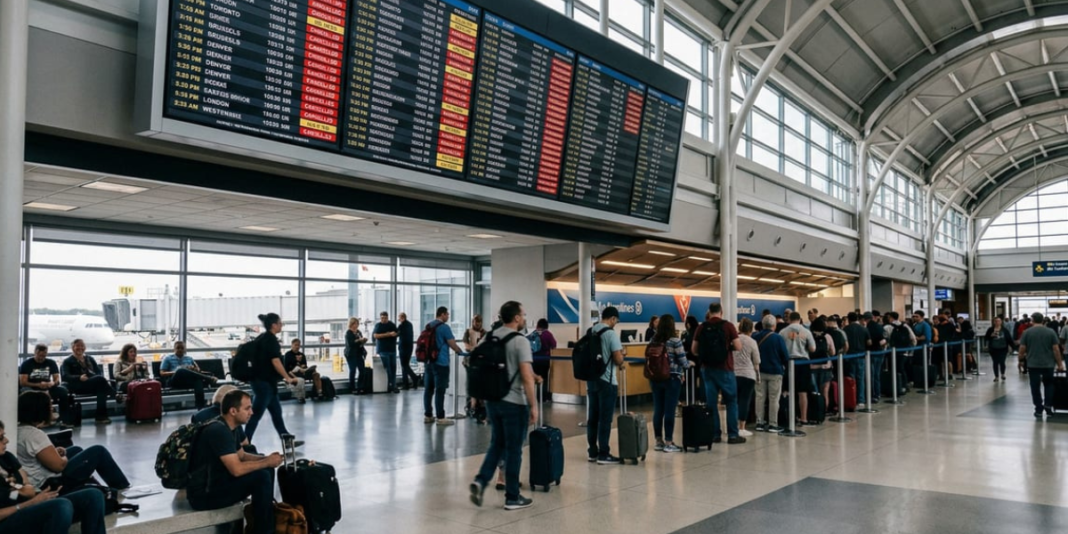
Air travel across the United States faced widespread delays and cancellations on Sunday, April 12, 2026, as a combination of severe weather and heavy weekend traffic disrupted operations at several major airports.
Thousands of passengers experienced delays throughout the day as a fast-moving weather system swept across multiple regions of the United States.
Aviation tracking data and airport updates indicated that over 2,000 flights were either delayed or canceled, with disruptions spreading across both domestic and connecting international routes.
Major airports reported the heaviest impact, including Atlanta, Chicago O’Hare, New York-area airports, Dallas/Fort Worth, and Los Angeles, where congestion and weather-related operational limits created significant backlogs.
Severe Weather and Air Traffic Congestion Drive Delays
Meteorologists reported unstable atmospheric conditions across central and eastern parts of the country, producing thunderstorms and wind-related safety restrictions that forced temporary ground stops and reduced takeoff rates at several airports.
At the same time, air traffic controllers were managing high weekend passenger volumes, which further strained already tight flight schedules.
The combination of weather delays and peak travel demand created a domino effect, with delays cascading from major hubs to smaller regional airports.
Airlines operating in affected regions implemented schedule adjustments throughout the day, including aircraft reassignments and flight cancellations intended to stabilize operations.
However, recovery was slow, as late departures and missed connections continued into the evening hours.
Passengers reported extended waiting times at departure gates, with some experiencing delays of several hours. In some cases, travelers were rebooked onto flights scheduled for the following day.
Impact on Passengers and Connections
The disruptions had a significant impact on connecting passengers, particularly those traveling through major hub airports.
Missed connections became a common issue as inbound flights arrived late and outbound services departed at reduced capacity.
Travel analysts note that Sunday disruptions often have a broader impact because they affect passengers returning from weekend trips and business travel, creating system-wide pressure at the start of the new week.
While flight delays are not uncommon in U.S. aviation, the scale of Sunday’s disruption highlights the system’s sensitivity to combined stress factors such as weather events and concentrated passenger demand.
Aviation experts say that even short periods of severe weather can quickly escalate into nationwide delays due to the tightly interconnected nature of airline scheduling.
Outlook for Recovery
Operations were expected to gradually normalize as weather conditions improved later in the day, though residual delays and aircraft repositioning challenges were likely to affect schedules into Monday.
Passengers were advised to monitor airline updates closely and allow additional travel time during periods of unstable weather and peak demand.
Also Read
Africa to Lead Air Travel Growth in 2026, Says IATA
UK Raises English Requirement for Work Visas: What Applicants Must Know by 2026

- Inside Isuzu’s Plan to Make South Africa the Truck Manufacturing Hub for Africa - October 12, 2026
- UPF Group Expands African Logistics Network with New Rwanda Office - September 18, 2026
- DP World’s Africa Network Is Growing While Jebel Ali Takes a Heavy Hit - August 15, 2026

